
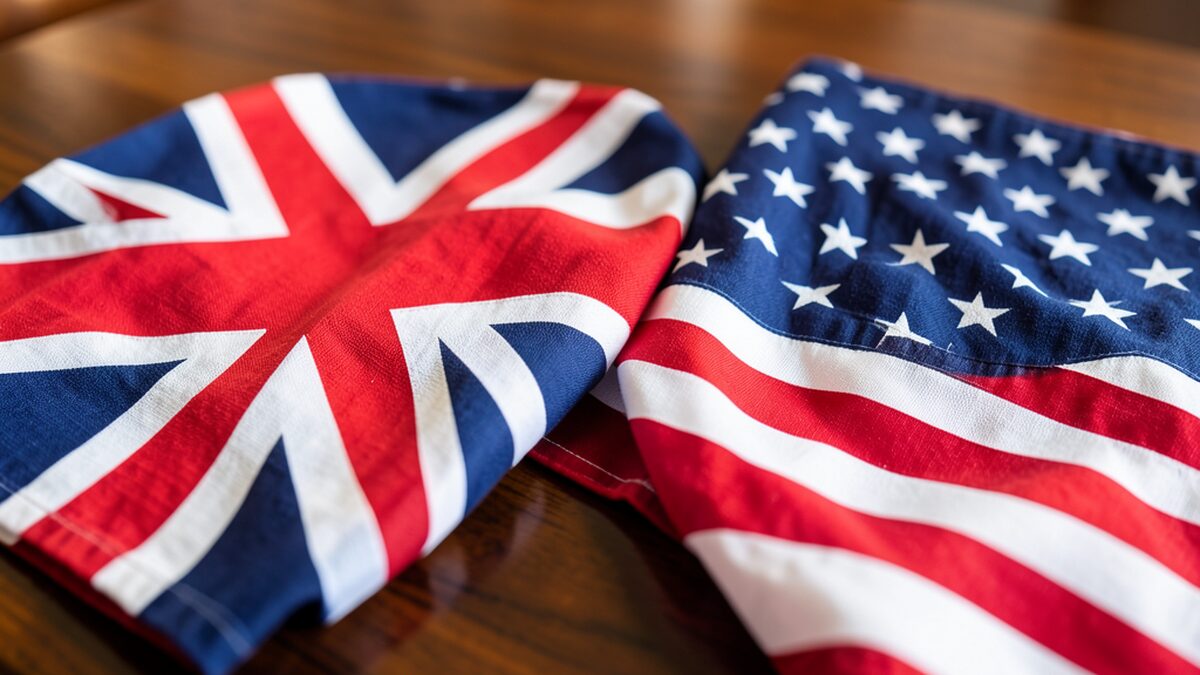
The Union Jack and the American flag stand as iconic emblems, each conveying unique narratives through their design elements. The intricate layering of crosses in the Union Jack underscores a deep-rooted historical union, while the American flag’s straightforward stars and stripes evoke themes of revolution and independence. Exploring these differences reveals how visual symbolism can encapsulate contrasting national identities and historical journeys.
Key Takeaways
- The Union Jack’s design symbolizes the historical union of nations within the United Kingdom.
- The American flag’s stripes and stars represent the original colonies and current states, emphasizing unity.
- The Union Jack reflects layered sovereignty and shared heritage through its intricate cross overlays.
- The American flag conveys new beginnings and collective identity formed through independence.
The Union Jack and the American flag stand as potent national symbols, yet their designs and embedded meanings diverge sharply. The Union Jack’s intricate overlay of crosses reflects a historical union of distinct nations within the United Kingdom, emphasizing layered sovereignty and shared heritage. In contrast, the American flag’s straightforward stripes and stars symbolize a revolutionary break from colonial rule and the unification of independent states under democratic ideals. While the Union Jack conveys a narrative of historical amalgamation, the American flag projects a message of new beginnings and collective identity forged through independence.
Core Visual Layout
The American flag is characterized by its clear and orderly pattern of thirteen horizontal stripes alternating red and white, symbolizing the original thirteen colonies, and a blue canton adorned with fifty white, five-pointed stars arranged in rows, each star representing a state within the union. This design, codified in 4 U.S.C. § 1, emphasizes simplicity and uniformity, reflecting the ideals of union and equality among states.
While the Union Jack conveys a narrative of historical amalgamation, the American flag projects a message of new beginnings and collective identity forged through independence.
In contrast, the Union Jack presents a complex and asymmetrical design composed of overlapping crosses on a blue field. It merges three distinct heraldic symbols: the red cross of St. George for England, the white saltire of St. Andrew for Scotland, and the red saltire of St. Patrick for Ireland. This layered configuration lacks the regularity of stripes and stars, embodying a composite identity rooted in the union of different kingdoms under one sovereign rather than a singular democratic entity.
Historical Origin
The American flag emerged during the American Revolution as a deliberate departure from British symbolism, including the Union Jack, which had previously flown over the colonies. The early Grand Union Flag retained the British Union Jack in the canton, symbolizing a transitional phase before the stars replaced the British emblem, marking a definitive statement of independence. The Continental Congress officially adopted the current design on June 14, 1777, signifying the birth of a new nation grounded in democratic principles.
Conversely, the Union Jack originated not from a revolutionary context but as a visual representation of the political union of England, Scotland, and Ireland under a single monarchy. Its design evolved to symbolize continuity and the layered sovereignty inherent in the British state. The flag’s function was to reinforce the legitimacy of monarchical rule and the integration of distinct national identities, rather than to represent a break or revolution.
Symbolic Meaning
The American flag’s symbolism is deeply tied to the themes of freedom, democracy, and unity. The thirteen stripes explicitly commemorate the original colonies that fought for and achieved independence, while the fifty stars reflect the nation’s expansion and the equal status of its constituent states. Together, these elements encapsulate the American civic tradition of collective identity forged through self-governance and republican values.
In contrast, the Union Jack embodies heritage, monarchy, and the enduring British state. Its constituent crosses symbolize the historical union of England, Scotland, and Ireland, emphasizing a shared ancestry and sovereign continuity. The asymmetrical layering of the crosses conveys the complex political relationships and historical amalgamations within the United Kingdom, projecting a narrative of unity within diversity upheld by monarchical authority rather than popular sovereignty.