
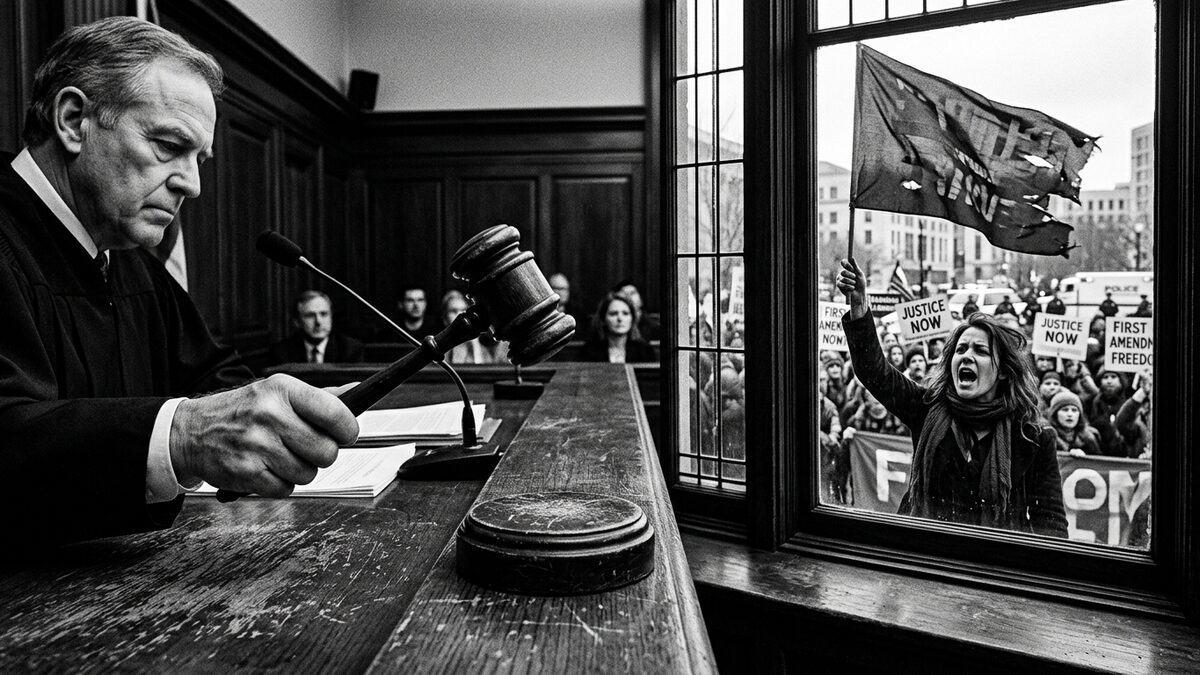
The intersection of flag desecration and First Amendment rights presents a complex legal battleground, where national symbolism clashes with free speech protections. From early twentieth-century disputes to the heightened tensions of the Vietnam War era, courts have grappled with defining the boundaries of protest and patriotism. Exploring these enduring controversies reveals not only evolving judicial interpretations but also the broader societal struggle to reconcile collective identity with individual expression.
Key Takeaways
- Flag desecration debates emerged prominently during the Vietnam War era as a form of protest against government authority.
- The flag is legally recognized as a symbol of American unity, complicating efforts to criminalize its desecration.
- Supreme Court rulings in Texas v. Johnson and United States v. Eichman protected flag desecration as a form of expressive conduct under the First Amendment.
- The balance between preserving the flag’s symbolic dignity and protecting free speech continues to influence legal and public discussions.
The legal controversies surrounding flag desecration and the First Amendment trace their roots to early twentieth-century debates over national identity and free expression, crystallizing notably during the Vietnam War era. The flag, enshrined as a potent symbol of American unity and values, became a focal point for protestors seeking to challenge governmental authority and social norms. This period witnessed a proliferation of statutes criminalizing flag desecration, prompting a series of judicial confrontations that forced courts to balance the government’s interest in preserving the flag’s symbolic dignity against the constitutional protections afforded to expressive conduct. These historical tensions continue to shape the jurisprudence and public discourse on the permissible limits of symbolic speech under the First Amendment.
Core Supreme Court Holdings on Flag Desecration
The Supreme Court’s landmark decisions in Texas v. Johnson, 491 U.S. 397 (1989), and United States v. Eichman, 496 U.S. 310 (1990), fundamentally shaped the constitutional landscape regarding flag desecration and the First Amendment. In a narrow 5–4 ruling, the Court in Johnson held that burning the American flag constitutes symbolic speech protected by the First Amendment. This decision reversed the conviction of Gregory Lee Johnson, who had been prosecuted under Texas law for flag desecration. The Court reaffirmed this principle a year later in Eichman, invalidating the federal Flag Protection Act of 1989 on similar grounds. Both opinions emphasized that the government cannot prohibit expression solely because it is offensive or disagreeable, reinforcing that expressive conduct, including acts intended to convey political messages, falls within the ambit of First Amendment protection.
The Supreme Court’s landmark decisions in Texas v. Johnson and United States v. Eichman fundamentally shaped the constitutional landscape regarding flag desecration and the First Amendment.
Texas v. Johnson: Facts and Legal Analysis
Gregory Lee Johnson’s act of burning the American flag during a 1984 political demonstration in Dallas, timed with the Republican National Convention, set the stage for a pivotal constitutional challenge. Texas prosecuted Johnson under a statute criminalizing desecration of venerated objects when such conduct was likely to incite anger. After his conviction was upheld through the state appellate courts, the Supreme Court confronted whether flag burning constituted symbolic speech protected from government regulation. Writing for the majority, Justice William Brennan framed flag burning as expressive conduct communicating political dissent, thus meriting First Amendment protection. The dissent, led by Justice John Paul Stevens, underscored the flag’s unique status as a symbol of national unity and argued for its distinct protection. The Court’s ruling in favor of Johnson established a constitutional precedent that acts of flag desecration, under certain circumstances, are a form of protected political expression.
United States v. Eichman and Federal Legislative Responses
In response to the Johnson decision, Congress enacted the Flag Protection Act of 1989, aiming to criminalize flag desecration nationwide. However, this legislative effort was swiftly challenged, culminating in United States v. Eichman. The Supreme Court again ruled 5–4 that the federal statute violated the First Amendment. The majority opinion reaffirmed that the government’s interest in preserving the flag’s symbolic value could not justify suppressing expressive conduct simply because it provoked offense or dissent. The Eichman ruling underscored the judiciary’s role in safeguarding political expression against majoritarian impulses to shield revered national symbols from criticism or protest. Together, these cases crystallize the enduring tension between reverence for the flag as a national emblem and the constitutional imperative to protect freedom of speech, framing the ongoing legal controversies surrounding flag desecration and the First Amendment.