
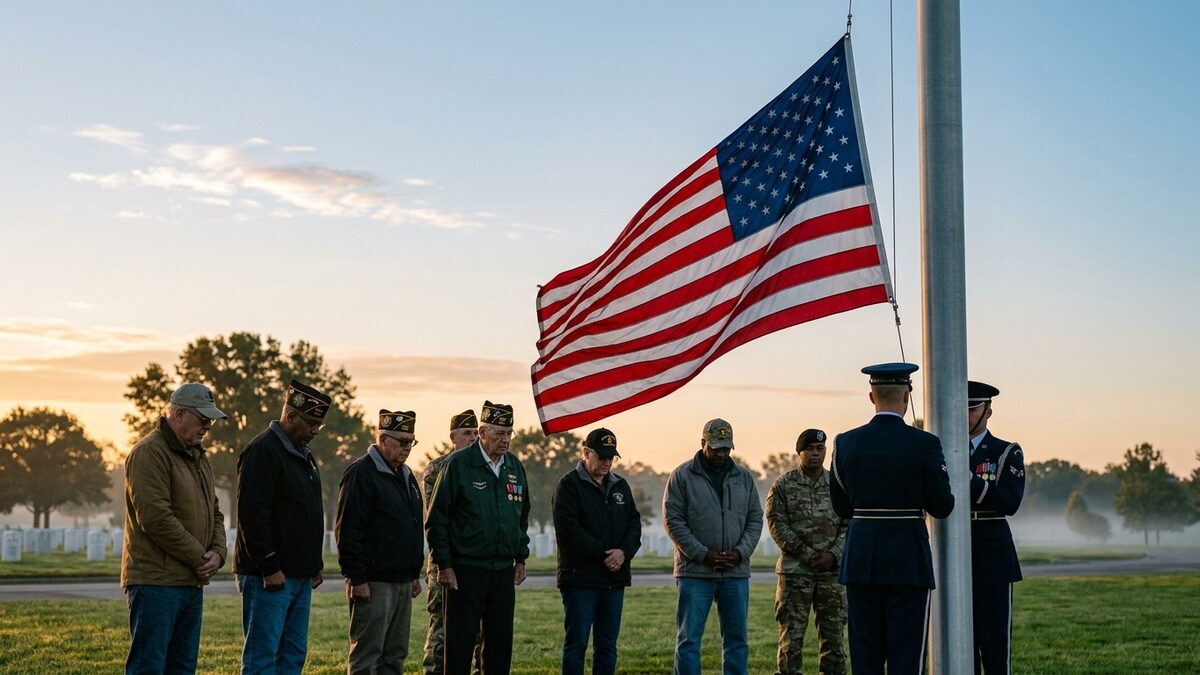
The half-staff flag protocol in the United States carries profound historical roots and cultural significance, tracing back to 17th-century naval customs and evolving through pivotal moments in American history. This enduring tradition serves not only as a symbol of mourning but also as a powerful expression of national unity and respect. Exploring its origins and formalization reveals much about the values and collective memory that shape U.S. ceremonial practices today.
Key Takeaways
- The half-staff flag tradition in the U.S. originated from 17th-century naval customs.
- It was adopted on land during the American Revolution as a symbol of collective mourning.
- The protocol is formalized in the U.S. Flag Code under 4 U.S.C. § 7.
- Flags must be raised to the peak before and after being flown at half-staff.
The tradition of flying flags at half-staff in the United States traces its roots to naval customs dating back to the 17th century, when ships lowered their ensigns to half-mast as a sign of mourning or respect. This practice was later adopted on land during the American Revolution, symbolizing collective grief and solemn remembrance amid a nascent nation’s trials. Over time, the half-staff flag protocol evolved into a formalized gesture within U.S. ceremonies, embodying a visual language of honor for fallen leaders, tragic events, and national mourning, thus reflecting the country’s enduring commitment to public commemoration and unity.
Constitutional and Legal Basis of Half-Staff Flag Protocol
The Half-Staff Flag Protocol in US Ceremonies is grounded in the U.S. Flag Code, codified in 4 U.S.C. § 7, which provides detailed guidance on the correct position and manner of flag display. According to this legal framework, when a flag is to be flown at half-staff, it must first be raised briskly to the peak of the flagpole before being lowered to the half-staff position. Similarly, before the flag is lowered for the day, it must be returned to the peak. This procedure underscores the respect and dignity inherent in the practice, ensuring the gesture is deliberate and ceremonial rather than casual.
Over time, the half-staff flag protocol evolved into a formalized gesture within U.S. ceremonies, embodying a visual language of honor for fallen leaders, tragic events, and national mourning, thus reflecting the country’s enduring commitment to public commemoration and unity.
Authority over half-staff proclamations primarily rests with the President of the United States, who may order flags on federal property nationwide to be lowered in response to national tragedies, the deaths of prominent officials, or other solemn occasions. The American Legion and various state authorities, such as the Commonwealth of Virginia, emphasize that half-staff observances serve as formal acts of respect. These legal and procedural standards collectively institutionalize the half-staff flag protocol, embedding it within the national framework of symbolic mourning and public observance.
Symbolic Meaning in U.S. Ceremonies
Within U.S. ceremonies, the half-staff position of the flag functions as a profound symbol of mourning, respect, and remembrance. It provides a visual language through which collective grief is publicly expressed, marking moments of solemnity in contrast to the flag’s usual position at full staff which signifies celebration or normalcy. Military branches, including the Air Force, explicitly describe half-staff as a gesture of respect or mourning, reinforcing its role in ritualizing loss and honor.
One of the most illustrative examples of the protocol’s symbolic depth is observed on Memorial Day. From sunrise until noon, the flag is flown at half-staff to honor those who have died in military service. At noon, the flag is ceremoniously raised to full staff, symbolizing the nation’s resolve and continuation beyond mourning. This transition encapsulates the dual function of the flag protocol: to remember the fallen and to reaffirm national unity and strength. Thus, the half-staff flag protocol within U.S. ceremonies operates as both a marker of sorrow and a medium of collective identity.
Historical Origins and Presidential Role in Half-Staff Observances
The modern federal practice of half-staff flag observance was firmly established by the mid-20th century, with early presidential proclamations providing key precedents. Notably, President Dwight D. Eisenhower’s Proclamation 3329, which ordered flags to be flown at half-staff until the burial of Walter W. Williams, exemplifies the formal use of the protocol at the national level. This proclamation illustrates how executive authority has historically been central in sanctioning half-staff observances, linking the practice to national mourning rituals and state recognition of individual loss.
The continuous issuance of half-staff proclamations by the White House for major deaths, such as that of Robert Joseph Dole in 2021, demonstrates the enduring significance of this protocol. It reflects the United States’ commitment to honoring prominent figures and collective tragedies through a consistent visual and ceremonial tradition. The presidential role in directing half-staff observances thus underscores the intersection of executive power, public memory, and national symbolism embedded in the history and significance of the half-staff flag protocol in U.S. ceremonies.