
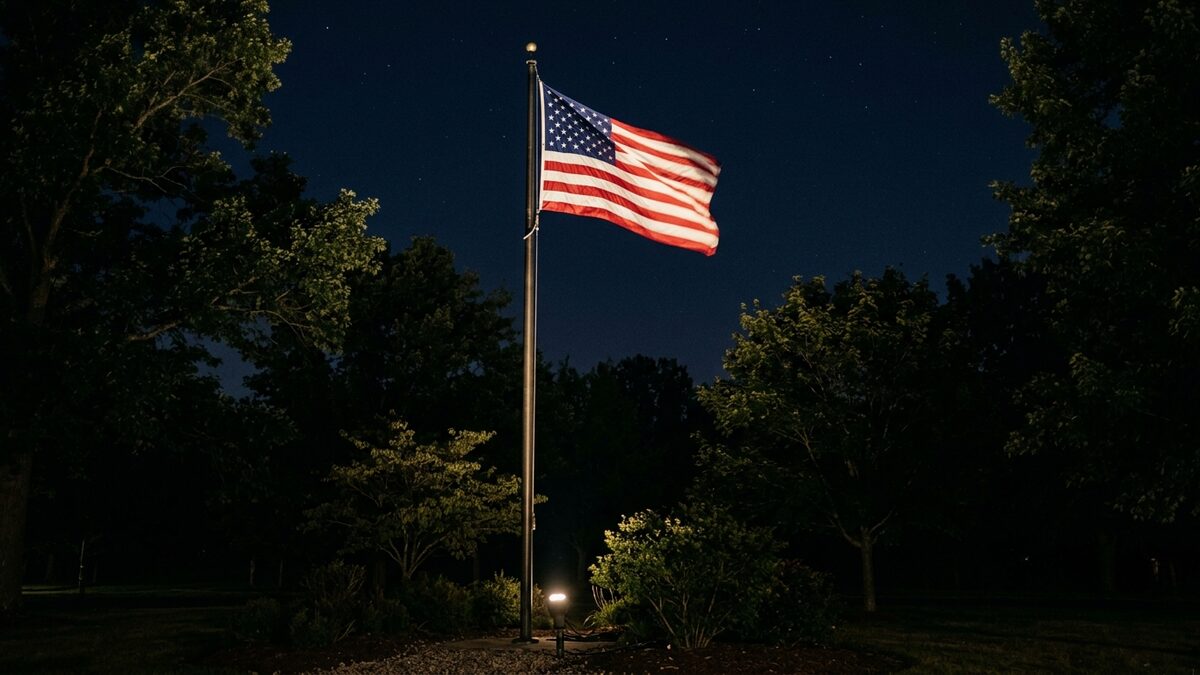
The U.S. Flag Code provides clear directives regarding the respectful display of the American flag after dark, highlighting the necessity of proper illumination. These provisions underscore the flag’s symbolic significance and aim to maintain uniformity in flag etiquette. Exploring the nuances of these guidelines reveals how they address common misunderstandings, ensuring the national emblem is honored appropriately at all times.
Key Takeaways
- The US Flag Code allows the flag to be displayed at night only if it is properly illuminated.
- Displaying the flag from sunrise to sunset is a customary practice, not an absolute rule.
- Proper illumination at night ensures the flag is treated with respect and visibility.
- Understanding these guidelines helps prevent common misconceptions about flag etiquette.
What protocols govern the display of the United States flag after dark, and why do they matter? The U.S. Flag Code, a set of guidelines designed to ensure respect and uniformity in flag etiquette, addresses the conditions under which the flag may be exhibited at night. Understanding these provisions is essential not only for compliance but also for appreciating the symbolic significance imbued in proper flag display. This article examines the specific rules and the rationale behind them, clarifying common misconceptions about nighttime flag presentation.
Core Rule on Night Display
The US Flag Code Provisions for Displaying the Flag at Night are principally set forth in 4 U.S.C. § 6(a), which governs the time and occasions for flag display. The Code establishes that the flag is customarily displayed from sunrise to sunset on buildings and stationary flagstaffs in the open. This customary practice reflects a longstanding tradition rather than an absolute prohibition against nighttime display. Crucially, the Code permits the flag to be displayed 24 hours a day provided it is properly illuminated during the hours of darkness. This allowance applies specifically when “a patriotic effect is desired,” signaling that the extended display serves to enhance the flag’s symbolic presence rather than merely violate time constraints.
Crucially, the Code permits the flag to be displayed 24 hours a day provided it is properly illuminated during the hours of darkness.
By framing the rule as a “universal custom,” the Flag Code acknowledges the importance of uniformity while allowing for flexibility. The nighttime display provision thus balances respect for the flag with practical considerations, allowing institutions and individuals to maintain the flag’s visibility and dignity beyond daylight hours if they take adequate steps to illuminate it.
Defining “Properly Illuminated” in Practice
The Flag Code does not provide a precise, technical definition of what constitutes “properly illuminated.” Instead, this term is interpreted through customary practice and guidance from authoritative flag organizations. According to the American Legion, proper illumination requires a dedicated light source aimed specifically at the flag. This light should be sufficient to make the flag clearly visible and recognizable to a casual observer during nighttime hours.
In practical terms, any lighting arrangement that achieves clear visibility of the flag satisfies the legal requirement. This interpretation is widely accepted among flag experts and reinforced by FAQs from historical and patriotic organizations. The emphasis remains on ensuring the flag’s features are discernible in the dark, thereby maintaining the respect and honor associated with its display. This broad yet clear standard allows for flexibility in lighting methods, provided the flag’s visibility is preserved.
Conditions for Overnight Flag Display
Under the US Flag Code Provisions for Displaying the Flag at Night, the flag may remain displayed overnight if it is properly illuminated throughout the hours of darkness. This means that the flag can remain raised after sunset when adequate lighting is in place to fulfill the illumination requirement. Common summaries of the rule state that the flag should be displayed from “sunrise to sunset unless lit at night,” succinctly capturing the core principle.
The Congressional Research Service affirms this position, noting that while the general practice is sunrise to sunset, a properly illuminated flag may be displayed continuously. This provision is not limited to ceremonial or special events but applies broadly to stationary outdoor displays. Consequently, entities such as government buildings, veterans’ organizations, and private institutions often maintain their flags overnight in compliance with these lighting standards, ensuring the flag’s honor is upheld at all times.