
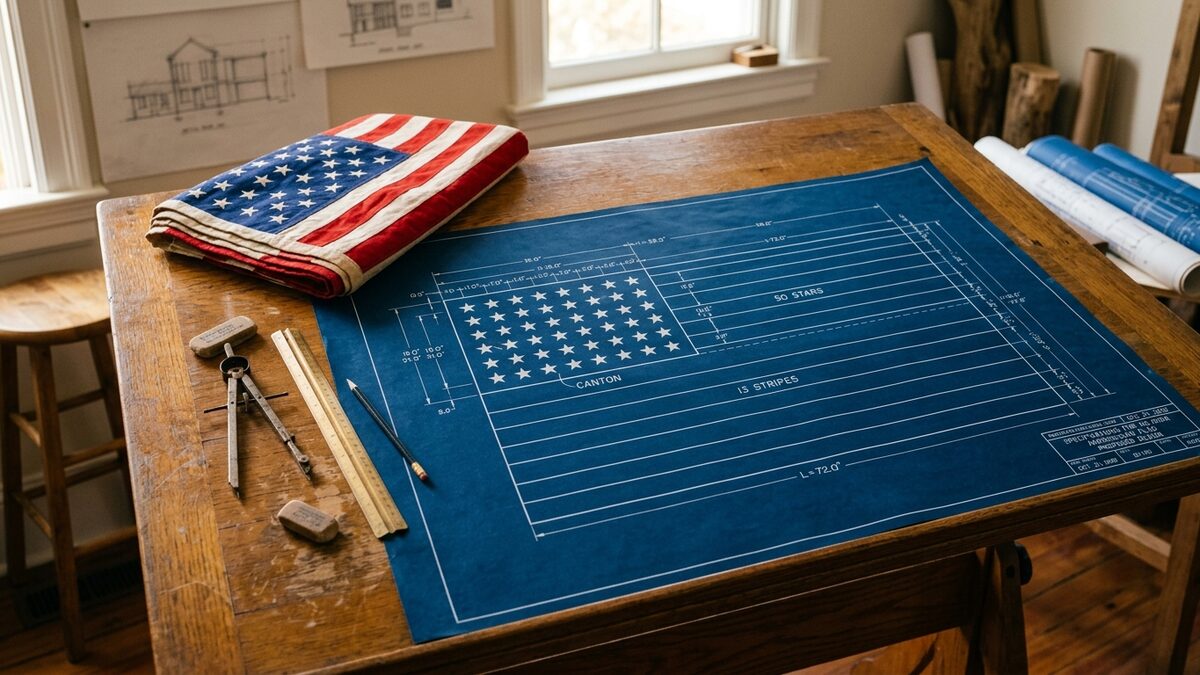
The 50-star American flag, officially adopted in 1960, marks a significant milestone in the nation’s symbolic evolution, capturing both historical continuity and the dynamic changes of its era. Emerging in the context of Hawaii’s statehood and the Cold War, this design reflects how the United States sought to project unity and resilience. Exploring the flag’s origins reveals deeper insights into the country’s identity and its response to shifting geopolitical landscapes.
Key Takeaways
- The 50-star flag design was adopted in 1960 following Hawaii's admission as the 50th state.
- The flag's design symbolizes unity and stability during the Cold War era.
- Its star arrangement continues a tradition of adapting the flag to represent the growing union.
- The design reflects both historical continuity and the United States' emergence as a global power.
The adoption of the 50-star flag in 1960 marked a significant moment in American history, echoing the nation’s evolving identity during the Cold War era. This design emerged shortly after Hawaii’s admission as the 50th state in 1959, completing a symbolic tableau that had expanded incrementally since the original 13-star banner was first raised in 1777. Rooted in a tradition of adapting the flag to reflect the union’s growth, the 50-star arrangement was meticulously crafted to convey unity and stability amid a rapidly changing geopolitical landscape. Its geometry and symbolism draw upon decades of precedent, embodying both continuity and the forward momentum of the United States as a global power.
Trigger for the Redesign
The immediate impetus for the redesign of the American flag was the admission of new states in rapid succession during 1959. Alaska became the 49th state on January 3, 1959, necessitating the creation of a 49-star flag. However, this configuration was short-lived due to the admission of Hawaii as the 50th state on August 21, 1959. This milestone required the development of a new flag design featuring 50 stars to accurately reflect the enlarged union. The practice of updating the flag’s star count has been historically tied to state admissions rather than legislative changes to the flag’s overall visual pattern, underscoring the flag’s role as a living symbol of the nation’s composition. The transition from the 49-star to the 50-star flag was thus not only a matter of symbolism but also a formal acknowledgment of the United States’ geographic and political expansion during the Cold War period.
The 50-star arrangement was meticulously crafted to convey unity and stability amid a rapidly changing geopolitical landscape.
Official Design Authority
The authority to formalize the 50-star flag design rested with the federal government under President Dwight D. Eisenhower’s administration. On August 21, 1959—the very day Hawaii was granted statehood—President Eisenhower issued Executive Order 10834, which codified the official design and specifications for the new flag. This order detailed the flag’s proportions and the precise arrangement of the stars within the blue canton, ensuring uniformity and adherence to established standards. The legal framework governing the flag design, including the addition of stars for new states, is embedded in Title 4 of the United States Code, which provides statutory authority for these modifications without requiring congressional approval for the design itself. Although the design was authorized in 1959, the 50-star flag officially became the national emblem on July 4, 1960, symbolizing a moment of national pride and unity during a period marked by international tension and domestic transformation.
The Design Committee and the Selected Star Pattern
A dedicated committee was convened to evaluate potential designs for the 50-star flag, submitting their recommendations on August 17, 1959. This group reviewed a wide range of creative proposals, including several elaborate and unconventional patterns. Ultimately, the committee favored a design that maintained continuity with the existing 48-star flag rather than pursuing radical innovation. The approved pattern employed a staggered arrangement of stars, alternating rows of six and five, forming nine offset horizontal rows in total. This layout was selected for its visual balance and practicality, reinforcing the flag’s established symbolism while accommodating the additional stars. The 50-star flag retained the traditional thirteen stripes—seven red and six white—preserving the historic reference to the original thirteen colonies. This approach underscored an emphasis on tradition and stability, reflecting the nation’s desire to honor its past while representing its contemporary unity.