
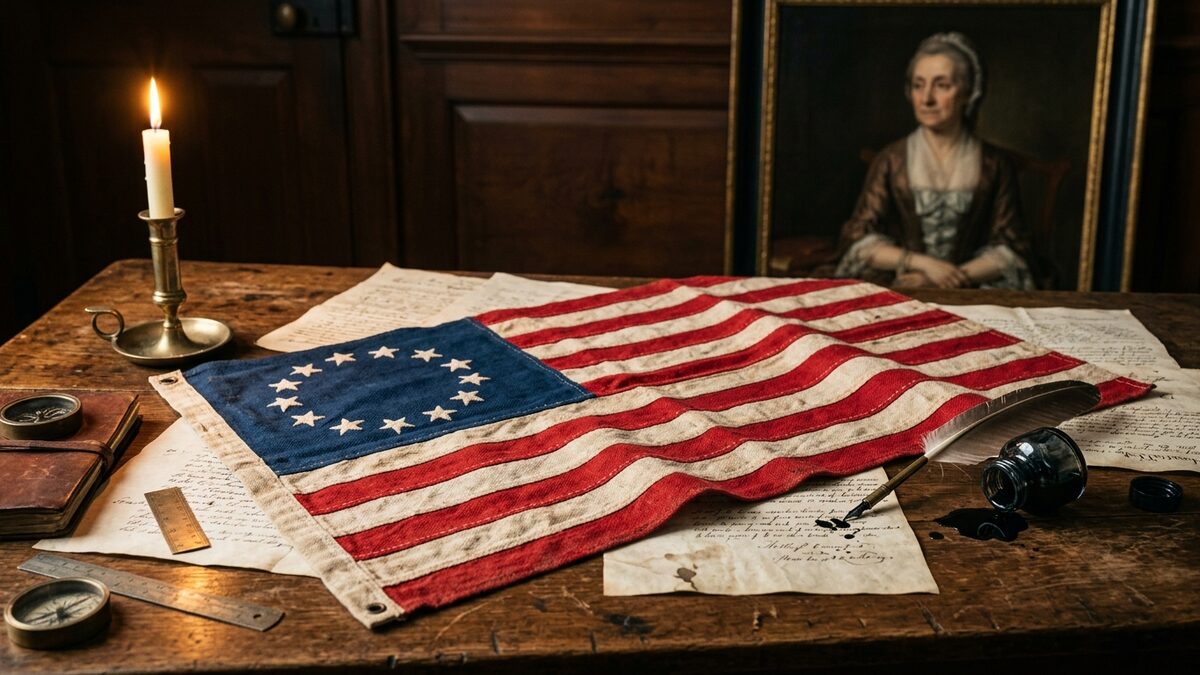
The Betsy Ross flag, often celebrated as a symbol of American unity and revolution, carries a complex legacy that intertwines historical fact with legend. As historians examine the origins and authenticity of this emblem, questions arise about its true creator and the cultural narratives that have solidified its place in national identity. Exploring these layers reveals how myth and memory influence the stories we tell about foundational moments in American history.
Key Takeaways
- The Betsy Ross flag design became a symbol of unity during the American Revolution.
- The story of Betsy Ross sewing the first flag emerged decades after the war.
- There is no contemporary evidence confirming Betsy Ross made the original flag.
- The flag's history reflects a blend of myth and national identity shaping American memory.
In the summer of 1776, as the Second Continental Congress debated the symbols that would represent a nascent America, the image of a flag bearing thirteen stars arranged in a circle emerged as a potent emblem of unity and rebellion. This design, later popularly attributed to Betsy Ross, has since become one of the most recognizable icons of the American Revolution. However, the historical origins of the so-called Betsy Ross flag remain contested, with scholarly examination revealing a complex interplay of myth, memory, and national identity that continues to fuel debate over its authenticity and symbolism.
The Emergence of the Betsy Ross Flag Legend
The narrative identifying Betsy Ross as the creator of the first American flag surfaced long after the Revolutionary War ended. The most familiar version of the story claims that Ross sewed the flag for George Washington in 1776. However, historians have found no contemporary records or official documentation to substantiate this claim. According to materials from the Smithsonian Institution, the legend gained significant attention only in 1870, when Ross’s grandson, William Canby, presented it to the Historical Society of Pennsylvania. This account, lacking primary evidence, is treated by many scholars as a patriotic family tradition rather than verified historical fact.
This design, later popularly attributed to Betsy Ross, has since become one of the most recognizable icons of the American Revolution.
The timing of the story’s popularity is notable. The tale became more widely accepted around the nation’s centennial celebrations in 1876, a period marked by heightened interest in Revolutionary War symbolism and national identity. This resurgence helped cement the image of the Betsy Ross flag in American popular culture, despite ongoing doubts regarding its factual basis. Thus, the Betsy Ross Flag Controversy History reflects the broader phenomenon of mythmaking in the service of collective memory and patriotic sentiment.
Documented Evidence from the Continental Congress
Historical investigation into the origins of the first national flag points to official records rather than individual anecdotes. The earliest documented design requirement is found in the Continental Congress’s resolution dated June 14, 1777. This resolution mandated that the flag should consist of thirteen stars and thirteen alternating red and white stripes, symbolizing the original colonies. Both the Smithsonian Institution and the U.S. State Department emphasize this 1777 Flag Act as the earliest firm evidence defining the American flag’s design.
In contrast to the Ross narrative, historians largely agree that there is no direct evidence linking her to the creation of the first flag. The focus of scholarly debate has thus shifted from identifying the specific maker of the flag to understanding the nature of the earliest documented flag design and its adoption by the fledgling nation. This shift highlights the complexities involved in disentangling fact from legend in the Betsy Ross Flag Controversy History and underscores the importance of primary sources in reconstructing Revolutionary era events.
The Smithsonian Institution’s Role in Debunking the Myth
The Smithsonian Institution has played a critical role in challenging the traditional Betsy Ross narrative through its research and public education efforts. Its National Museum of American History clarifies that while Betsy Ross was one of many women who made flags in Philadelphia during and after the Revolution, she did not create the Star-Spangled Banner—that distinction belongs to Mary Pickersgill. The Smithsonian’s materials further explain that William J. Canby’s 1870 account, which popularized the Ross story, described events allegedly occurring in 1776, a year before the Flag Act of 1777 officially defined the flag’s design.
By presenting evidence-based perspectives and highlighting the absence of contemporary documentation, Smithsonian resources encourage a more nuanced understanding of the Betsy Ross Flag Controversy History. This approach reflects the institution’s broader commitment to separating myth from history and fostering informed public discourse about America’s foundational symbols. Ultimately, the Smithsonian’s scholarship reveals how the flag’s story has been shaped as much by cultural memory as by historical fact.