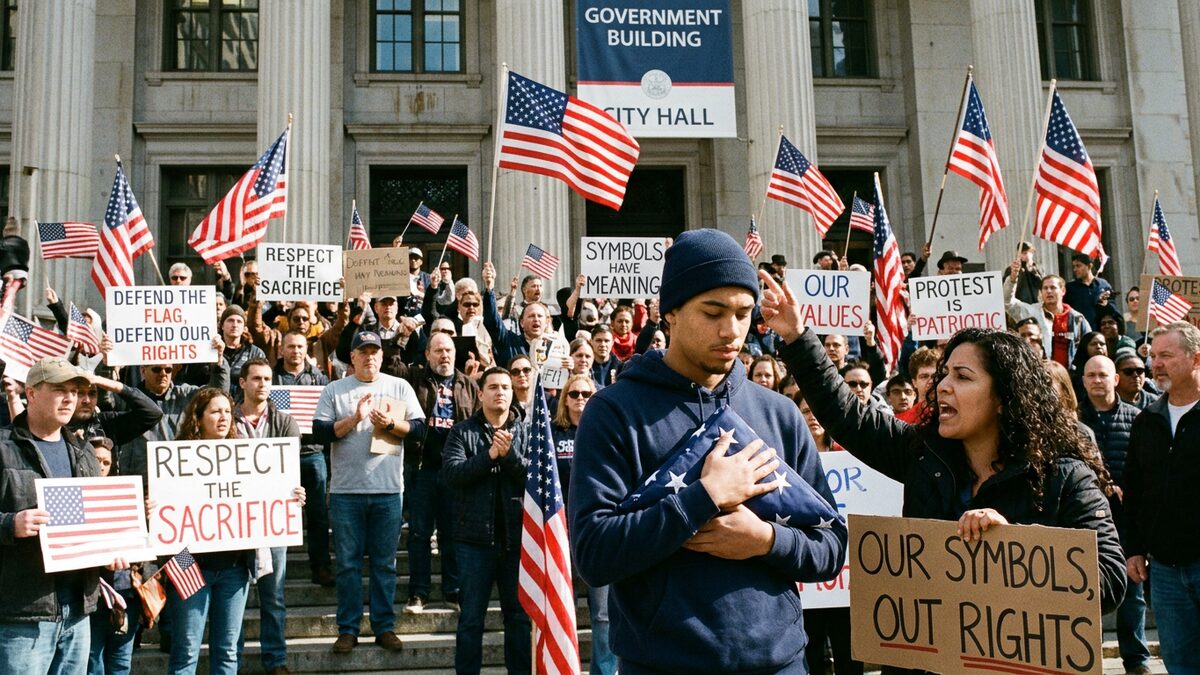
The article examines the intricate tension between flag desecration laws and First Amendment protections in the United States, raising critical questions about the boundaries of free expression. By analyzing landmark cases like Texas v. Johnson, it reveals the ongoing debate over whether acts such as flag burning represent protected symbolic speech or punishable conduct. This discussion challenges readers to consider how national symbols intersect with constitutional freedoms and government authority.
Key Takeaways
- The Supreme Court ruled in Texas v. Johnson that flag burning is protected symbolic speech under the First Amendment.
- Flag desecration laws raise complex issues about balancing national symbols with individual free expression.
- The debate highlights tensions between patriotism and the right to dissent in American society.
- Courts continue to struggle with how to interpret constitutional protections in cases involving flag desecration.
What does it mean to protect a symbol if doing so infringes upon the very freedoms that symbol is meant to represent? The tension between flag desecration laws and First Amendment rights in the United States raises profound questions about the limits of free speech and the role of government in regulating expression. As courts have grappled with whether burning or otherwise desecrating the flag constitutes protected symbolic speech or punishable conduct, the debate reveals deeper conflicts about patriotism, dissent, and constitutional interpretation. This article examines the legal contours of flag desecration jurisprudence and the enduring struggle to reconcile national reverence with individual liberty.
Core Constitutional Rule: Texas v. Johnson
The landmark decision in Texas v. Johnson, 491 U.S. 397 (1989), fundamentally shaped the constitutional discourse surrounding flag desecration laws and First Amendment rights in the US. In a narrow 5–4 ruling announced on June 21, 1989, the Supreme Court held that flag burning constitutes symbolic speech protected under the First Amendment. Justice William Brennan, writing for the majority, emphasized that the act of burning the flag in protest was expressive conduct, conveying a particularized message understood by observers. The Court decisively rejected the contention that the government’s interest in preserving the flag as a national symbol warranted a special exemption from free speech protections. Crucially, the decision underscored that the mere offense taken by spectators does not justify the suppression of speech, reinforcing a broad interpretation of expressive freedoms even when the expression is provocative or unpopular.
The Supreme Court held that flag burning constitutes symbolic speech protected under the First Amendment.
Subsequent Confirmation: United States v. Eichman
Following Johnson, the Supreme Court reaffirmed its position in United States v. Eichman, 496 U.S. 310 (1990), striking down the federal Flag Protection Act of 1989. This 5–4 ruling reinforced the constitutional principle that the government cannot prohibit flag desecration solely because it conveys a message the government finds objectionable. The Court held that Congress lacked authority to enact a broad ban on flag desecration without infringing on the First Amendment’s guarantee of free expression. In doing so, Eichman cemented the modern legal consensus that flag desecration, when used as a form of political protest or symbolic speech, remains protected speech under the Constitution. This jurisprudence places limits on government action aimed at shielding national symbols from criticism, reaffirming the primacy of individual liberty over symbolic preservation.
Federal Statutory Law and Its Current Status
Despite the Supreme Court’s rulings, federal statutes criminalizing flag desecration remain codified in law. The original federal flag desecration statute was enacted in 1968 amid the Vietnam War era, codified at 18 U.S.C. § 700. This law prohibits knowingly mutilating, defacing, defiling, burning, or trampling the U.S. flag, prescribing penalties including fines of up to $1,000 or imprisonment for up to one year. Nevertheless, after the Supreme Court’s decisions in Johnson and Eichman, this statute is widely regarded as unenforceable insofar as it conflicts with First Amendment protections. The continued presence of this law in the U.S. Code reflects the complex interplay between legislative impulses to protect national symbols and judicial enforcement of constitutional free speech limits. As a result, enforcement agencies generally refrain from prosecuting flag desecration under federal law, acknowledging the primacy of constitutional rights despite statutory language to the contrary.