
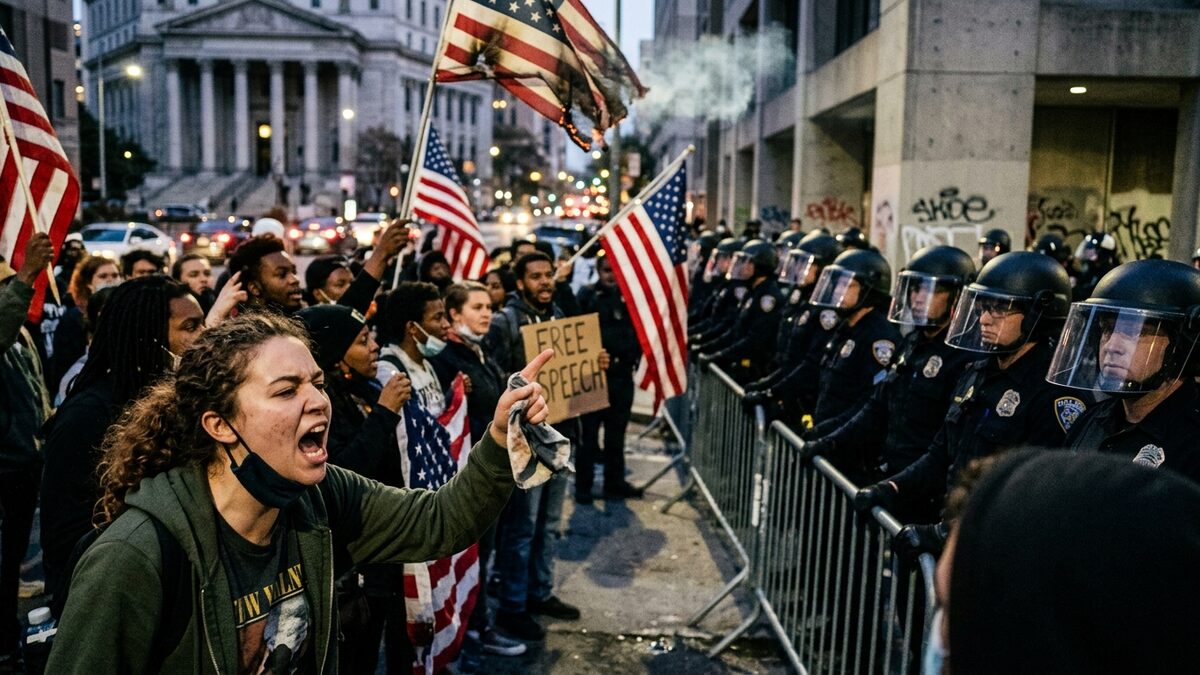
The ongoing legal debate over flag desecration probes the delicate balance between safeguarding national symbols and preserving First Amendment freedoms. This contentious issue raises profound constitutional questions about the extent to which government can restrict provocative expressions of dissent. Central to this discourse are landmark Supreme Court decisions that have shaped the boundaries of symbolic speech, challenging society to reconcile collective identity with individual rights in an evolving legal landscape.
Key Takeaways
- The government faces legal challenges in balancing flag desecration laws with First Amendment rights.
- The Supreme Court ruled in Texas v. Johnson that flag burning is protected symbolic speech.
- Expression cannot be banned solely because it is offensive or disagreeable to the public.
- Flag desecration cases highlight the tension between national symbols and individual liberty.
What limits, if any, should the government impose on the expression of dissent when it involves acts as provocative as flag desecration? This question lies at the heart of ongoing legal controversies that pit the symbolic sanctity of the national flag against the constitutional guarantee of free speech. The tension between protecting a revered national emblem and upholding robust First Amendment rights raises profound constitutional challenges, forcing courts to navigate a delicate balance between collective identity and individual liberty.
Supreme Court Landmark Rulings on Flag Burning
The Supreme Court has played a pivotal role in defining the constitutional boundaries of flag desecration as a form of symbolic speech. In the seminal case of Texas v. Johnson (1989), the Court ruled in a narrow 5–4 decision that burning the American flag constitutes expressive conduct protected by the First Amendment. Justice William Brennan, writing for the majority, emphasized that the government may not prohibit expression simply because it is offensive or disagreeable to society. This decision underscored the principle that freedom of speech extends to acts that challenge deeply held patriotic symbols.
The tension between protecting a revered national emblem and upholding robust First Amendment rights raises profound constitutional challenges, forcing courts to navigate a delicate balance between collective identity and individual liberty.
Following this, the Court addressed the constitutionality of the Flag Protection Act of 1989 in United States v. Eichman (1990). Once again, in a 5–4 ruling, the Court invalidated the federal statute that criminalized flag desecration, reaffirming the protection of such acts under the First Amendment. The Eichman ruling confirmed that legislative attempts to shield the flag from desecration could not override the fundamental right to free expression, even when the message conveyed is provocative or unpopular.
Key Legal Entities and Individuals Involved
Central to the discourse on flag desecration and free speech is Gregory Lee Johnson, whose act of burning the flag during a 1984 political demonstration sparked the legal challenges culminating in Texas v. Johnson. Johnson’s conviction under Texas law was overturned, setting the stage for a national debate on the limits of expressive conduct. Justice William Brennan emerged as a critical figure through his majority opinions in both Texas v. Johnson and United States v. Eichman, articulating the Court’s stance on protecting provocative political expression.
The dissenting voices, including Chief Justice William Rehnquist and Justices Stevens, White, and O’Connor, reflected a contrasting view that prioritized the flag’s symbolic importance and advocated for its protection through criminal sanctions. More recently, legal scholars such as Eugene Volokh have criticized executive actions, like the 2025 Trump administration’s executive order on flag burning, arguing that such measures risk encouraging selective and potentially unlawful enforcement of laws intended to be neutral, thereby exacerbating the legal controversies surrounding this issue.
Statutes and Legislative Responses to Court Decisions
The legal controversies surrounding flag desecration have prompted numerous legislative efforts to restrict such acts, often in direct response to judicial rulings. The Federal Flag Desecration Law of 1968 was an early attempt by Congress to criminalize acts of contempt against the flag, including mutilation and burning. However, this statute was effectively rendered unenforceable after the Court’s decision in Texas v. Johnson.
In an effort to circumvent the Court’s ruling, Congress enacted the Flag Protection Act of 1989, aiming to prohibit flag desecration under federal law. This statute was quickly struck down in United States v. Eichman, reaffirming the constitutional protection of flag burning as free speech. Subsequent legislative attempts, including proposed constitutional amendments, have sought to redefine the legal status of the flag, but none have succeeded in overcoming the First Amendment protections established by the Supreme Court. These legislative developments continue to fuel the debate over the permissible scope of government regulation in the realm of symbolic expression.