
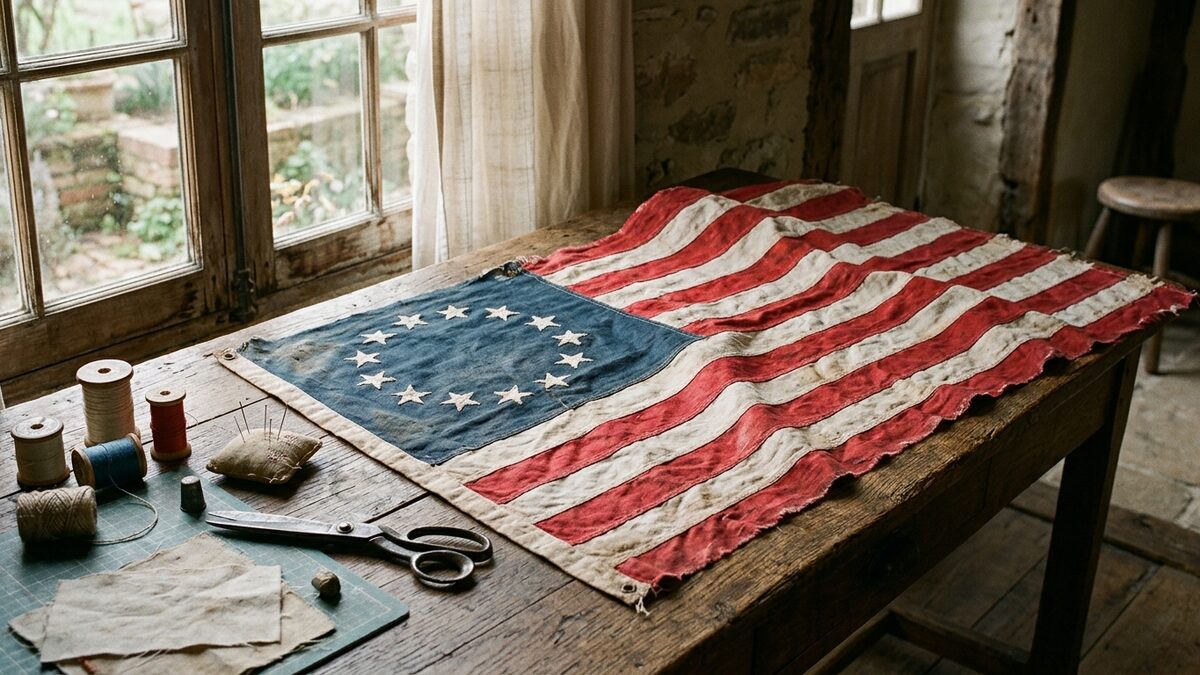
The Betsy Ross flag stands as a potent symbol of unity and rebellion during a defining moment in American history. Its thirteen stars and stripes encapsulate the fledgling colonies’ fight for independence, yet its legacy extends beyond mere symbolism, touching on the evolving narratives of patriotism and historical memory. Exploring its origins and enduring significance reveals deeper insights into the Revolutionary era and the ways in which national identity is constructed and remembered.
Key Takeaways
- The Betsy Ross flag symbolizes early American unity during the Revolution.
- It features thirteen stars and stripes representing the original colonies.
- Betsy Ross is traditionally credited with sewing the first American flag.
- The flag reflects both patriotic spirit and complex historical memory.
In the midst of the American Revolution, as the thirteen colonies sought to unify under a common symbol, the Betsy Ross flag emerged as an emblem of nascent national identity. Allegedly stitched in 1776, this flag—characterized by its thirteen alternating red and white stripes and a blue canton adorned with thirteen white stars arranged in a circle—has been closely linked to the early struggle for independence. Its creation coincided with the Continental Congress’s efforts to establish symbols that would inspire unity among disparate colonies. Over time, the Betsy Ross flag has come to embody not only the Revolutionary spirit but also the complexities of American historical memory and patriotism.
Origins of the Legend and Key Figures
The legend surrounding the Betsy Ross flag centers on Elizabeth “Betsy” Ross, a Philadelphia upholsterer credited with designing and producing the first American flag. According to family oral history passed down through generations, Ross was approached in late May 1776 by a committee that included George Washington, Colonel George Ross, and Robert Morris. The story claims that during this meeting, Betsy Ross suggested altering the design of the stars from six points to five points, a change that Washington reportedly approved and incorporated. This narrative, however, did not enter public consciousness until 1870, when Ross’s granddaughter, Mary Elizabeth Canby, first publicly attributed the flag’s creation to her grandmother, more than a century after the flag had appeared in various forms of art and iconography.
Over time, the Betsy Ross flag has come to embody not only the Revolutionary spirit but also the complexities of American historical memory and patriotism.
Further embellishments appeared in an 1871 pamphlet that credited Ross not only with the flag’s design but also with coining the phrase “United States of America” and composing the hymn that inspired “La Marseillaise.” These additional claims lack documentary support and are generally regarded by scholars as unfounded. The legend thus evolved more through familial and cultural narrative than through contemporaneous evidence, highlighting the interplay between mythmaking and the construction of national symbols.
Historical Timeline and Official Adoption
Records confirm that on May 29, 1777, Betsy Ross received payment from the Pennsylvania State Navy Board for sewing flags, establishing her as an active flag maker during the Revolutionary period. The Continental Congress formally adopted the “Stars and Stripes” as the national flag on June 14, 1777, specifying thirteen alternating red and white stripes and thirteen white stars on a blue field to symbolize the thirteen colonies. Notably, the Flag Act of 1777 did not prescribe the arrangement of the stars, leaving room for variation in early flag designs.
The circular arrangement of stars commonly attributed to the Betsy Ross flag conformed to the Act’s requirements, though it was not mandated. Ross’s continued production of flags for the federal government over more than five decades underscores her significance as an early American flag maker. This timeline situates the Betsy Ross flag within the broader context of flag adoption and manufacture, illustrating how the symbol evolved alongside the emerging nation’s identity and governmental structures.
Lack of Archival Evidence and Historical Consensus
Despite the enduring popularity of the Betsy Ross narrative, extensive historical research has failed to uncover contemporary evidence supporting the claim that she designed the first American flag. A thorough examination of Continental Congress diaries, correspondence, and journals reveals no mention of a flag committee meeting in May 1776 or any discussions about the flag’s design involving Ross. Moreover, no archival documents or recorded oral traditions from the Revolutionary era substantiate the story promulgated by her descendants.
Most professional historians regard the Betsy Ross origin story as apocryphal, emphasizing the absence of documentation as a critical factor in this assessment. While the narrative has become a powerful element of American cultural memory and patriotism, it reflects more about how historical symbols are constructed and commemorated than about verifiable historical fact. The story’s persistence illustrates the complexities inherent in the history and significance of the Betsy Ross flag as both a national emblem and a subject of historical inquiry.