
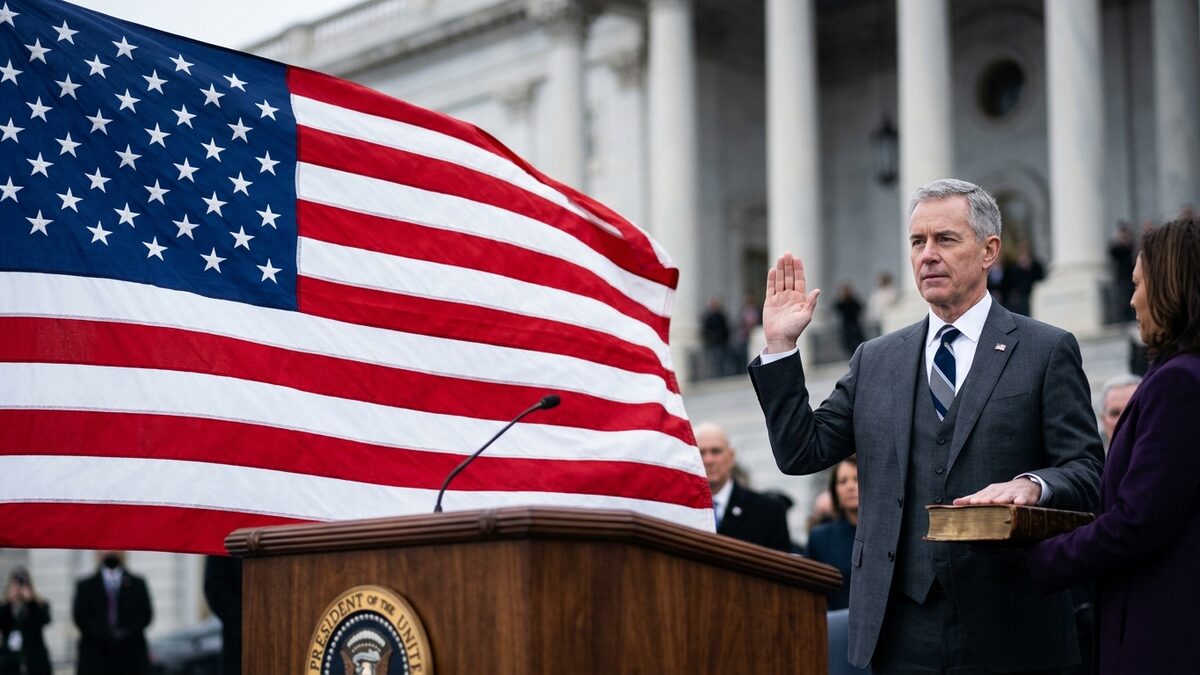
The American flag’s presence at presidential inaugurations serves as a powerful emblem of national unity and the peaceful transfer of power. Tracing its evolving role from George Washington’s 1789 ceremony to today’s elaborate five-flag display reveals deeper insights into shifting conceptions of patriotism, identity, and governance. Exploring this symbolic tradition offers a unique lens through which to understand the enduring values at the heart of American democracy.
Key Takeaways
- The American flag has symbolized national unity and democratic continuity since the first inauguration in 1789.
- Its presence at inaugurations highlights the solemn transfer of power and enduring ideals of the republic.
- The flag's prominence in ceremonies has evolved to reflect changing views of patriotism and governance.
- Since 1993, a standardized five-flag display on the Capitol West Front links the president’s heritage to the national union.
Since George Washington’s first inauguration in 1789, the American flag has served as a potent symbol of national unity and democratic continuity in presidential ceremonies. Throughout history, its presence at inaugurations has underscored the solemn transfer of power and the enduring ideals of the republic. From the earliest displays of the Stars and Stripes to contemporary ceremonies, the flag’s evolving prominence reflects changing notions of patriotism, identity, and governance within the American political tradition.
Standardized Flag Arrangement on the Capitol West Front
The contemporary visual centerpiece of the American Flag in Presidential Inaugurations is the five-flag display positioned on the Capitol’s West Front during the swearing-in ceremony. This arrangement, established in 1993 during Bill Clinton’s inauguration, consists of five large United States flags hung vertically. The central flag is the current 50-star flag, symbolizing the present-day union of all states. Flanking this central flag are two flags whose star counts correspond to the admission dates of the incoming president’s home state, linking the president’s personal heritage to the broader national narrative. The outermost flags consistently feature the 13-star “Betsy Ross” flag, notably arranged in a circle, which honors the original thirteen colonies and the foundational period of the United States.
Since George Washington’s first inauguration in 1789, the American flag has served as a potent symbol of national unity and democratic continuity in presidential ceremonies.
This configuration reflects a deliberate blend of historical symbolism and contemporary identity, visually integrating the nation’s origins, evolution, and leadership. The inclusion of the Betsy Ross flag at the periphery anchors the ceremony in the republic’s revolutionary roots, while the home-state flags personalize the event and emphasize the federal structure of the nation.
Historical Flag Variations by President’s Home State
The role of the American Flag in Presidential Inaugurations extends beyond mere decoration, serving as a canvas for historical reference and state pride. Prior to the standardized five-flag arrangement, different flag configurations were used to evoke specific historical moments or regional connections. For instance, George H.W. Bush’s 1989 inauguration featured inner flags with 28 stars, acknowledging Texas’s admission as the 28th state in 1846. Barack Obama’s 2009 ceremony included 23-star flags, representing Illinois’s 1818 admission. Similarly, Donald Trump’s 2021 inauguration incorporated the Francis Hopkinson flag, with 13 stars arranged in rows, reflecting New York’s 1776 entry into the Union.
Joe Biden’s 2021 inauguration also employed the Hopkinson flag to signify Delaware’s early statehood status. These choices reinforce the federal nature of the American state system and highlight the president’s personal and regional heritage. Before this more personalized approach, George Bush Sr.’s 1989 inauguration utilized 38 flags to honor the 1876 Centennial flag, focusing on a historic national milestone rather than home-state symbolism. Such variations illustrate how the American Flag in Presidential Inaugurations has been adapted to emphasize different aspects of American history and identity depending on the context of each presidency.
Official Flag Protocols and Presidential Directives
Flag protocol during presidential inaugurations is closely regulated, reflecting the symbolic weight of the ceremony. In 2025, President Donald Trump issued a presidential action mandating that the U.S. flag be flown at full-staff on all future Inauguration Days. This directive covers the White House, public buildings, military installations, naval stations, and U.S. embassies abroad, underscoring the unity and solemnity of the inauguration nationwide and internationally. The full-staff display is intended to symbolize national celebration and the peaceful transfer of power.
However, the same directive also demonstrated flexibility in symbolic gestures. Following the conclusion of Inauguration Day 2025, the flag was ordered returned to half-staff to honor the death of former President Jimmy Carter. This half-staff period was established for 30 days, signifying respect and mourning while balancing the celebratory nature of the inauguration. Such protocols reveal how the American Flag in Presidential Inaugurations functions not only as a symbol of unity and renewal but also as a medium for official national expression and remembrance.