
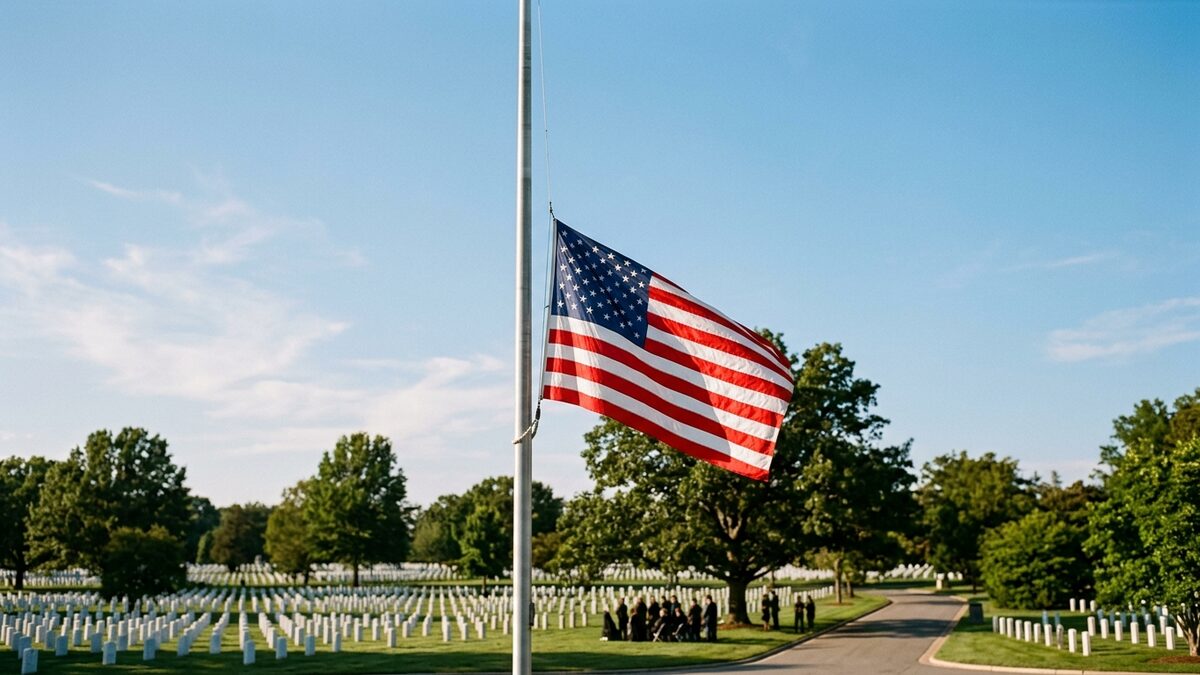
The tradition of flying the American flag at half-staff serves as a powerful visual expression of collective mourning and respect. Rooted in official protocols, this practice underscores moments of national significance, from tragedies to the honoring of distinguished individuals. Understanding the reasons and guidelines behind this solemn gesture reveals how the nation unites in shared grief and remembrance, reflecting a profound respect for those impacted.
Key Takeaways
- The American flag flown at half-staff symbolizes mourning, respect, or distress during significant national events.
- Half-staff means the flag is lowered to halfway between the top and bottom of the flagpole, following official protocol.
- Proper etiquette requires raising the flag to the peak before lowering it to half-staff and raising it back to the peak afterward.
- This tradition reflects a nation's collective expression of grief and solidarity in response to tragedy or the passing of notable individuals.
What message does the American flag convey when it is flown at half-staff, and why do nations observe this solemn tradition? The practice of lowering the flag to half its normal height serves as a visible symbol of mourning, respect, or distress, reflecting moments of national tragedy, remembrance, or honor. Understanding when and why this protocol applies offers insight into how a nation collectively expresses grief and solidarity in response to significant events or the passing of notable individuals.
Understanding the American Flag Half-Staff Protocol
The term “half-staff” refers to the position of the American flag when it is lowered to approximately halfway between the top and bottom of the flagpole. This precise positioning is consistent across official flag guidance and the U.S. Flag Code. When raising the flag to half-staff, proper etiquette dictates that it should first be hoisted briskly to the peak of the pole before being lowered to the half-staff position. Similarly, at the end of the period of observance, the flag must be raised again to the top before being fully lowered for the day. These procedures apply equally to vertical flag displays on walls or poles.
The practice of lowering the flag to half its normal height serves as a visible symbol of mourning, respect, or distress, reflecting moments of national tragedy, remembrance, or honor.
The practice of flying the flag at half-staff centers on demonstrating mourning and respect. It is a symbolic gesture rather than one related to the physical size of the flag or the dimensions of the flagpole. The American Flag Half-Staff Protocol reflects a solemn tradition that communicates collective national sentiment during times of grief or solemn remembrance.
Reasons for Flying the U.S. Flag at Half-Staff
The primary purpose of flying the American flag at half-staff is to express mourning, respect, and remembrance for deceased national leaders, public officials, and victims of significant tragedies. The U.S. Flag Code specifies that the flag be lowered “as a mark of respect” on the death of individuals such as the President, Vice President, Supreme Court justices, and members of Congress. Beyond these statutory categories, presidential proclamations often extend half-staff observance to honor other notable figures or events that have national significance.
This tradition is deeply embedded in U.S. history and is reinforced by official guidance from government agencies such as the Department of Veterans Affairs. It serves as a public and unifying expression of grief. It is noteworthy that the term “half-staff” is the proper designation for land-based flag displays, while “half-mast” is more commonly used in maritime contexts, although the two terms are often used interchangeably in everyday speech.
The Unique Protocol for Memorial Day
Memorial Day represents a key exception within the American Flag Half-Staff Protocol and Reasons. On this day, the flag is flown at half-staff only from sunrise until noon. At noon, the flag is raised to full staff and remains there for the rest of the day. This distinct practice honors the nation’s battle dead, symbolizing the transition from mourning to remembrance and celebration of their sacrifice.
This noon raising is mandated by official sources, including the Department of Veterans Affairs and organizations such as the American Legion. Unlike other observances where the flag remains at half-staff until sunset, the Memorial Day protocol is strictly observed and not optional. This exception highlights the unique significance of Memorial Day in the United States as a day dedicated to honoring military personnel who have died in service.