
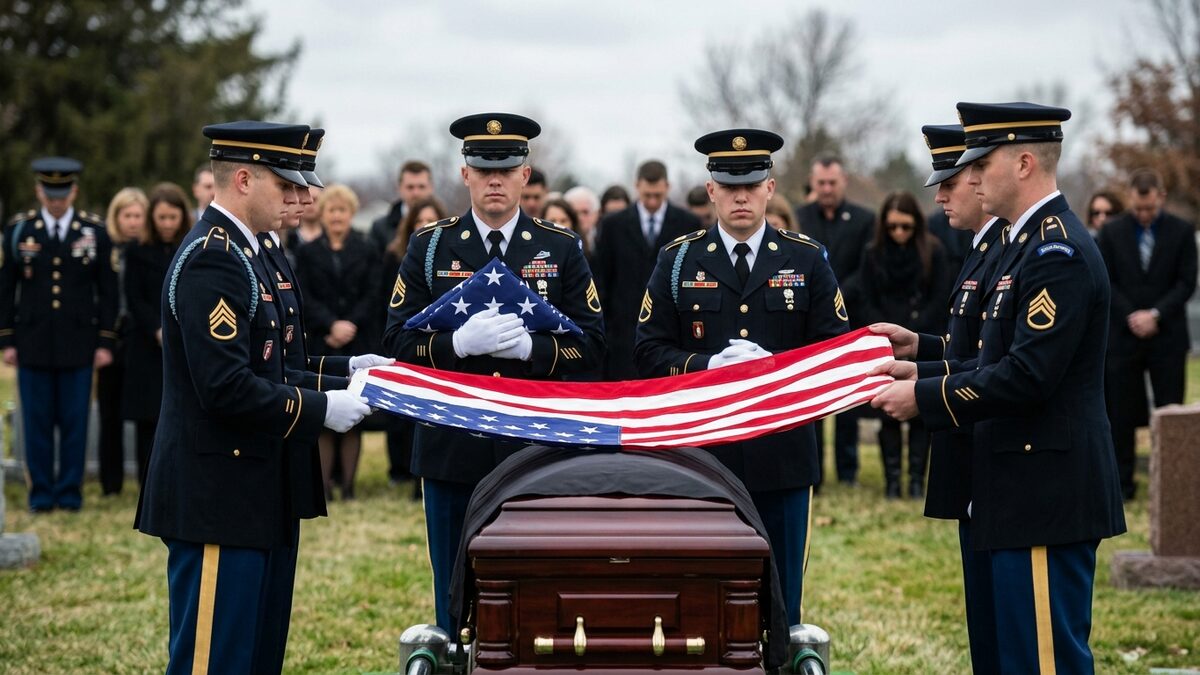
The American flag’s presence in military funeral protocols carries profound historical and symbolic weight, embodying the nation’s gratitude and reverence for those who served. Tracing its evolution from Revolutionary War battlefield burials to contemporary ceremonies reveals a rich tradition of honor and respect. Exploring this practice invites a deeper understanding of how national values are visually and ceremonially preserved through the flag’s solemn role in commemorating sacrifice.
Key Takeaways
- The American flag symbolizes liberty, sacrifice, and national unity in military funerals.
- Its use in ceremonies honors the service member's commitment and sacrifice to the nation.
- Flag presentation is a formal, codified ritual across military branches.
- The folded flag represents national gratitude and respect for the deceased veteran.
Since the American Revolution, the flag of the United States has symbolized the ideals of liberty, sacrifice, and national unity. Its presence in military funeral protocols echoes this legacy, serving as a solemn tribute to those who have borne arms in defense of the nation. From the Revolutionary War’s battlefield burials to contemporary ceremonies, the flag’s role has evolved into a codified expression of honor and respect, reflecting both historical continuity and the enduring values for which American service members have given their lives.
Core Role of the Flag in Military Funeral Protocols
The American Flag in Military Funeral Protocols functions foremost as a profound symbol of honor, emblematic of the deceased service member’s commitment and sacrifice to the nation. Official Military OneSource guidance emphasizes that the flag presentation honors a veteran’s “honorable and faithful service,” underscoring the flag’s role beyond mere decoration to a representation of national gratitude. The ceremonial use of the flag is codified across branches, with Arlington National Cemetery identifying the formal folding of the flag as an essential component of military funeral honors.
The American Flag in Military Funeral Protocols functions foremost as a profound symbol of honor, emblematic of the deceased service member’s commitment and sacrifice to the nation.
Further codification is evident in the U.S. Navy’s funeral directive, which mandates that every military funeral must at minimum include the folding and presentation of the American flag accompanied by the playing of *Taps*. Throughout the ceremony, the flag is treated with solemn respect, maintained under constant control by designated honor guard members to prevent it from touching the ground. This practice preserves the flag’s sanctity as a ceremonial object and underscores its symbolic weight in memorializing the fallen.
Flag Placement on the Casket
The placement of the American flag on the casket follows precise and consistent guidelines that reinforce its symbolic significance. Official instructions stipulate that the blue union—the field of stars—must be positioned at the head of the casket, covering the deceased’s left shoulder. This placement is uniformly endorsed by the United States Flag Manual and Arlington National Cemetery, reflecting a longstanding tradition that visually associates the flag’s blue canton with the heart and honor of the individual.
For a closed casket, the flag lies flat with the stripes extending lengthwise down the casket’s length. In cases of a half-couch casket, the flag is arranged in three distinct layers, with the blue union forming the top fold on the deceased’s left side. For a full-couch casket, the flag is meticulously folded into a triangle, then placed above the left shoulder on the head panel. These variations in presentation accommodate different casket styles while maintaining the flag’s respectful orientation and ceremonial significance.
Ceremony Sequence and Timing of the Flag Presentation
The sequence and timing of the flag’s presentation during military funerals are carefully structured to maximize solemnity and respect. Military OneSource notes that the flag is generally presented to the next of kin following the playing of *Taps*, serving as a culminating moment of the ceremony. Similarly, Arlington National Cemetery’s protocol includes three rifle volleys, *Taps*, the formal folding of the flag, and then the presentation, thereby ensuring a dignified and measured progression of honors.
The Navy’s funeral directive identifies the combination of *Taps* and the flag presentation as the minimum ceremonial elements required, highlighting their central importance. The flag is removed from the casket immediately after the musical interlude of *Taps* concludes, signaling the conclusion of formal honors. This sequence not only provides a structured ritual but also allows family and attendees to focus on the flag as a tangible symbol of the nation’s appreciation and remembrance.