
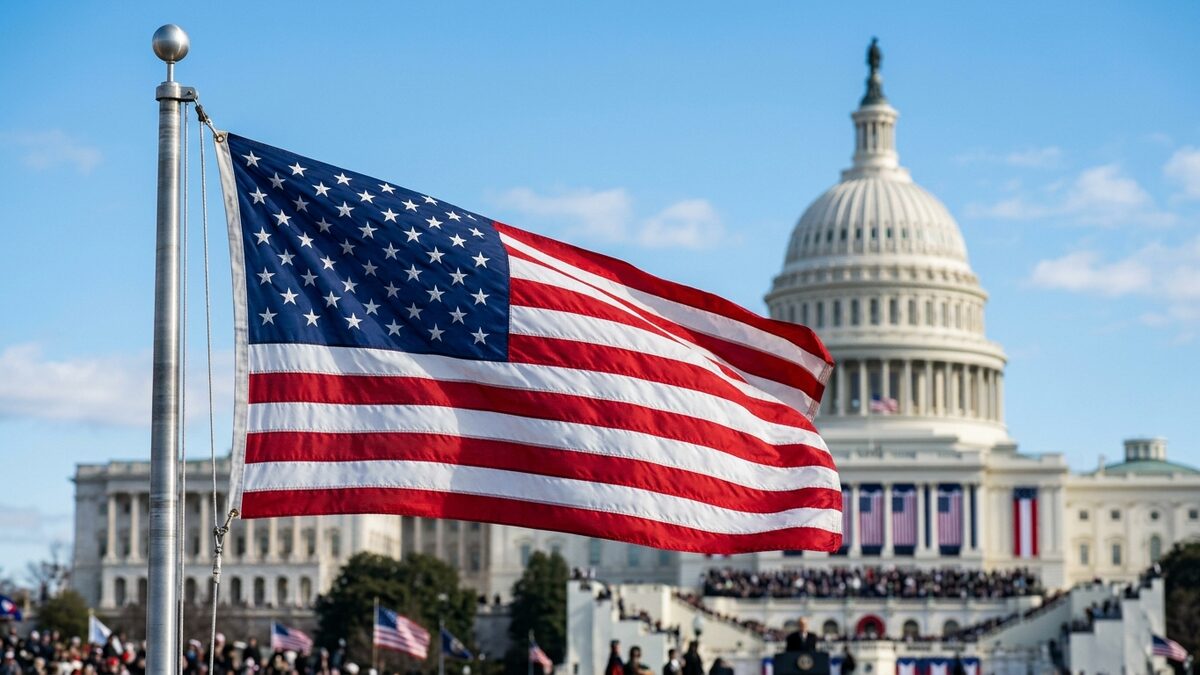
The American flag’s presence at presidential inaugurations extends far beyond mere decoration, embodying themes of national identity, authority, and democratic continuity. Since George Washington’s first inauguration, its carefully chosen placement has reinforced the symbolism of political transition and unity. Exploring how this iconic emblem shapes the ceremony reveals deeper insights into the values and traditions that define the American republic during these historic moments.
Key Takeaways
- The American flag has been a central symbol of unity and continuity at presidential inaugurations since 1789.
- Its display embodies national identity, authority, and the peaceful transition of democratic power.
- The flag arrangement at inaugurations is carefully designed to emphasize historical and political symbolism.
- Five flags, including the U.S. flag and two 13-star flags, are prominently positioned to honor the nation's origins and present.
Since George Washington’s first inauguration in 1789, the American flag has been a silent yet potent presence at presidential ceremonies, symbolizing the unity and continuity of the republic. As the nation’s foremost emblem, the flag’s display during these pivotal moments reflects broader themes of national identity, authority, and democratic transition. Examining its evolving role in inauguration rituals reveals how the flag functions not merely as decoration but as a deliberate instrument of political symbolism and civic meaning.
Core Ceremonial Placement of the American Flag
The official layout of flags at presidential inaugurations is meticulously arranged to enhance the symbolic gravity of the event. According to the Joint Congressional Committee on Inaugural Ceremonies (JCCIC), five flags are prominently displayed on the West Front of the Capitol during the ceremony. The United States flag occupies the central position, serving as the focal point that represents the nation in its current form. Flanking this central flag are two 13-star flags, which pay homage to the original thirteen colonies that formed the foundation of the republic. On the outermost edges of this arrangement are two flags commonly known as the “Betsy Ross flag,” recognized for its thirteen stars arranged in a circle. This carefully balanced configuration not only frames the swearing-in platform visually but also reinforces the historical continuity and legitimacy of the incoming administration.
Since George Washington’s first inauguration in 1789, the American flag has been a silent yet potent presence at presidential ceremonies, symbolizing the unity and continuity of the republic.
Symbolic Meaning Behind the Flag Lineup
The selection and positioning of the flags convey layered meanings that connect the present to the past. The central American flag symbolizes the current United States, emphasizing the continuity of governance and the enduring nature of the republic. The two 13-star flags, whose design is often attributed to Francis Hopkinson, a member of the Continental Congress, evoke the founding era and the original union of states. The outer Betsy Ross flags, dating back to the early 1790s, further emphasize this connection to the nation’s origins. This deliberate arrangement serves to visually and symbolically link the incoming president and administration to the historical roots of American democracy, highlighting a narrative of evolving governance grounded in foundational principles.
Historical Development of the West Front Flag Display
The tradition of displaying flags on the West Front of the Capitol during inaugurations has developed into a distinctly American ceremonial practice. While flag displays have been part of inaugurations for centuries, the standardized arrangement featuring five flags in a symmetrical pattern became established in the late 20th century. Contemporary accounts, such as an ABC News report on the 2001 inauguration, note that the five-flag setup was in place, with some variation in the historical flags used. For example, the 2001 ceremony featured two 28-star flags honoring Texas, reflecting political considerations related to the incoming president, alongside the Betsy Ross-style outer flags. This evolution illustrates how the American flag in presidential inauguration ceremonies not only maintains traditional symbolism but can also be subtly adapted to reflect the unique context of each administration.