
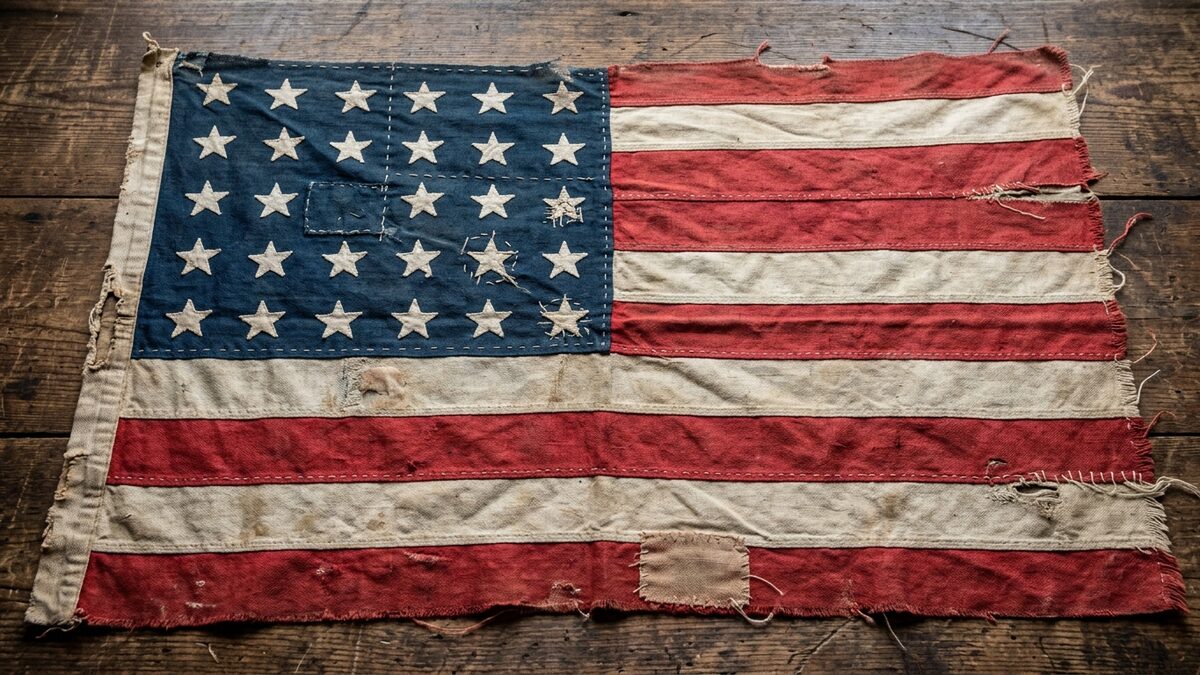
The evolution of the American flag during the Civil War era reveals more than aesthetic adjustments; it encapsulates the nation’s fractured identity and contested loyalties. Changes in the arrangement and count of stars not only marked new states but also symbolized the competing visions of unity and division. Exploring these design modifications offers a unique lens through which to understand the political and cultural upheaval that defined this turbulent period in American history.
Key Takeaways
- The American flag's design during the Civil War reflected the nation's political divisions.
- Star counts on the Union flag changed as new states joined the Union.
- The red, white, and blue layout of the flag remained consistent despite star changes.
- Flag modifications symbolized the struggle for unity and sovereignty during the war.
In 1861, as the United States plunged into the turmoil of the Civil War, the American flag became more than a symbol of national identity; it evolved into a visual testament to a fractured nation’s shifting political landscape. The conflict between Union and Confederacy prompted critical alterations to the flag’s design, reflecting the complex dynamics of loyalty, statehood, and the quest for unity amidst division. These modifications, including changes in star arrangements and the addition or removal of stars, encapsulated the era’s turbulent interplay between symbolism and sovereignty.
Union Flag Stars Changed as New States Were Admitted
Throughout the Civil War, the fundamental red, white, and blue layout of the United States flag remained unchanged; however, the number of stars representing states in the Union evolved in response to territorial admissions. At the war’s outset, the flag displayed 33 stars, a count established following Oregon’s admission in 1859. This number increased to 34 stars shortly before hostilities began, with Kansas joining the Union in January 1861.
The conflict between Union and Confederacy prompted critical alterations to the flag’s design, reflecting the complex dynamics of loyalty, statehood, and the quest for unity amidst division.
Further admissions during the war reflected the shifting political landscape. West Virginia’s secession from Confederate Virginia and subsequent admission in 1863 added the 35th star. Nevada, admitted in 1864, brought the star count to 36, though some flags bearing 36 stars appeared only in 1865, after the war’s conclusion. These incremental changes symbolized the Union’s persistence and growth, reinforcing the flag’s role as an emblem of national unity even as the country was deeply divided.
The Union Flag Became a Stronger National Symbol During the War
Before the Civil War, the American flag was largely confined to military forts, government buildings, and naval vessels, seldom seen in the public sphere. The bombardment and subsequent defense of Fort Sumter in April 1861 marked a turning point, as the flag became a rallying symbol for the Union cause. The flag carried by Union troops in battle ignited a surge of patriotic enthusiasm known as “Flagmania” in Northern states.
This heightened visibility transformed the flag from a largely institutional emblem into a widespread symbol of national identity and loyalty. The U.S. Army’s permission to carry the flag into battle, overturning an 1847 restriction limiting its use to camps, further entrenched its significance. Consequently, the flag’s presence in public life normalized, embodying the Union’s determination to preserve the nation amidst civil strife.
Confederate National Flags Changed Three Times During the War
In contrast to the Union’s relatively stable flag design, the Confederate States of America adopted three distinct national flags throughout the Civil War, each reflecting attempts to forge a unique Confederate identity. The first, known as the Stars and Bars, was used from 1861 to 1863. Its design, featuring a circle of stars and three horizontal stripes, often caused confusion on the battlefield due to its similarity to the Union flag.
To address this, the Confederate government introduced the Stainless Banner in May 1863, combining a white field with the well-known Confederate battle emblem in the canton. However, the predominance of white was interpreted by some as a symbol of surrender, prompting the adoption of the Blood-Stained Banner in March 1865, which added a red vertical stripe to the fly end. These successive modifications underscored the Confederacy’s struggle to establish a distinct and enduring national symbol amid ongoing conflict and eventual defeat.