
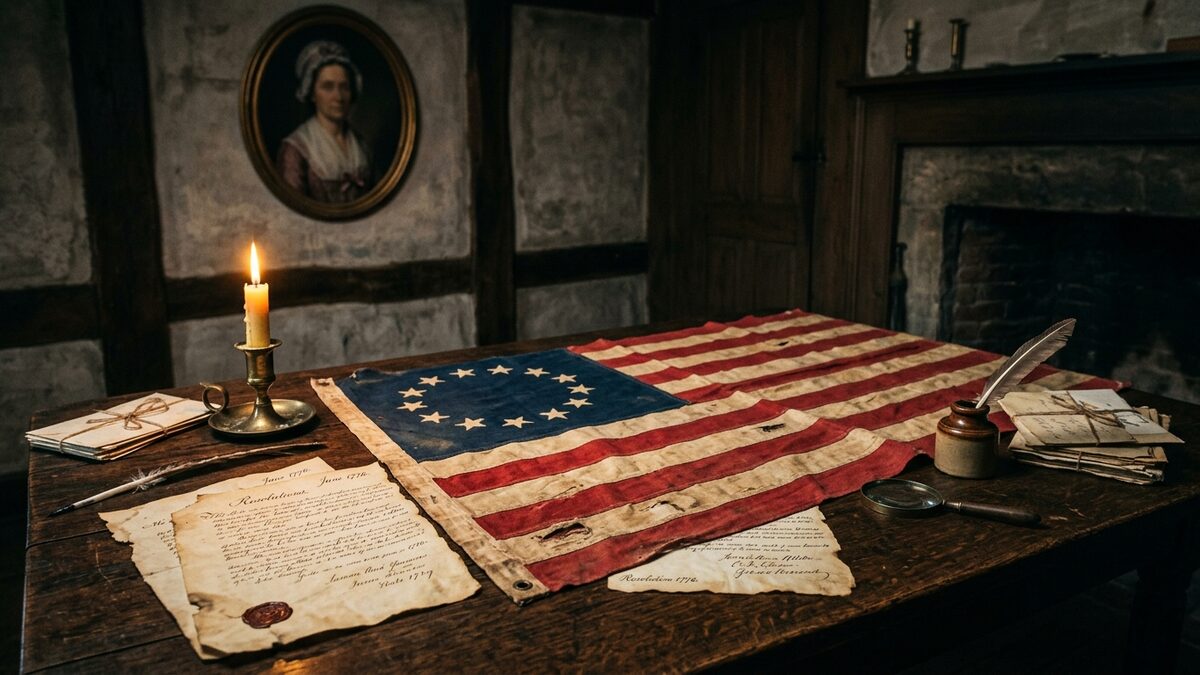
The Betsy Ross flag stands as a powerful emblem of early American unity, yet its origins are shrouded in debate. While commonly linked to Betsy Ross and the birth of the nation, recent scholarship challenges this narrative, raising questions about the interplay between myth and historical fact. Exploring these conflicting perspectives reveals deeper insights into how national symbols are shaped and remembered.
Key Takeaways
- The Betsy Ross flag symbolizes the unity of the original thirteen colonies after the American Revolution.
- Its design features thirteen stars in a circle and thirteen stripes, reflecting the Flag Act of 1777.
- Betsy Ross’s credited role in creating the flag is historically debated and lacks definitive evidence.
- The first known depiction of this flag design appears in a 1790 painting by John Trumbull.
In the aftermath of the American Revolution, as the fledgling United States sought symbols to unify its diverse colonies, the Betsy Ross flag emerged as a potent emblem of national identity. Traditionally credited with its creation in 1776, this thirteen-star, thirteen-stripe banner purportedly encapsulated the original thirteen colonies’ unity. However, the historical veracity of Betsy Ross’s role and the flag’s design origins have been subjects of debate among scholars, reflecting broader tensions between myth-making and documented history in the nation’s early symbolic heritage.
Origins of the Betsy Ross Flag
The flag commonly referred to as the Betsy Ross flag features thirteen alternating red and white stripes and thirteen white stars arranged in a circle on a blue canton. This design corresponds with the requirements set forth by the Flag Act of 1777, which mandated thirteen stripes and thirteen stars to represent the original colonies but did not prescribe the shape or arrangement of the stars. The earliest visual record of this emblematic design appears in John Trumbull’s 1790 painting of George Washington at Trenton, a work that postdates the Revolutionary War by over a decade. Notably, the designation “Betsy Ross flag” emerged more than a century after the flag’s documented appearance in Trumbull’s artwork, suggesting a retrospective attribution rather than contemporaneous naming. The design itself remains emblematic of the unity of the thirteen colonies during the American Revolutionary War era, but its precise origins remain ambiguous.
The historical veracity of Betsy Ross's role and the flag’s design origins have been subjects of debate among scholars, reflecting broader tensions between myth-making and documented history in the nation’s early symbolic heritage.
Betsy Ross and the Origin Story
Elizabeth “Betsy” Ross was a Philadelphia upholsterer whose family, decades after the Revolution, claimed she designed and produced the first American flag. According to this narrative, George Washington and other congressional figures visited Ross in 1776, commissioning her to create a flag for the new nation. The story includes a detail wherein Ross purportedly altered Washington’s initial six-pointed star design to five-pointed stars, citing ease of cutting as the rationale. This account was first publicly introduced by Ross’s descendants around 1870, nearly a century after the alleged event. Despite its popularity in American folklore, modern historians and vexillologists generally reject the claim that Ross was the flag’s original designer, viewing the story as a family legend rather than verified historical fact.
What the Documentary Record Shows
Extensive scholarly investigation, including searches through diaries, letters, and Continental Congress journals, has failed to substantiate the Betsy Ross origin story. The Smithsonian Postal Museum explicitly notes the absence of any documentary evidence confirming Ross’s involvement or the specific flag design during the relevant period. Neither the correspondence of George Washington nor the official records of the Continental Congress mention a flag commission or its design details. USHistory.org highlights the lack of surviving documents to support the narrative, describing the claim as insufficiently evidenced. This gap in the documentary record underscores a broader historiographical tendency to differentiate between patriotic myth and established fact in the development of early American symbols. Consequently, the Betsy Ross flag controversy remains a salient example of how national myths can overshadow and complicate the historical understanding of foundational icons.