
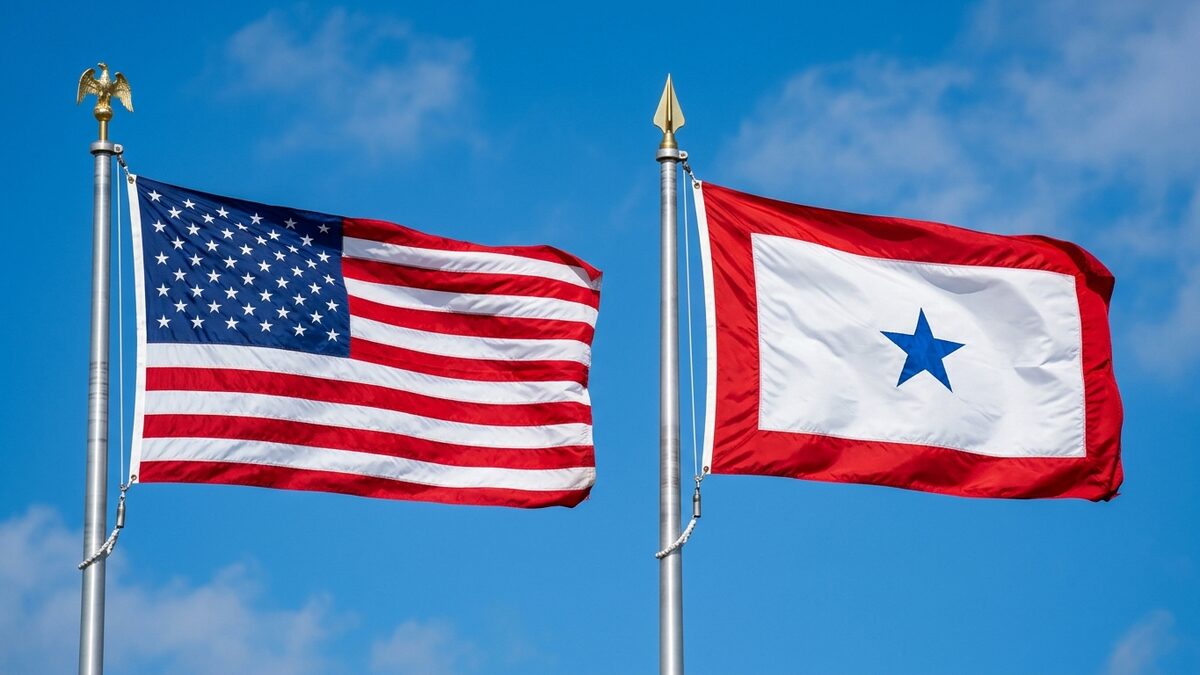
The United States national flag and military service flags serve distinct yet complementary roles in representing the nation and its armed forces. While the national flag stands as a powerful emblem of unity and sovereignty, military service flags communicate unique identities and honors tied to specific branches and sacrifices. Exploring these differences reveals how symbolism and design convey broader national ideals alongside specialized military heritage, inviting a deeper understanding of their significance.
Key Takeaways
- The U.S. national flag symbolizes the unity and sovereignty of the entire nation.
- Military service flags represent specific branches or honor individual service members.
- National flags use stars and stripes to convey collective identity, while service flags use unique emblems and colors.
- Service flags reflect specialized military traditions distinct from the broader national ethos.
The United States national flag, with its thirteen stripes and fifty stars, symbolizes the unity and identity of the nation as a whole, while military service flags, often distinguished by their unique emblems and colors, honor the individual branches and sacrifices within the armed forces. Whereas the national flag represents the collective ideals and sovereignty of the country, service flags serve as personalized banners that recognize specific commitments, achievements, and lineage within military tradition. This juxtaposition reveals not only differing purposes but also distinct visual and symbolic languages that reflect the broader national identity versus the specialized ethos of military service.
1. Representation and Symbolism
The U.S. national flag represents the entire nation and embodies federal authority and unity across all states and territories. In contrast, military service flags either denote specific branches of the armed forces, such as the Army or Navy, or serve as family service banners, which honor individual members currently serving. These distinctions emphasize the national flag’s role as a collective symbol, while service flags highlight particular military identities or familial connections.
Whereas the national flag represents the collective ideals and sovereignty of the country, service flags serve as personalized banners that recognize specific commitments, achievements, and lineage within military tradition.
2. Legal and Official Status
The United States flag is protected and regulated by the U.S. Flag Code, which prescribes its display and handling as the nation’s foremost symbol. Family service flags derive their legal recognition from 36 U.S.C. § 901, permitting immediate relatives to display them during wartime or hostilities. Branch flags are organizational symbols officially adopted by each military service and governed by Department of Defense protocols, with specific rules on their order of precedence and usage.
3. Display Precedence and Protocol
The U.S. national flag always holds the highest precedence in any display arrangement, positioned in the place of honor such as the observer’s far left or the highest point. Military branch flags follow in a prescribed order—Army, Marine Corps, Navy, Air Force, Space Force, and Coast Guard—reflecting institutional seniority and tradition. Family service flags, while recognized, do not have precedence over the national flag or branch flags in formal displays.
4. Visual Design and Elements
The national flag features thirteen alternating red and white stripes symbolizing the original colonies, and fifty white stars on a blue field representing the states. Military branch flags incorporate unique colors, insignias, and mottos specific to each service, often reflecting historical heritage and mission focus. The family service flag is distinctively a white field bordered in red, displaying blue stars for each active service member, visually setting it apart from official military and national banners.
5. Purpose and Usage Contexts
The U.S. flag serves as a unifying emblem displayed at government buildings, schools, and public events to affirm national identity and sovereignty. Military branch flags are primarily used within their respective services for ceremonies, units, and official functions to foster esprit de corps and institutional pride. Family service flags are displayed privately or publicly by households to acknowledge and honor the service and sacrifice of individual military family members during times of conflict.