
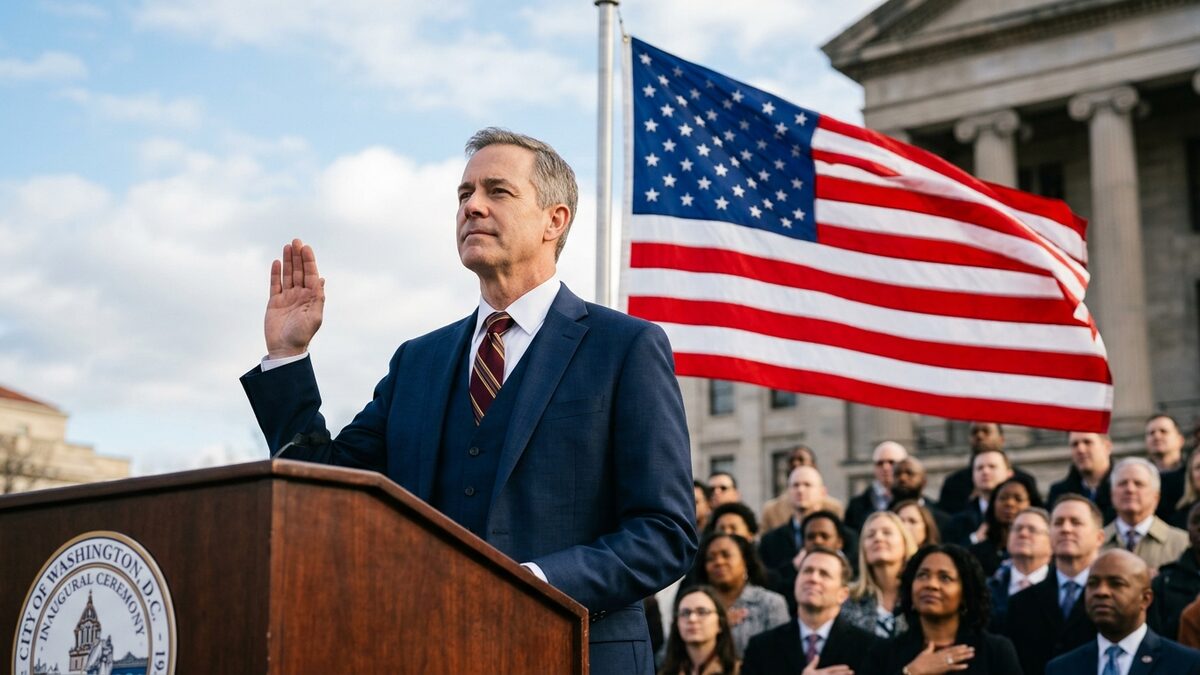
The American flag’s presence at presidential inaugurations transcends mere tradition, embodying the nation’s unity and the enduring values of its republic. From George Washington’s inaugural oath to contemporary ceremonies witnessed worldwide, this evolving symbol reinforces the peaceful transfer of power and constitutional stability. Exploring its historical and visual significance reveals how the flag continues to shape the collective identity during these pivotal moments in American democracy.
Key Takeaways
- The American flag has symbolized national unity and continuity since the first inauguration in 1789.
- Its presence during inaugurations represents the peaceful transfer of power and constitutional stability.
- The flag display at inaugurations is carefully arranged to honor both the current nation and its original colonies.
- The American flag serves as a powerful visual affirmation of collective identity during political transitions.
Since George Washington’s first inauguration in 1789, the American flag has stood as a potent emblem of national unity and continuity during presidential ceremonies. Though the flag’s design evolved over the years, its presence at inaugurations has consistently symbolized the peaceful transfer of power and the enduring principles of the republic. From the early 19th century, when the flag was unfurled alongside the oath of office, to modern ceremonies broadcast worldwide, the flag has functioned not merely as decoration but as a visual affirmation of constitutional stability and collective identity at moments of political transition.
Official Inauguration Flag Display
The American Flag in Presidential Inauguration Ceremonies occupies a central and carefully curated position. According to the Joint Congressional Committee on Inaugural Ceremonies (JCCIC), the West Front of the U.S. Capitol is traditionally adorned with five flags during the inauguration. The arrangement places the current U.S. flag at the center, flanked immediately on both sides by flags bearing thirteen stars, symbolizing the original colonies. The two outermost flags in this display are the Betsy Ross flags, recognized for their thirteen alternating red and white stripes and thirteen white stars arranged in a circle. This configuration serves as a visual narrative of the nation’s origins and its enduring unity, linking the present ceremony to the country’s foundational history.
Since George Washington’s first inauguration in 1789, the American flag has stood as a potent emblem of national unity and continuity during presidential ceremonies.
The use of these specific flags is deliberate, reflecting layers of symbolism that resonate during the inauguration. The central placement of the modern flag underscores continuity and the evolution of the republic, while the surrounding historical flags evoke the nation’s beginnings and the principles enshrined at its founding. This five-flag display has become an integral part of the ceremonial setting at the Capitol, underscoring the American Flag in Presidential Inauguration Ceremonies not only as an emblem of patriotism but as a marker of historical legacy and constitutional order.
The Joint Congressional Committee on Inaugural Ceremonies’ Role
Since its establishment in 1901, the Joint Congressional Committee on Inaugural Ceremonies (JCCIC) has assumed responsibility for the meticulous planning and execution of presidential inaugurations at the Capitol. This committee operates within the framework of the 20th Amendment of the U.S. Constitution, which sets the date for the commencement of presidential and vice presidential terms. The JCCIC’s duties encompass overseeing the swearing-in ceremonies of both the president-elect and vice president-elect, ensuring that the events proceed with due solemnity and adherence to tradition.
Composed of sitting senators and representatives from both major political parties, the JCCIC reflects a bipartisan approach to managing the inauguration, reinforcing the nonpartisan nature of the event. Beyond the oath of office, the committee also organizes the traditional inaugural luncheon, contributing to the ceremonial continuity that defines the peaceful transfer of power. Through its stewardship, the JCCIC ensures that the American Flag in Presidential Inauguration Ceremonies remains a consistent and respected symbol within a carefully orchestrated event that celebrates constitutional democracy.
Flag Protocol on Inauguration Day
The American Flag in Presidential Inauguration Ceremonies is further highlighted by official flag protocols observed on Inauguration Day itself. On January 20, 2025, for instance, the White House issued a proclamation that mandated the U.S. flag be flown at full-staff across the White House, public buildings and grounds, military posts, naval stations and vessels, and U.S. facilities abroad. This directive underscored the significance of Inauguration Day as a moment to honor the nation and its governmental framework through the prominent display of the flag.
The proclamation specified that the flag would remain at full-staff for the entire day, symbolizing respect and unity at the moment of presidential transition. Subsequently, the flag was ordered to return to half-staff status under a prior Proclamation 10876, which related to former President Jimmy Carter. This protocol illustrates how flag positioning on Inauguration Day functions as a communicative gesture, marking the solemnity of the occasion while integrating commemorations of past leaders. The flag’s status thus contributes to the broader narrative of continuity, respect, and constitutional stability that defines presidential inaugurations.