
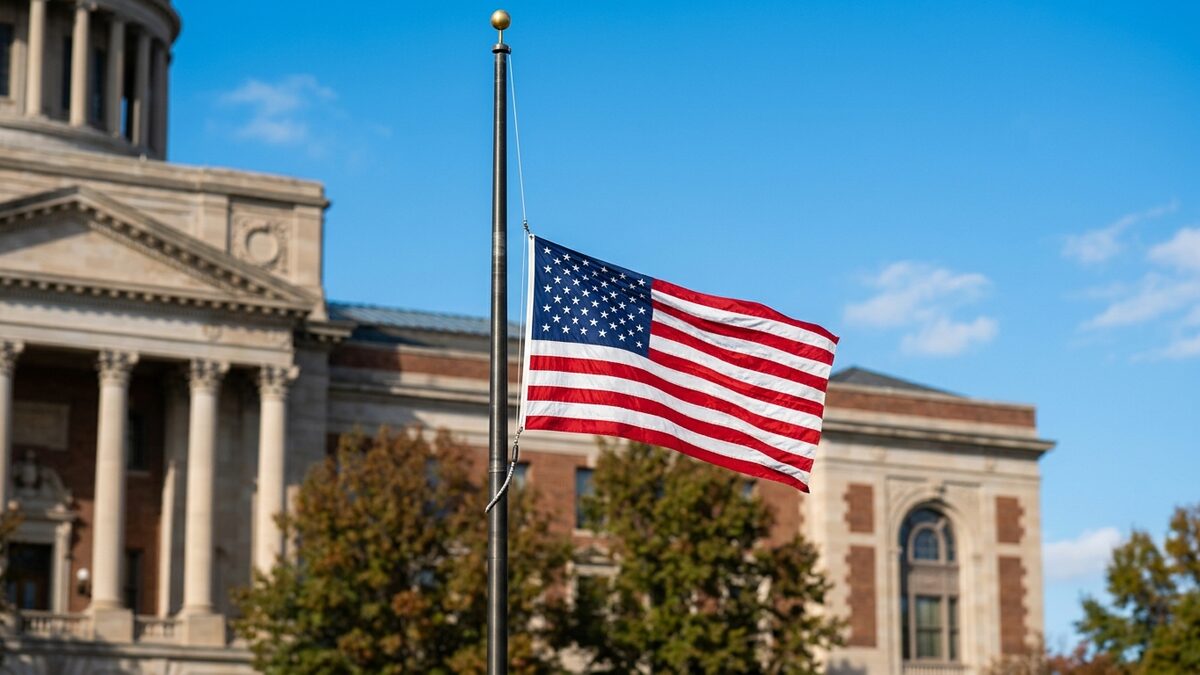
The practice of displaying the U.S. flag at half-staff carries deep historical significance, rooted in naval traditions from the Revolutionary War era. The U.S. Flag Code codifies this solemn gesture, outlining specific guidelines that reflect both respect for the nation’s past and contemporary standards of civic decorum. Exploring these protocols reveals how legal structure preserves the flag’s symbolic power in times of mourning and remembrance.
Key Takeaways
- The US Flag Code mandates that the flag be flown at half-staff only by the President's order during specific mourning periods.
- Half-staff means the flag is positioned midway on the flagpole between the top and bottom.
- This practice originates from naval customs dating back to the Revolutionary War.
- The Flag Code legally formalizes the tradition as a symbol of national mourning and respect.
Since the early days of the American republic, the practice of lowering the national flag to half-staff has served as a solemn symbol of mourning and respect, tracing back to naval customs adopted during the Revolutionary War. This tradition, deeply embedded in the nation’s collective consciousness, is codified in the United States Flag Code, which delineates the precise protocols for displaying the flag at half-staff. Understanding these regulations reveals the legal framework that governs this poignant gesture, reflecting both historical reverence and contemporary civic duty.
Core Legal Rule in the U.S. Flag Code
The principal federal regulation concerning the display of the American flag at half-staff is found in Title 4 of the United States Code, Section 7. This provision specifies that the flag shall be flown at half-staff solely “by order of the President” during designated national periods of mourning or following the death of certain officials. The term “half-staff” is explicitly defined as positioning the flag midway between the top and bottom of the flagstaff. This legal standard is affirmed by authoritative sources such as The American Legion and the National Archives, which maintain records of presidential proclamations authorizing half-staff display as an established element of federal flag protocol.
Since the early days of the American republic, the practice of lowering the national flag to half-staff has served as a solemn symbol of mourning and respect, tracing back to naval customs adopted during the Revolutionary War.
Procedure for Raising and Lowering the Flag at Half-Staff
The U.S. Flag Code prescribes a specific ceremonial method for raising and lowering the flag when displayed at half-staff. The flag must first be hoisted briskly to the peak of the staff before being lowered slowly to the half-staff position. At the conclusion of the day’s display, the flag is again raised promptly to the peak before being fully lowered. This procedure is consistent across federal guidelines and is mirrored in state-level instructions, such as those issued by Arizona. It is important to note that the half-staff position is not a fixed physical marker on flagpoles but is calculated as one-half the distance between the top and bottom of the staff, ensuring uniformity in the flag’s display.
Authority to Order Half-Staff Display
The authority to order the flag to be flown at half-staff is vested primarily in the President of the United States, who may issue nationwide proclamations during periods of national mourning or significant events. Additionally, state governors possess the power to mandate half-staff display within their respective states. The Mayor of the District of Columbia holds similar authority for the District. Federal installations located within a governor’s or the D.C. mayor’s jurisdiction are generally required to comply with such proclamations, particularly in cases involving military deaths. State-specific guidelines, such as those promulgated by Missouri, reiterate these divisions of authority, underscoring the coordinated but distinct roles of federal and state officials in regulating half-staff observances.