
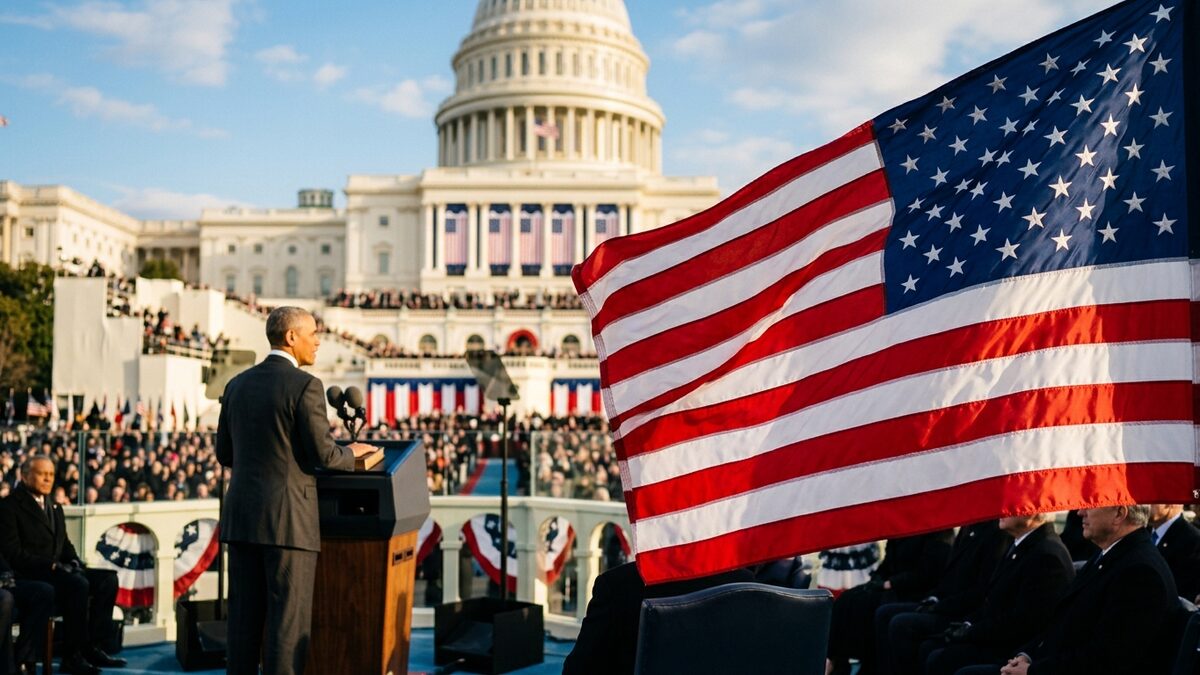
The American flag’s presence at presidential inaugurations transcends mere tradition, serving as a potent emblem of democracy, unity, and constitutional authority. From George Washington’s foundational oath to Lincoln’s wartime second inauguration and Kennedy’s aspirational renewal, the flag has symbolized the enduring principles and legitimacy of the presidency. This article examines how the flag’s evolving significance shapes public perception and reinforces national identity during these pivotal moments.
Key Takeaways
- The American flag at presidential inaugurations symbolizes the nation's ideals and political continuity.
- Its presence reinforces democracy, unity, and constitutional authority during transitions of power.
- Historical inaugurations show the flag as a visual anchor for legitimacy and national identity.
- Flag status on Inauguration Day signals presidential authority and national continuity.
Since George Washington’s first oath of office in 1789, the American flag has stood as a potent emblem during presidential inaugurations, embodying the nation’s ideals and continuity amidst political transitions. Throughout history, the flag’s presence at these ceremonies has symbolized not merely patriotism but the enduring principles of democracy, unity, and constitutional authority. From Lincoln’s solemn second inauguration amid civil strife to Kennedy’s hopeful call for civic renewal, the flag has served as a visual anchor, reinforcing the legitimacy and gravity of the presidential office. This article examines the evolving political significance of the American flag in inaugurations, highlighting its role in shaping public perceptions and reinforcing national identity at moments of profound political change.
Inauguration Day Flag Status Signals National Continuity
The status of the American flag on Inauguration Day serves as a deliberate political signal underscoring national continuity and presidential authority. On January 20, 2025, President Donald Trump issued an executive order mandating the U.S. flag to fly at full-staff on Inauguration Day and on all future inaugural dates. This directive extended to the White House, public buildings, military posts, naval stations, and U.S. diplomatic facilities worldwide. By explicitly framing the flag as a representation of “our Nation, our people, and our form of Government,” the order elevated the flag’s symbolic function beyond mere ceremonial decorum to a statement of unified governance and constitutional legitimacy.
Since George Washington’s first oath of office in 1789, the American flag has stood as a potent emblem during presidential inaugurations, embodying the nation’s ideals and continuity amidst political transitions.
Moreover, the subsequent return of the flag to half-staff, reflecting the federal mourning for former President Jimmy Carter, illustrates how flag protocol on inauguration occasions can reflect both continuity and respect for institutional memory. This executive action demonstrates the political utility of flag display as a tool for expressing presidential discretion, signaling unity, and reaffirming the government’s stability during moments of political transition.
The Capitol Display: Structured Symbolism and National Identity
The visual arrangement of flags on the Capitol’s West Front during presidential inaugurations is highly structured, conveying layered symbolism that reflects the nation’s constitutional order. According to the Joint Congressional Committee on Inaugural Ceremonies, five flags are prominently displayed, with the central position occupied by the contemporary U.S. flag. Flanking this centerpiece are two 13-star flags on each side, representing the original thirteen colonies. This deliberate configuration is described by the official inaugural page as “uniquely American,” emphasizing historical continuity and the foundational identity of the nation.
The symmetry and repetition inherent in this display transform the inauguration platform into a powerful visual statement about the United States’ enduring federal system. The arrangement reinforces the solemnity of the occasion, linking the incoming president to a legacy of constitutional governance rooted in the union of the original states. Such symbolism enhances the political significance of the American flag in presidential inaugurations by visually anchoring the ceremony in national history and collective unity.
Historical Flag Choices and Presidential Connection to the Union
Presidential inaugurations have also employed historical iterations of the American flag to forge symbolic connections between presidents and their home states, thereby reinforcing their ties to the broader Union. This practice highlights the evolving nature of the flag as a political symbol that not only represents the nation but also its constituent parts. For example, Barack Obama’s inaugurations in 2009 and 2013 featured 21-star flags, marking Illinois’ admission as the 21st state in 1818. Similarly, George W. Bush’s 2001 and 2005 inaugurations used 28-star flags corresponding to Texas’ entry into the Union in 1845.
Bill Clinton’s 1993 and 1997 inaugurations incorporated 25-star flags, reflecting Arkansas’s status as the 25th state. These historical flag choices function as deliberate gestures linking the president’s personal political identity to the nation’s expansion and unity. They underscore the American flag’s role in inaugurations not merely as a national emblem but as a symbol of the evolving federal system and the president’s place within that continuum.