
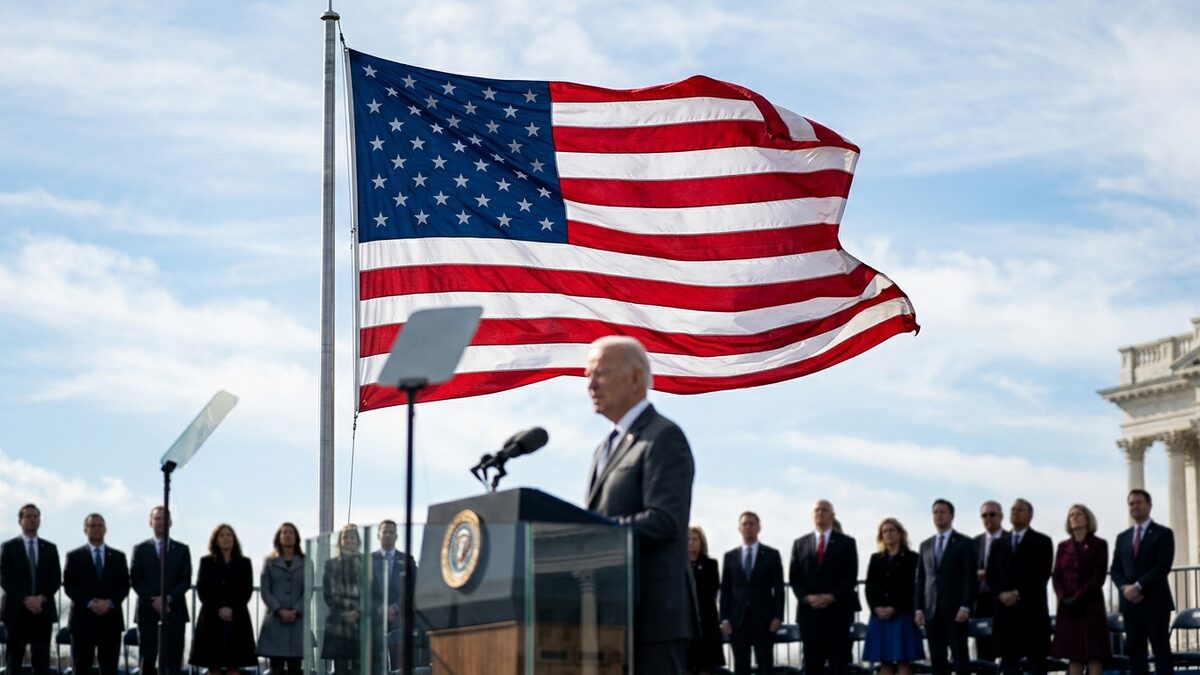
The American flag’s presence at presidential inaugurations transcends mere decoration, embodying the nation’s enduring values and unity through centuries of change. From its early role as a simple backdrop to its current status as a powerful symbol of continuity and democratic legitimacy, the flag’s evolving significance offers deep insights into the interplay between ceremony and national identity. Exploring this transformation reveals much about the country’s political and cultural landscape.
Key Takeaways
- The American flag has symbolized national identity and unity since the first inauguration in 1789.
- Its role has evolved into a deliberate emblem of continuity, patriotism, and peaceful power transfer.
- The flag reflects and reinforces the ideals that unify the nation through times of conflict and change.
- Displayed centrally at inaugurations, it signifies presidential legitimacy and constitutional continuity.
Since George Washington first took the oath of office in 1789, the American flag has stood as a potent emblem of national identity and unity during presidential inaugurations. Its presence at these ceremonies has evolved from a mere backdrop to a deliberate symbol of continuity, patriotism, and the peaceful transfer of power. Through wars, social upheavals, and political transformations, the flag has both reflected and reinforced the ideals that bound the nation together, underscoring the inauguration’s role not only as a political ritual but as a reaffirmation of American democracy itself.
The Flag as a Central Symbol of Presidential Legitimacy
The American flag occupies a prominent and deliberate place in the visual landscape of presidential inaugurations, symbolizing the legitimacy and continuity of constitutional government. At the West Front of the Capitol, where the oath is administered, the national flag is displayed centrally within a five-flag arrangement, underscoring its role as the primary emblem of the United States. This placement is no accident; official Senate inaugural materials emphasize that the flag of the United States occupies the place of honor, signaling the unbroken chain of governance and the authority vested in the incoming president.
Through wars, social upheavals, and political transformations, the flag has both reflected and reinforced the ideals that bound the nation together, underscoring the inauguration’s role not only as a political ritual but as a reaffirmation of American democracy itself.
By positioning the American flag so visibly—both to the assembled public and the millions watching via broadcast media—the inauguration ceremony is framed as a national event transcending partisan divisions. The flag’s presence reinforces the idea that the transfer of power is a peaceful, institutional process rooted in shared national values and the Constitution. In this way, the American flag functions not only as a symbol of patriotism but as a visual assertion of the president’s legitimate authority derived from the American people.
The Five-Flag Arrangement on the Capitol’s West Front
One of the most consistent visual traditions during presidential inaugurations is the display of five flags on the West Front of the Capitol. The American flag occupies the central position, flanked by four historical flags representing the nation’s origins. Immediately adjacent to the national flag are two flags featuring the 13-star design, symbolizing the original colonies at the founding of the Republic. The outermost flags also reflect historical U.S. flag designs rather than contemporary state or partisan emblems.
This five-flag configuration has been documented repeatedly in official inaugural programs and reference materials, illustrating the care taken to connect the ceremony to the nation’s early history. The choice to include historical flags alongside the current 50-star banner visually encapsulates the enduring nature of the American Republic, linking the present moment of leadership transition to the foundational era of the United States. It also serves to remind observers of the nation’s origins and the evolving story of American identity.
Flag Display as a Reflection of Historical Continuity
The inclusion of older U.S. flag designs in inauguration ceremonies underscores a deliberate effort to emphasize historical continuity during the peaceful transfer of presidential power. The 13-star flags evoke the original colonies and the revolutionary period, symbolically rooting the incoming administration in the nation’s founding principles. This blend of historical and contemporary flags visually narrates the evolution of the American nation while affirming ongoing allegiance to its constitutional ideals.
Reference materials and inauguration-era descriptions spanning multiple administrations reveal that this tradition is longstanding. The pairing of the present 50-star flag with earlier historical versions acts as a bridge between past and present, reminding the public and participants alike that each new presidency represents both a continuation and renewal of the American democratic experiment. Through this symbolic display, the American Flag in Presidential Inaugurations serves as a powerful visual testament to the resilience and unity of the United States across centuries.