
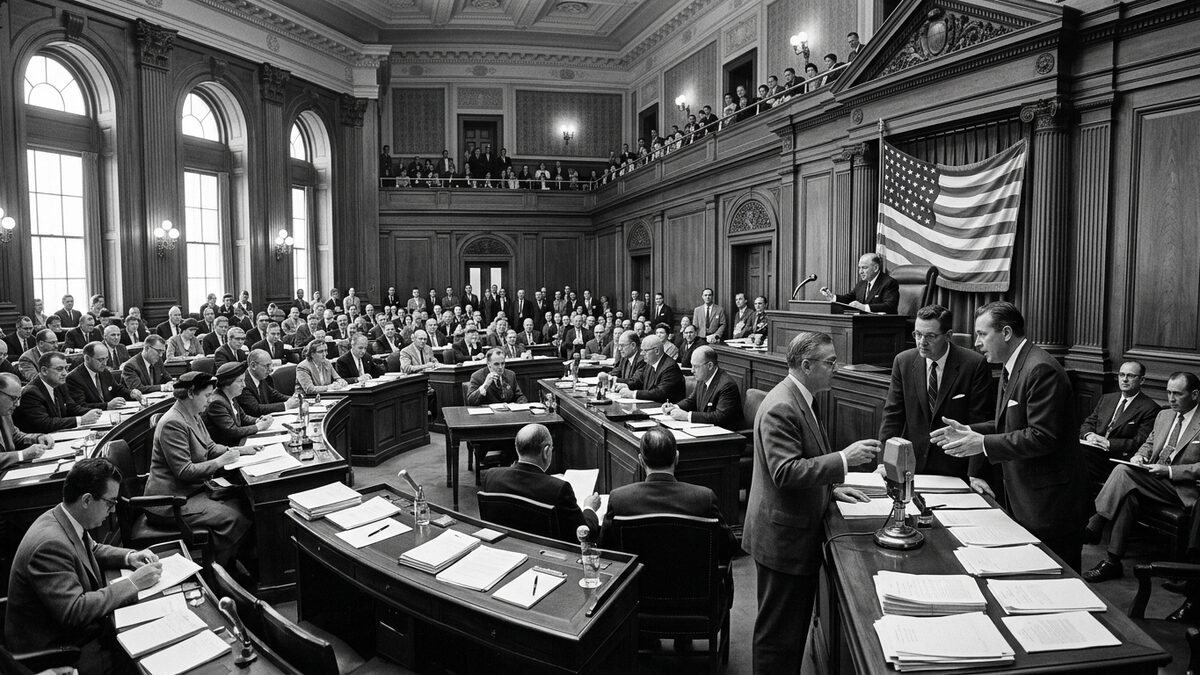
The congressional debates surrounding flag-related legislation in the 20th century reveal a complex interplay between national identity, patriotism, and evolving social values. As the country navigated post-World War I changes, these discussions became a battleground for broader issues such as civil rights, loyalty, and free expression. Understanding these legislative conflicts offers crucial insights into how symbols of unity can also reflect deep societal divisions and political struggles.
Key Takeaways
- Congressional debates over the American flag in the 20th century mirrored broader social and political changes in the U.S.
- The National Flag Conference of 1923 was pivotal in creating unified civilian flag etiquette.
- Early flag etiquette was based mostly on informal customs before federal codification.
- Legislation on the flag symbolized deeper issues of citizenship, loyalty, and free speech.
In the aftermath of World War I, as the United States grappled with emerging notions of national identity and patriotism, congressional chambers became arenas for intense debates over the symbolism and regulation of the American flag. These discussions, spanning the tumultuous decades of the 20th century, reflected broader social and political currents—from the rise of nationalism and civil rights movements to Cold War anxieties and evolving interpretations of free speech. The legislative battles that unfolded were not merely about cloth and stars; they were contests over the meaning of citizenship, loyalty, and dissent in a rapidly changing nation.
From Informal Customs to the First Federal Codification
Prior to formal legislation, American flag etiquette was governed largely by informal customs and regional practices. The National Flag Conference, convened in Washington, D.C., on June 14, 1923, marked a turning point by proposing a set of civilian flag rules that sought to unify these disparate traditions. These guidelines became the foundation for the first federal codification of flag etiquette, demonstrating Congress’s intent to standardize national symbols in response to growing patriotic fervor during the interwar period.
The legislative battles that unfolded were not merely about cloth and stars; they were contests over the meaning of citizenship, loyalty, and dissent in a rapidly changing nation.
Congress took definitive legislative action on June 22, 1942, when President Franklin D. Roosevelt approved the initial flag law as a joint resolution of the 77th Congress, designated Public Law 623. This enactment institutionalized flag customs into federal law, signaling a new era in flag governance. Later that year, on December 22, the law was amended (Public Law 829, Chapter 806) to refine its provisions. Initially codified in Title 36 of the United States Code, the Flag Code was eventually relocated to Title 4 during the 105th Congress, reflecting its elevated status within federal law.
The 1942 Debates Over Patriotism, Salute, and Civic Behavior
The congressional debates of 1942 surrounding the Flag Code were deeply intertwined with the national wartime context. Lawmakers sought to cultivate a unified patriotic observance amid World War II, and the legislation codified rules governing civilian display of the flag, the national anthem, and the Pledge of Allegiance. One significant point of contention was the form of salute accompanying these rituals. Initially, the statute incorporated the raised-arm salute, a gesture adopted from the 1924 Flag Day Conference, which some associated with fascist symbolism.
Responding to these concerns, Congress amended the salute provision on December 22, 1942, replacing the raised-arm salute with the hand-over-heart gesture, which remains standard today. This change underscored congressional sensitivity to the political implications of patriotic symbolism. Importantly, the Flag Code was framed as a voluntary code of conduct, not a criminal enforcement mechanism, signaling a nuanced approach that balanced patriotic uniformity with constitutional freedoms such as free speech and expression.
Mid-Century Revisions and Consolidation of the Flag Code
Rather than overhaul the Flag Code, Congress adopted a pattern of incremental amendments throughout the mid-20th century, reflecting continuity and adaptability in flag-related legislation. Notable revisions occurred in 1953 and 1954, documented as Public Laws 107 and 396 of the 83rd Congress respectively, which refined various aspects of flag etiquette in response to evolving social norms and political climates. These legislative updates preserved the original framework while responding to contemporary needs.
The bicentennial period prompted further congressional attention, culminating in a 1976 amendment that reflected renewed national interest in patriotic symbolism during a milestone year. The modern Flag Code, as compiled under Title 4 of the U.S. Code, traces its legal lineage directly back to the 1942 enactment and subsequent amendments, illustrating a century-long legislative trajectory shaped by debates over identity, loyalty, and civic behavior. These congressional debates on 20th century flag legislation not only standardized flag etiquette but also mirrored the nation’s ongoing struggle to define the boundaries of patriotism and dissent.