
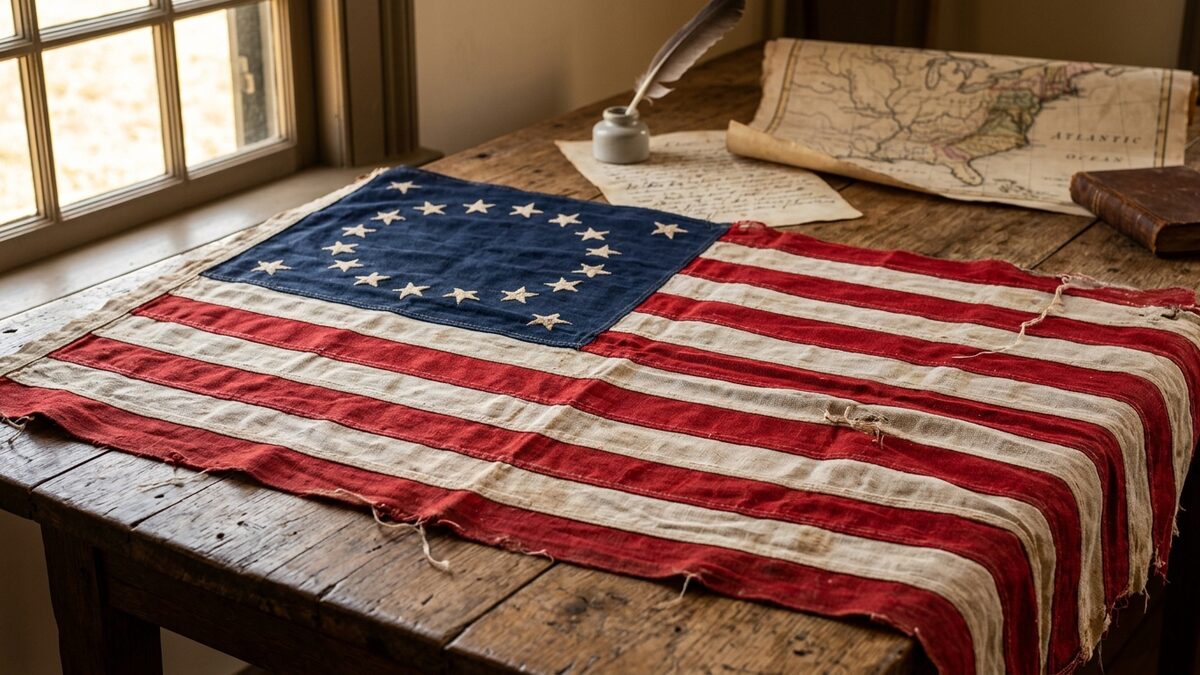
The American flag’s thirteen stripes offer more than a simple design element; they embody the nation’s revolutionary beginnings and the original colonies’ unity. Despite the country’s expansion to fifty states, this symbolic feature remains unchanged, prompting reflection on how historical identity continues to shape national symbols. Exploring the reasons behind this enduring choice reveals deeper insights into American heritage and collective memory.
Key Takeaways
- The thirteen stripes on the American flag represent the original thirteen colonies.
- The flag’s design was adopted in 1777 to unify the new nation.
- Despite adding new states, the stripes have remained unchanged.
- The stripes serve as a lasting symbol of America’s revolutionary origins.
When the Continental Congress adopted the first official American flag in 1777, it featured thirteen stripes to symbolize the original thirteen colonies that declared independence from British rule. This design choice, rooted in the revolutionary era, was intended to unify the fledgling nation under a common emblem reflecting its origins. Despite the subsequent admission of new states, the flag’s thirteen stripes remain unchanged, serving as a continuous reminder of the country’s foundational struggle and the enduring legacy of its birth.
The Original Meaning of the 13 Stripes
The thirteen stripes on the American flag represent the original thirteen colonies that declared independence from Britain and became the first states of the United States. This symbolism is well documented in official U.S. government sources, such as USA.gov and the U.S. Embassy’s flag facts, which affirm that the 13 stripes directly reference the nation’s founding political entities. The flag features seven red and six white stripes, a deliberate choice established in the first official flag design rather than a later decorative addition. The stripes encapsulate the revolutionary origins of the country, grounding the flag’s identity in the historical moment of the nation’s birth and emphasizing unity among the original states.
Despite the subsequent admission of new states, the flag’s thirteen stripes remain unchanged, serving as a continuous reminder of the country’s foundational struggle and the enduring legacy of its birth.
The 1777 Flag Resolution and Its Enduring Legacy
On June 14, 1777, the Continental Congress passed the Flag Resolution, formally establishing the design of the United States flag. This resolution specified that the flag would bear thirteen stripes alternating red and white, alongside thirteen stars on a blue field to symbolize “a new constellation.” This design laid the foundation for the iconic “Stars and Stripes” motif that endures today. The date of this resolution is commemorated annually as Flag Day, underscoring its significance in American history. The 1777 decision codified the symbolism of the stripes and stars, linking the flag’s appearance to the nation’s revolutionary ideals and newly formed identity.
Maintaining 13 Stripes Amidst a Growing Nation
Before the 1777 flag, earlier revolutionary banners already featured thirteen stripes, notably the Grand Union Flag used from 1775 to 1777. This flag displayed thirteen alternating red and white stripes but retained the British Union Jack in the canton, reflecting the colonies’ complex relationship with Britain at the time. The stripes drew inspiration from earlier colonial symbols, such as the Sons of Liberty flag, and were integrated into the 1777 design to ensure continuity with the revolutionary cause. As the United States expanded, Congress initially experimented with adding stripes for new states but ultimately found this impractical. In 1818, Congress resolved to maintain the thirteen stripes permanently to honor the original colonies, while adding a star for each new state. This decision preserved the flag’s historical core while allowing it to evolve with the nation’s growth.