
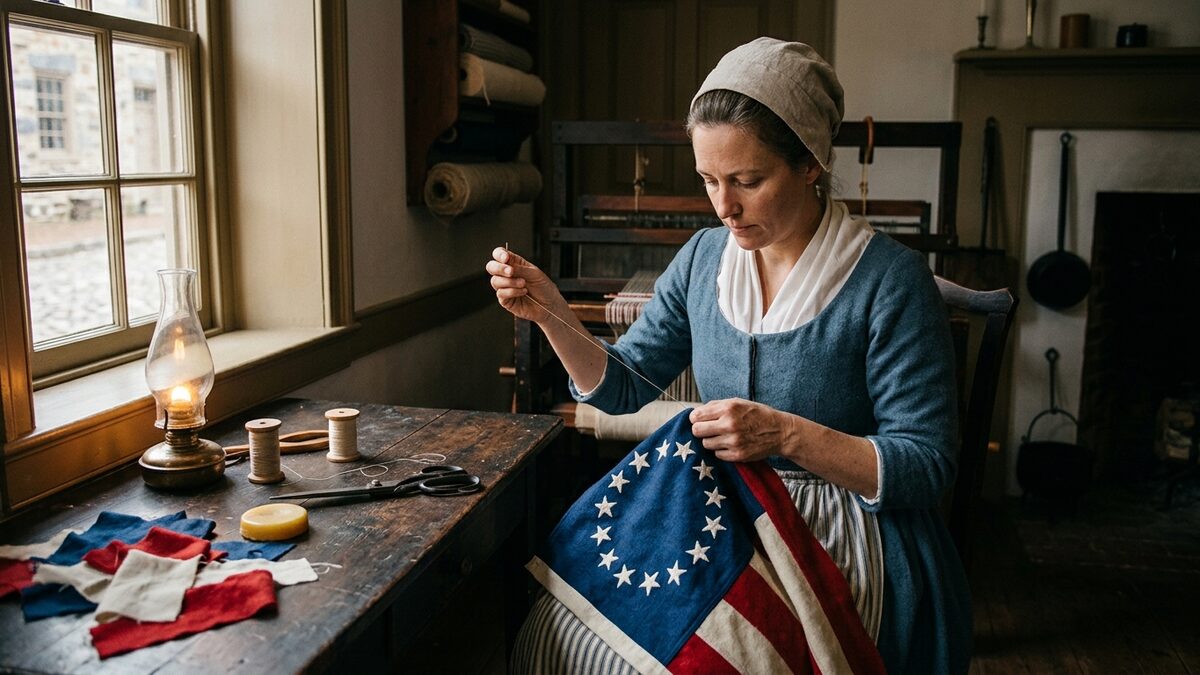
The Betsy Ross flag, with its distinctive circle of thirteen stars, has long been celebrated as a symbol of unity and equality during the American Revolution. While the story credits Philadelphia seamstress Betsy Ross with its creation, historical verification remains elusive. This blend of fact and legend invites a deeper examination of how such narratives shape national identity and collective memory, raising questions about the intersection of history and folklore.
Key Takeaways
- The Betsy Ross flag symbolizes unity and equality among the original thirteen colonies.
- The story of Betsy Ross sewing the first American flag is largely based on folklore.
- The term "Betsy Ross flag" was coined long after the American Revolution.
- The Flag Act of 1777 officially established the design of the United States flag.
In the midst of the American Revolution, as the thirteen colonies sought to forge a unified identity against British rule, a flag bearing thirteen stars arranged in a circle emerged as a potent symbol of nascent independence. Attributed to Betsy Ross, a Philadelphia seamstress, this design purportedly encapsulated the ideals of unity and equality among the colonies. Although historical documentation remains sparse, the story of Ross’s involvement in creating the first American flag has endured, intertwining with the nation’s revolutionary narrative to become a cornerstone of American folklore.
The Betsy Ross Flag as a Later Attribution
The flag commonly known today as the Betsy Ross flag features thirteen alternating red and white stripes with a blue canton containing thirteen stars arranged in a circle. This design represents the original thirteen colonies and symbolizes unity and equality. However, the term “Betsy Ross flag” was not used contemporaneously but emerged much later, becoming a popular label for this early U.S. flag design. The Flag Act of June 14, 1777, formalized the design of the United States flag, specifying thirteen stripes and thirteen stars but not the arrangement of the stars as a circle. While the circular star pattern has become iconic, there is no definitive evidence that this specific configuration was selected during the flag’s inception.
Although historical documentation remains sparse, the story of Ross’s involvement in creating the first American flag has endured, intertwining with the nation’s revolutionary narrative to become a cornerstone of American folklore.
Smithsonian Institution materials emphasize that the association of this star pattern with Betsy Ross is rooted more in legend than in contemporaneous documentation. The design itself is historically significant, but its direct connection to Ross remains unverified. Thus, the Betsy Ross flag, as a named entity, reflects a popular narrative rather than a verified historical fact.
The Core Legend of Betsy Ross and the 1776 Visit
The central legend surrounding the Betsy Ross flag design involves a purported 1776 visit by George Washington, Robert Morris, and George Ross—Betsy Ross’s late husband’s uncle—to her Philadelphia home. According to the story, Washington presented Ross with a rough sketch of a flag featuring thirteen stars and stripes, seeking her expertise as a skilled seamstress. The tale credits Ross with suggesting the use of five-pointed stars instead of the six-pointed stars originally proposed, a detail that has become a defining element of the flag’s design.
This narrative situates the creation of the flag prior to the official Flag Act of 1777, implying that Ross played a pivotal role in the flag’s genesis. The visit and design consultation form the foundation of Ross’s place within American folklore, portraying her as an unsung patriot contributing to the nation’s symbol of independence. The simplicity and human interest of this story have made it enduringly popular in American cultural memory despite the absence of documentary corroboration.
Historical Scrutiny and the Later Popularization of the Legend
Historians and institutions including the Smithsonian and Colonial Williamsburg have found scant historical evidence to substantiate the Betsy Ross flag legend. Extensive reviews of diaries, letters, and records from the Continental Congress reveal no mention of Ross’s involvement in flag design or any flag-related discussions consistent with the legend’s timeline. The Smithsonian Postal Museum explicitly states that no authentic information supports the claim that Ross designed the first American flag, and National Geographic categorizes the story as a myth lacking substantiated proof.
The legend’s prominence arose well after the Revolutionary period, gaining widespread attention during the late 19th century. In 1893, Charles Weisgerber’s painting, The Birth of Our Nation’s Flag, was exhibited at the World’s Columbian Exposition, visually cementing the story in the popular imagination. Mass-marketed prints of the painting helped popularize the narrative, embedding the Betsy Ross flag design in American folklore as a symbol of patriotic craftsmanship and female contribution to the nation’s founding. This resurgence illustrates how national identity and myth-making can elevate unverified stories into enduring cultural icons.