
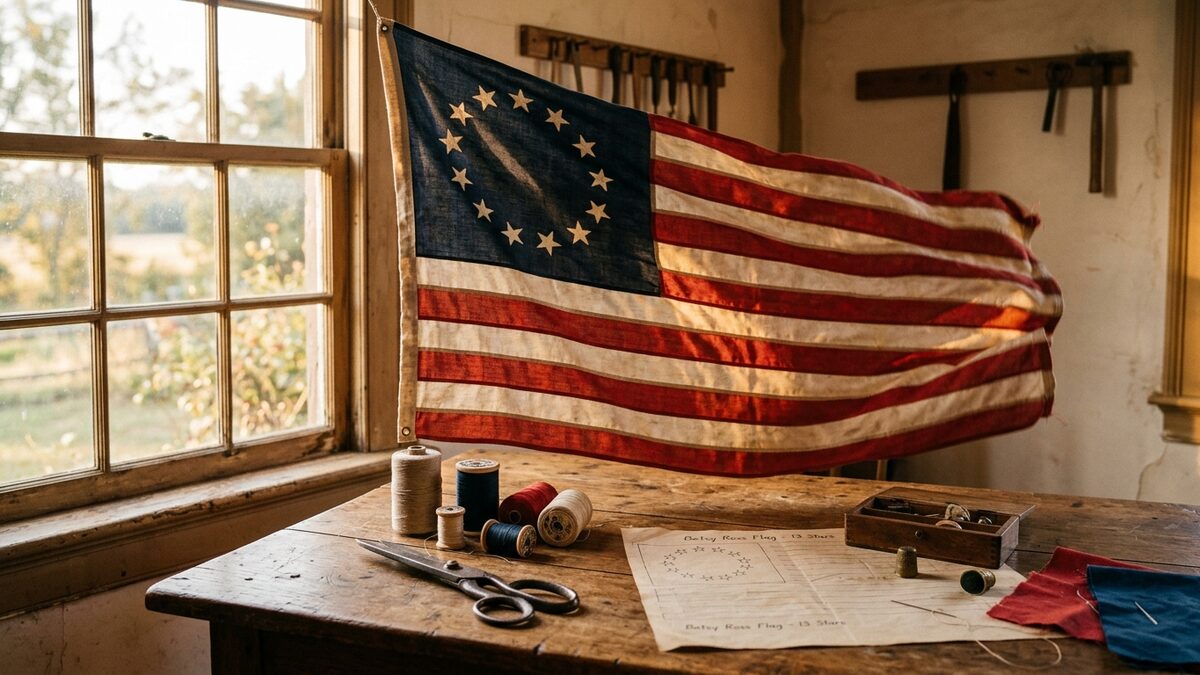
The Betsy Ross flag, with its distinctive circle of thirteen stars and alternating stripes, holds a unique place in American history. Originating during the Revolutionary War, it symbolized unity and equality among the colonies at a pivotal moment of nation-building. Exploring how this design evolved from a practical creation into an enduring icon reveals much about the values and identity that shaped early America.
Key Takeaways
- The Betsy Ross flag originated during the Revolutionary War as a symbol of American unity and independence.
- Its design features thirteen stars in a circle and thirteen stripes, representing the original thirteen states equally.
- The flag aligns with the Flag Act of 1777, which officially adopted the thirteen stars and stripes for the new nation.
- It has become an enduring icon of national pride and historical memory in the United States.
In the midst of the Revolutionary War, as the thirteen colonies sought to forge a united identity against British rule, the Betsy Ross flag emerged as a potent symbol of American independence. Allegedly stitched in 1776 by Philadelphia seamstress Betsy Ross, the design featuring thirteen stars arranged in a circle on a field of thirteen stripes encapsulated the ideals of unity and equality among the fledgling states. This emblem, rooted in the crucible of revolution, transcended its origins to become an enduring icon of national pride and historical memory.
The Betsy Ross Flag Design and Its Symbolism
The Betsy Ross flag is characterized by thirteen alternating red and white stripes and thirteen white stars set in a blue canton. These stars are typically arranged in a circle, symbolizing equality among the original thirteen states, an arrangement that visually reinforced the ideals of unity during the early years of the American republic. This design aligns with the Flag Act of 1777, which formally established the use of thirteen stripes and thirteen stars to represent the new nation’s foundational states. Over time, the flag’s distinctive pattern became one of the most recognizable emblems of the American Revolution and the fledgling United States, embodying the collective identity emerging from colonial rebellion.
This emblem, rooted in the crucible of revolution, transcended its origins to become an enduring icon of national pride and historical memory.
Its striking visual simplicity and symbolism contributed significantly to its enduring status. The circular configuration of the stars departed from hierarchical representations, emphasizing parity and mutual respect among states. This design choice resonated with revolutionary ideals and helped embed the flag as a symbol of the nascent nation’s democratic aspirations. Consequently, the Betsy Ross flag design evolved beyond its practical use as a banner into a powerful icon of American independence and early national unity.
Origins of the Betsy Ross Attribution
The association of the flag with Betsy Ross stems primarily from family lore rather than contemporary documentary evidence. This narrative was popularized in 1870 by Ross’s grandson, William Canby, who recounted the story that his grandmother had sewn the first American flag in 1776. The story gained wider public recognition during the centennial celebrations of 1876, when there was renewed interest in Revolutionary War symbols and mythology. Despite its popularity, rigorous historical investigations, including those conducted by the Smithsonian Institution, have found no archival documentation—such as letters, diaries, or official records—that confirms Ross’s direct role in designing or producing the first Stars and Stripes flag.
Most historians consider the Betsy Ross story to be apocryphal or unproven, viewing it as part of a broader pattern of patriotic myth-making that sought to personalize and dramatize the origins of the American flag. The absence of contemporaneous evidence suggests that while Ross may have contributed to flag-making efforts, the specific claim that she designed the first official flag remains unsupported by primary sources. Nonetheless, the narrative has persisted in American cultural memory, shaping perceptions of the flag’s origins and reinforcing the symbolic status of the Betsy Ross flag design as an American icon.
Betsy Ross’s Role in Philadelphia’s Flag-Making Community
Elizabeth Griscom Ross, known as Betsy Ross, was a Philadelphia upholsterer born in 1752 and active during the Revolutionary era. Historical records indicate that she was part of a larger community of women engaged in the production of flags for military and civic purposes. The Smithsonian National Postal Museum and other historical analyses emphasize that Ross was one among many women who contributed to the flag-making efforts supporting the Revolution, including producing flags for the Pennsylvania Navy and other local entities.
Ross’s professional skills as an upholsterer positioned her well to participate in this craft, and her work reflects the broader involvement of women in sustaining the revolutionary cause through material contributions. While the specific claim of her creating the first national flag remains unverified, her documented role in flag production highlights the collective and often overlooked efforts of women in the American Revolution. This context enriches understanding of the Betsy Ross flag design as an American icon—not merely as a singular creation but as a symbol emerging from a community committed to the ideals of independence and nation-building.