
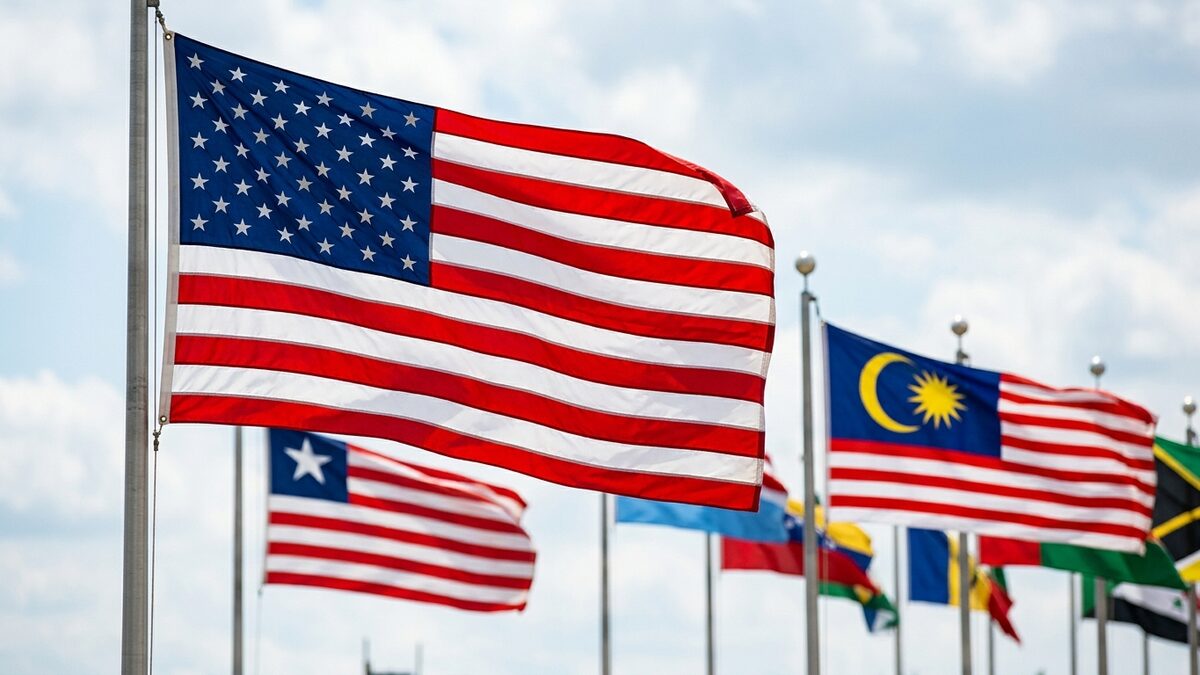
The American flag’s distinctive arrangement of fifty white stars and thirteen stripes stands apart from other national flags featuring stars and stripes. By comparing the U.S. flag’s symbolism and design to those of countries like Malaysia and Liberia, which incorporate stars and stripes in markedly different ways, the discussion reveals how each flag conveys unique historical and cultural messages. This exploration invites a deeper understanding of national identity through the lens of flag design.
Key Takeaways
- The American flag’s stars and stripes symbolize federalism and foundational history.
- Other national flags with stars and stripes, like Malaysia and Liberia, use these elements to represent unity or independence.
- The U.S. flag has fifty stars in a blue canton and thirteen stripes, while others have different star and stripe arrangements.
- These design differences reflect distinct national narratives and regional identities.
The American flag’s arrangement of stars and stripes stands in stark contrast to other national flags that employ similar motifs, revealing distinct symbolic intentions and design principles. While nations like Malaysia and Liberia incorporate stars and stripes to evoke unity or historical references, their configurations—such as Malaysia’s alternating red and white stripes paired with a crescent and a single star or Liberia’s solitary star on a field of stripes—diverge sharply from the United States’ precise canton of fifty white stars set against a blue field and its thirteen horizontal stripes. This juxtaposition underscores the American flag’s dual emphasis on federalism and foundational history, distinguishing it from other flags where stars and stripes serve alternate narratives or regional identities.
1. Symbolic Representation of Stars and Stripes
The American flag features thirteen horizontal stripes symbolizing the original colonies, and fifty white stars representing each state, signifying a federal union. In contrast, flags like Liberia’s have a single star symbolizing independence, and Malaysia’s flag uses stripes for states with a crescent and single star reflecting Islamic heritage, presenting divergent symbolic frameworks.
This juxtaposition underscores the American flag’s dual emphasis on federalism and foundational history, distinguishing it from other flags where stars and stripes serve alternate narratives or regional identities.
2. Fixed Number of Stripes with Variable Stars
U.S. law mandates a consistent thirteen stripes to honor the founding colonies, while the star count adjusts to the number of states, currently fifty. Other flags with stars and stripes often alter stripe counts for regional significance or use a fixed star count unrelated to political subdivisions, illustrating differing approaches to standardization and symbolism.
3. Distinctive Canton and Stripe Layout
The American flag’s design uniquely confines stars to the upper hoist-side canton set against a blue field, with stripes extending full width, creating a clear division. Other flags, such as Malaysia’s, incorporate a crescent and a single star within the canton, or Liberia’s single star in a blue square, differing significantly in spatial arrangement and visual emphasis.
4. Legal Codification and Historical Continuity
The U.S. flag design is codified in federal law with a detailed official specification, reflecting a historical evolution from the 1777 resolution to the modern 50-star version. Many other nations’ flags featuring stars and stripes lack such detailed legal standardization or have undergone different historical changes tied to colonial or cultural transitions.
5. Color Usage and Proportional Differences
While red, white, and blue are common, the American flag’s proportions and color shades are specifically regulated, producing a balanced visual hierarchy between stars and stripes. Other flags, such as Chile or Puerto Rico, use these colors with different ratios, star sizes, and stripe widths, resulting in distinct visual identities despite superficial similarities.