
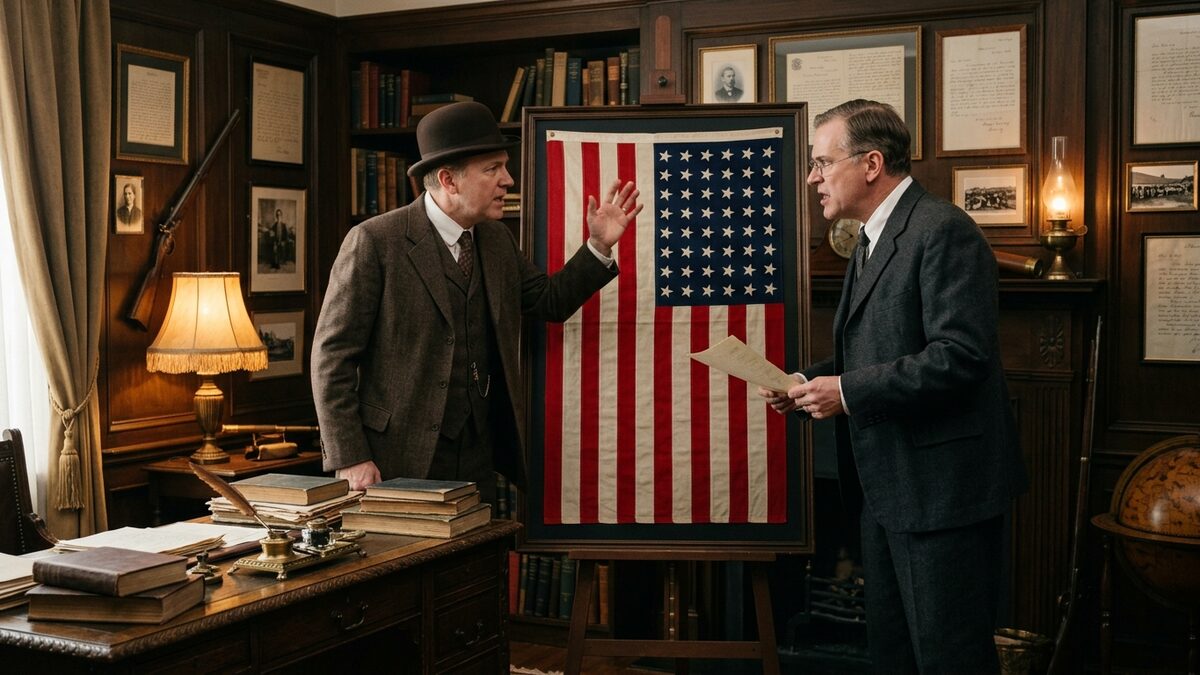
The ongoing debate surrounding the proper orientation of the United States flag reveals far more than questions of protocol; it uncovers layers of national identity and historical symbolism that have evolved since its inception in 1776. Examining how the flag’s display has shifted during times of conflict and social change offers a compelling lens through which to understand America’s enduring struggles with unity and meaning.
Key Takeaways
- The orientation of the US flag has been debated since the nation's founding.
- The flag's design symbolizes unity and national ideals.
- Flag Code mandates the union be uppermost and to the flag’s right when displayed.
- Disputes over flag display reflect broader issues of identity and symbolism.
The orientation of the United States flag has long been enshrined in tradition, yet its interpretation has sparked debate since the early days of the republic. When Betsy Ross is said to have sewn the first Stars and Stripes in 1776, the arrangement of stars and stripes symbolized a new nation’s unity and ideals. However, as the flag evolved through subsequent wars and social changes, questions about the proper display—such as the positioning of the canton during distress or in battle—emerged. These disputes reflect deeper tensions over national identity, protocol, and symbolism, illustrating how a seemingly straightforward emblem can become a contested historical artifact.
Core Flag-Orientation Rules and Protocol
The United States Flag Code provides explicit guidance on the proper orientation of the flag to ensure consistent respect and symbolism. When displayed flat or hung vertically against a wall, the union—the blue field with stars—must be positioned uppermost and to the flag’s own right, which corresponds to the observer’s left. This rule applies whether the flag is indoors or outdoors, including when displayed in a window, where the blue field should appear to the left from the street viewer’s perspective. Additionally, when the flag is suspended vertically over the middle of a street, the Flag Code mandates its orientation based on cardinal directions: the union should face north on an east-west street and east on a north-south street. These standards, reaffirmed by organizations such as the National Flag Foundation and public sources like PBS, underscore the importance of a uniform and respectful presentation of the flag’s elements.
These disputes reflect deeper tensions over national identity, protocol, and symbolism, illustrating how a seemingly straightforward emblem can become a contested historical artifact.
Historical Standardization of the Flag Design
The design and orientation of the U.S. flag have been formalized progressively through legislative and executive actions, reflecting the nation’s growth and evolving identity. The Flag Act of 1818 was pivotal in establishing the foundational logic of the flag by restoring the thirteen stripes to represent the original colonies and adding a star for each new state admitted to the Union. More than a century later, President William Howard Taft’s 1912 executive order was the first to specify an official arrangement of stars within the canton, mandating six horizontal rows of eight stars each. This standardization addressed inconsistencies that had existed since the flag’s inception. Subsequent executive orders by President Dwight D. Eisenhower in 1959 further refined the flag’s design to accommodate the 49-star and later the current 50-star configuration, maintaining the tradition of precise symbolism and orientation as the nation expanded.
Understanding Why the Flag Sometimes Appears “Backwards”
One of the most frequent sources of confusion in the historical debate over US flag orientation arises from the flag’s depiction on military uniforms and equipment. On the right sleeve of a U.S. military uniform, the flag patch is designed so the canton faces forward, or the flag’s own right, which creates the visual impression of a reversed flag to observers. This practice is rooted in the principle that the flag should appear as if it is streaming backward in motion, with the stars leading rather than trailing. The Smithsonian’s Air and Space Museum explains that this forward-facing star field emphasizes the flag’s symbolism of advancing and moving ahead. While this mirrored appearance can seem contradictory to conventional display rules, it adheres to a distinct tradition within military contexts that prioritizes dynamism and forward momentum in iconography.