
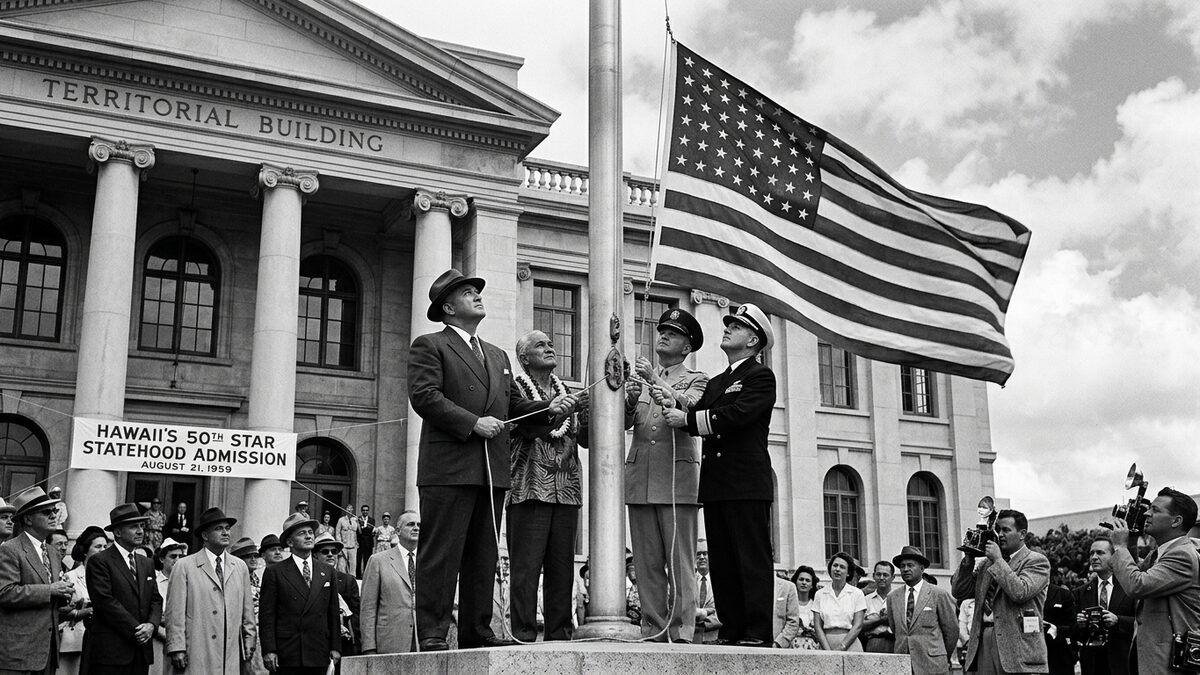
The inclusion of the 50th star on the U.S. flag represents more than a simple addition; it embodies decades of political negotiation, cultural tension, and strategic calculation. Hawaii’s journey from annexation to statehood highlights the intricate balance between American expansionism and evolving national identity. Exploring this pivotal moment reveals how geography and politics intertwined to reshape the nation’s symbolic landscape in profound ways.
Key Takeaways
- The 50th star was added to the U.S. flag in 1960 after Hawaii became a state in 1959.
- Hawaii was an independent kingdom before its monarchy was overthrown in 1893.
- The overthrow of Queen Liliʻuokalani was influenced by American business and military interests.
- Hawaii’s statehood symbolized the extension of U.S. territory and complex political dynamics.
The addition of the 50th star to the United States flag in 1960 marked the culmination of a century-long process of territorial expansion and statehood that began with the admission of the original thirteen colonies. Following the annexation of Hawaii in 1898, debates over its political status persisted through World War II and the postwar era, reflecting broader themes of strategic importance, cultural integration, and national identity. The official incorporation of Hawaii as the 50th state on August 21, 1959, symbolized not only a geographic extension of the Union but also a significant moment in American history, encapsulating the complex interplay of imperial ambition and domestic politics.
Hawaii’s Political Status Before the 50th Star
Prior to its incorporation into the United States, Hawaii was an independent kingdom with its own monarchy and government. This autonomy ended abruptly in 1893 when Queen Liliʻuokalani was overthrown in a coup supported by U.S. Marines, a pivotal event that paved the way for American annexation. The overthrow reflected the growing influence of American business interests and strategic considerations in the Pacific. In 1898, during the Spanish-American War, the U.S. Congress formally annexed Hawaii through a joint resolution, motivated in part by the islands’ strategic position as a naval base.
The official incorporation of Hawaii as the 50th state on August 21, 1959, symbolized not only a geographic extension of the Union but also a significant moment in American history, encapsulating the complex interplay of imperial ambition and domestic politics.
Following annexation, Hawaii was designated a U.S. territory in 1900. As a territory, Hawaii had limited political representation and autonomy under federal oversight. For decades, the islands’ status remained ambiguous, and debates over the possibility of full statehood were recurrent. The territorial period was marked by ongoing discussions about the cultural and political integration of Hawaii’s diverse population and the islands’ role within the broader American polity.
The Push for Statehood in the Mid-20th Century
The momentum for Hawaii’s statehood gained significant traction in the aftermath of World War II. Advocates argued that Hawaii, having contributed substantially to the U.S. war effort, deserved full representation in Congress and equal political rights. This movement was bolstered by labor unions, veterans’ groups, and political organizers, particularly in the wake of the 1954 Democratic Revolution in Hawaii, which shifted political power toward local leaders favoring statehood and reform.
Despite strong local support, opposition persisted on the mainland United States. Critics cited Hawaii’s geographic isolation, cultural distinctiveness, and concerns over the impact on the national political balance. However, proponents emphasized the loyalty and sacrifices of many Hawaiians who served in the U.S. military, framing statehood as both a civil rights and political equality issue. This push for statehood also aligned with broader mid-century American themes of expanding civil liberties and labor protections.
The Formal Admission of Hawaii as the 50th State
The Hawaii Admission Act, passed by Congress in March 1959, set the stage for Hawaii’s transition from territory to state. A referendum held on June 27, 1959, demonstrated overwhelming public support for statehood, with nearly 93% of voters approving the measure—a 17-to-1 margin in favor. This decisive mandate reflected the local population’s desire for full political integration and representation.
On August 21, 1959, President Dwight D. Eisenhower signed the official proclamation admitting Hawaii as the 50th state of the United States. This event not only expanded the geographic boundaries of the nation but also introduced a new star to the American flag. The addition of the 50th star symbolized the culmination of decades of political struggle and reflected the evolving identity of the United States as a diverse and far-reaching republic.