
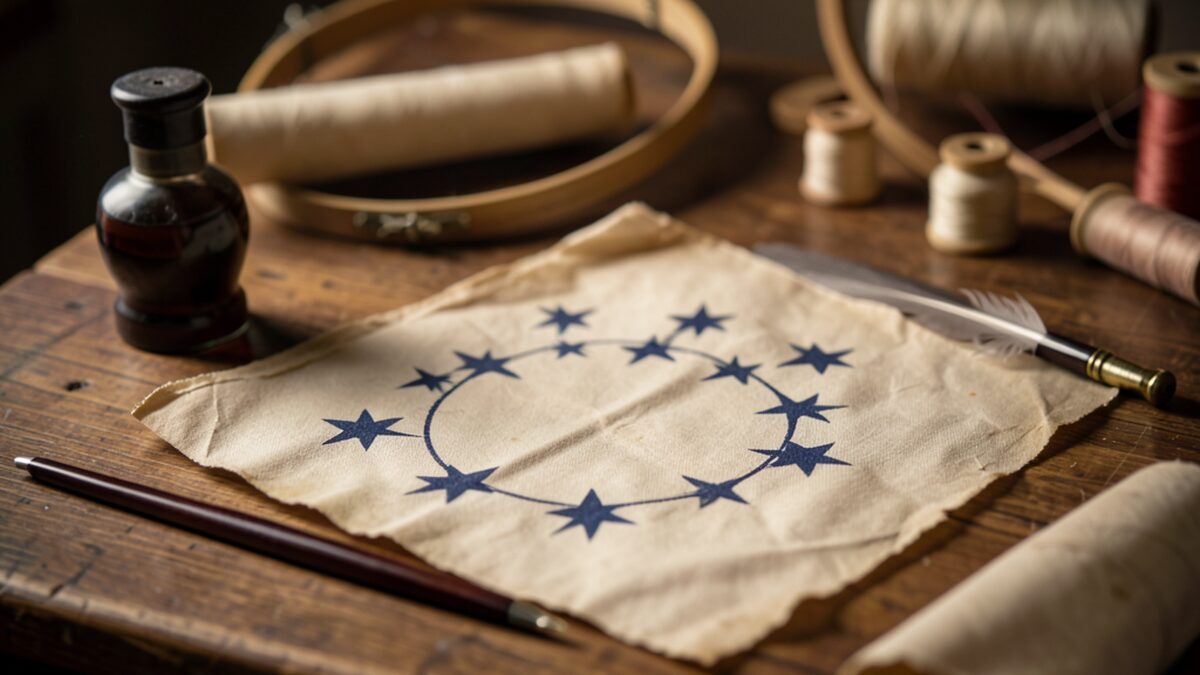
The Betsy Ross flag stands as an enduring emblem of American identity, intertwining historical fact with enduring legend. While commonly attributed to a single seamstress, the origins of this iconic banner remain clouded by myth and contested evidence. Exploring the complex interplay between symbolism, storytelling, and national memory reveals how this flag came to represent more than just a piece of fabric, but a powerful narrative of unity and revolution.
Key Takeaways
- The Betsy Ross flag features thirteen stars in a circle and thirteen stripes representing the original colonies.
- Betsy Ross is traditionally credited with sewing the first American flag, but this claim is historically debated.
- The flag's design symbolizes unity and equality among the thirteen original states.
- The story of Betsy Ross blends fact and folklore, shaping American national mythology.
In 1776, as the thirteen American colonies declared independence from Britain, a new symbol of unity and identity began to take shape: the stars and stripes of the emerging national flag. Among the many stories surrounding its creation, the figure of Betsy Ross—credited with sewing the first flag featuring thirteen stars arranged in a circle—has become an enduring emblem of Revolutionary America. However, the historical accuracy of this narrative has been the subject of extensive scrutiny, revealing a complex interplay between fact, folklore, and the construction of national mythology.
The Betsy Ross Flag: Design and Symbolism
The Betsy Ross flag is characterized by thirteen alternating red and white stripes and a blue canton containing thirteen white stars arranged in a perfect circle. This configuration visually distinguishes it from later American flags, which often display stars in rows or other patterns. The thirteen stars and stripes represent the original thirteen colonies that declared independence from Britain, symbolizing unity and equality among the states. Although this design is widely recognized today as a patriotic emblem of the American Revolution, the term “Betsy Ross flag” itself did not emerge contemporaneously but rather developed later as part of a popular legend that linked the flag’s creation to Elizabeth “Betsy” Ross, a Philadelphia seamstress.
The historical accuracy of this narrative has been the subject of extensive scrutiny, revealing a complex interplay between fact, folklore, and the construction of national mythology.
The Core Legend of Betsy Ross
The narrative crediting Betsy Ross with sewing the first American flag centers on a meeting in 1776 involving George Washington, Robert Morris, and George Ross, her late husband’s uncle. According to family oral history, Washington presented Ross with a rough sketch of a flag featuring thirteen six-pointed stars. Ross purportedly suggested altering the design by using five-pointed stars, which were easier to produce by cutting a single piece of fabric. This story, passed down through the Ross family before gaining widespread circulation in the late 19th century, depicts Ross as an instrumental figure in shaping a symbol of American identity. Despite its popularity, the legend lacks direct contemporary documentation and rests primarily on anecdotal accounts.
Historical Context and Institutional Perspectives
Historically verifiable records provide a different perspective on the flag’s origins. The Continental Congress enacted the Flag Act on June 14, 1777, specifying that the flag should contain thirteen alternating red and white stripes and thirteen stars on a blue field but made no mention of the stars’ arrangement. The circular pattern associated with the Betsy Ross flag is thus a later artistic interpretation rather than an official design. Furthermore, the 1795 flag design added two stars and two stripes to represent new states, Vermont and Kentucky, illustrating the flag’s evolution beyond the original thirteen-star motif. Institutional sources such as the National Postal Museum acknowledge that the Betsy Ross story is “shrouded in as much legend as fact,” noting the absence of corroborating documentation in diaries, letters, or Congressional records. Similarly, Colonial Williamsburg states that historians almost uniformly regard the narrative as a myth, emphasizing the lack of evidence for the flag’s alleged creation in 1776. This critical stance underscores the distinction between the flag’s symbolic resonance and the historical veracity of the Betsy Ross legend.