
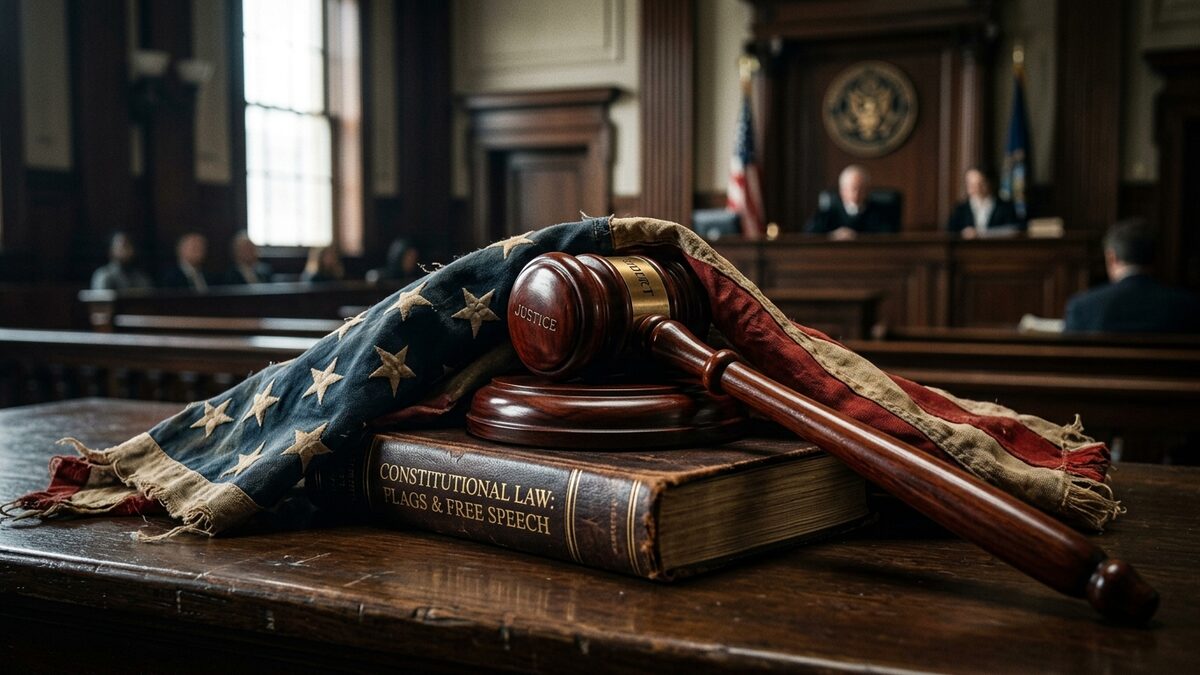
The complex intersection of free speech and national symbolism emerges prominently in the legal discourse on American flag desecration. This article scrutinizes the delicate balance U.S. law strikes between protecting expressive conduct under the First Amendment and enforcing statutes like 18 U.S.C. § 700 that criminalize flag mutilation. By tracing shifting judicial interpretations, it reveals ongoing tensions in defining the limits of constitutional protections amid deeply held patriotic sentiments.
Key Takeaways
- The federal statute 18 U.S.C. § 700 prohibits flag desecration but allows respectful disposal of worn flags.
- Flag desecration laws face challenges due to First Amendment protections of free speech.
- Courts have struggled to balance national symbolism with individual expressive conduct.
- Legal interpretations of flag desecration continue to evolve with changing societal values.
What legal boundaries govern the act of desecrating the American flag, and how do these boundaries reconcile the tension between expressive conduct and national symbolism? This question lies at the heart of a contentious intersection between constitutional protections and societal values. The legal implications of flag desecration under United States law compel a careful examination of First Amendment jurisprudence, statutory prohibitions, and the evolving interpretations that shape the limits of permissible expression.
Federal Statutory Framework Governing Flag Desecration
At the federal level, 18 U.S.C. § 700 establishes a baseline prohibition against the mutilation, defacement, physical defilement, burning, or trampling of the American flag. This statute criminalizes such acts with penalties including imprisonment for up to one year, fines, or both. Importantly, the statute carves out an explicit exception for the disposal of worn or soiled flags, allowing for respectful handling and disposal without criminal liability. The law defines the “flag of the United States” broadly, encompassing any part of the flag made of any material and of any size, provided it is commonly displayed. Additionally, Congress clarified that this federal statute does not preempt state or territorial authority to prosecute flag-related offenses independently.
The legal implications of flag desecration under United States law compel a careful examination of First Amendment jurisprudence, statutory prohibitions, and the evolving interpretations that shape the limits of permissible expression.
This statutory framework reflects Congress’s intent to protect the flag from desecration while simultaneously recognizing the limitations imposed by constitutional protections. Despite the clear language of 18 U.S.C. § 700, its enforceability is constrained by judicial interpretations that prioritize constitutional rights over statutory prohibitions. Thus, while the statute remains in force, its practical application is circumscribed by Supreme Court rulings that have redefined the legal landscape surrounding flag desecration.
Supreme Court Jurisprudence on Flag Burning as Symbolic Speech
The pivotal moment in the legal implications of flag desecration in US law arose with the Supreme Court’s decision in Texas v. Johnson (1989). The Court, in a narrow 5–4 ruling, held that flag burning constitutes expressive conduct protected by the First Amendment’s guarantee of free speech. This landmark decision recognized that the flag, as a symbol, can be used to convey political messages, even if those messages are offensive or controversial. The Court emphasized that the government may not prohibit expression simply because it is disagreeable or disrespectful to national symbols.
Following Texas v. Johnson, the Court reaffirmed this principle in United States v. Eichman (1990), invalidating a federal statute that criminalized flag burning. The rulings collectively underscore that laws targeting flag desecration are subject to strict scrutiny due to their impact on symbolic speech. The Congressional Research Service and educational materials from the U.S. Courts consistently reflect this interpretation, confirming that flag burning, as a form of symbolic speech, enjoys constitutional protection notwithstanding the federal statute’s prohibitions. These decisions highlight the judiciary’s role in balancing respect for national symbols with the fundamental right to free expression.
Constitutional Limits on Prosecution for Flag Desecration
The constitutional limitations on prosecuting flag desecration stem primarily from the recognition that such acts frequently constitute expressive conduct rather than mere physical conduct. This distinction is critical because the First Amendment’s protections extend beyond verbal communication to include actions intended to convey political or ideological messages. When flag burning is performed as a form of protest or political expression, it engages constitutional protections that restrict government interference.
Consequently, even though federal and state statutes may criminalize desecration, their enforcement is often precluded by constitutional safeguards. The Supreme Court’s jurisprudence makes clear that the government cannot impose penalties on flag desecration solely because it is offensive or provocative. This principle ensures that the legal implications of flag desecration in US law are shaped not only by statutory language but also by the imperative to uphold free speech, preserving the delicate balance between national reverence and individual rights.