
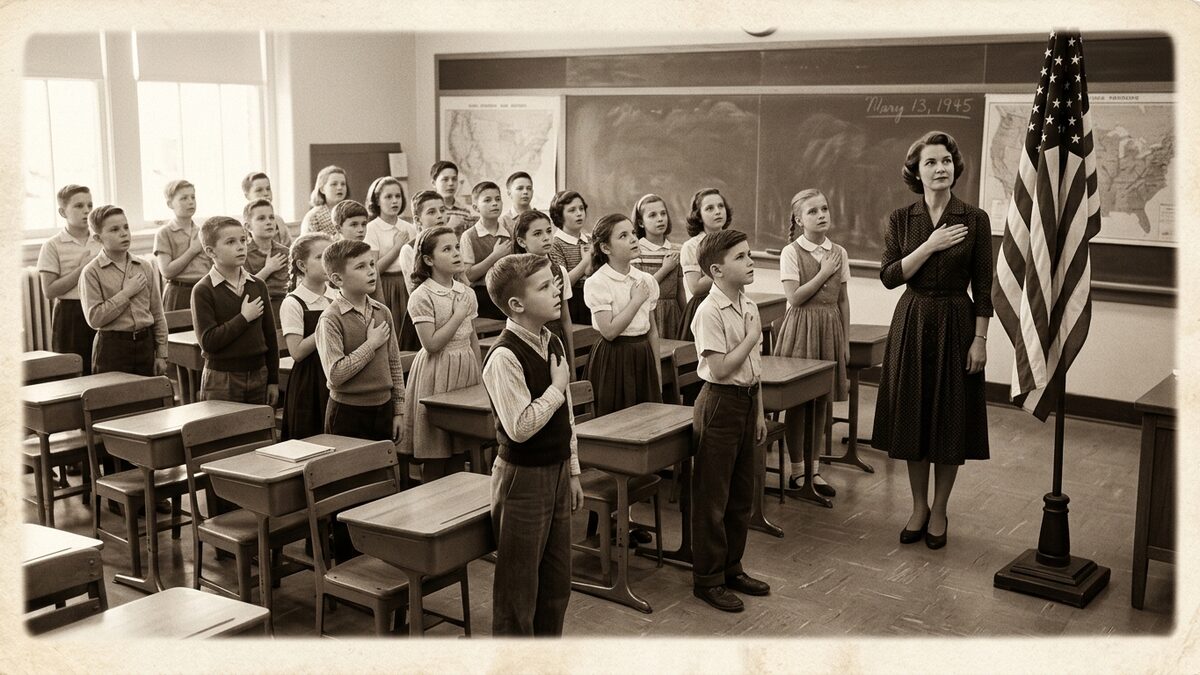
The addition of the Pledge of Allegiance to US flag ceremonies in 1892 reveals how a nation sought to forge unity amid profound social transformation. Crafted by Francis Bellamy during a pivotal anniversary, the pledge emerged as more than a simple recitation—it became a symbolic response to industrialization, immigration, and evolving national identity. Exploring its origins offers insight into the complex interplay between patriotism and social change in American history.
Key Takeaways
- The Pledge of Allegiance was written in 1892 by Francis Bellamy to promote national unity among schoolchildren.
- It was introduced during the 400th anniversary of Columbus’s arrival to inspire patriotism.
- The pledge was part of a broader campaign to standardize flag ceremonies in public schools.
- Its adoption reflected efforts to strengthen American identity amid rapid industrialization and immigration.
In 1892, as the United States commemorated the 400th anniversary of Christopher Columbus’s arrival in the Americas, a young socialist minister named Francis Bellamy composed the Pledge of Allegiance to foster national unity among schoolchildren. This period, marked by rapid industrialization and waves of immigration, heightened concerns about American identity and patriotism. The Pledge was soon incorporated into flag ceremonies, evolving from a unifying exercise into a formalized expression of loyalty that reflected broader social and political efforts to consolidate national cohesion in an era of profound change.
Origin in 1892
The Pledge of Allegiance was created in 1892 by Francis Bellamy as part of a national campaign to promote flag ceremonies in public schools. This initiative coincided with the 400th anniversary of Columbus’s voyage to the Americas, aiming to inspire patriotism and unity among a diverse and rapidly changing population. Bellamy’s pledge first appeared publicly in the September 1892 issue of The Youth’s Companion, a widely read Boston weekly magazine, which spearheaded the effort to standardize flag observances across American schools. The inaugural public recitation took place during the National Public School Celebration on October 21, 1892, marking the beginning of the pledge’s integration into educational rituals.
The Pledge was soon incorporated into flag ceremonies, evolving from a unifying exercise into a formalized expression of loyalty that reflected broader social and political efforts to consolidate national cohesion in an era of profound change.
The ceremony was designed not only to promote respect for the American flag but also to serve as a vehicle for patriotic education at a time when the country faced social unrest and cultural shifts. Bellamy’s pledge was a deliberate effort to cultivate a shared national identity among schoolchildren, many of whom were first- or second-generation immigrants, by linking loyalty to the flag with allegiance to the republic itself.
Why it was added to flag ceremonies
The addition of the Pledge of Allegiance to US flag ceremonies was motivated by a desire to create a unified, nationwide expression of patriotism within the public school system. The campaign led by The Youth’s Companion sought to establish consistent practices of flag respect and to embed these rituals into daily school life. Bellamy’s pledge functioned as the verbal component complementing the physical act of raising the flag, thereby standardizing the ceremony across states and districts.
This integration made flag salutes and the pledge a routine part of school activities, reinforcing civic values and national loyalty from an early age. Importantly, the early adoption of the pledge was primarily an educational and civic initiative rather than a military or congressional mandate. Its role was to foster cohesion in a rapidly diversifying population, responding to broader social concerns about assimilation and patriotism during a period of significant demographic change.
Early wording and revisions
The original wording of the Pledge of Allegiance differed notably from the version familiar today. Bellamy’s initial text declared, “I pledge allegiance to my flag and to the Republic for which it stands,” reflecting a more general attachment to the flag as a symbol of the republic. However, as the United States saw continued immigration and the need for clearer national identification, changes were made to the language.
In 1923, the phrase “my flag” was replaced with “the flag of the United States” to clarify the pledge’s referent for foreign-born citizens. The following year, “of America” was added after “United States” to further specify the national flag. These modifications were guided by the National Flag Conferences of 1923 and 1924, which played a pivotal role in standardizing the pledge’s wording. Despite these adjustments, the pledge’s text continued to evolve over subsequent decades before receiving formal federal recognition.