
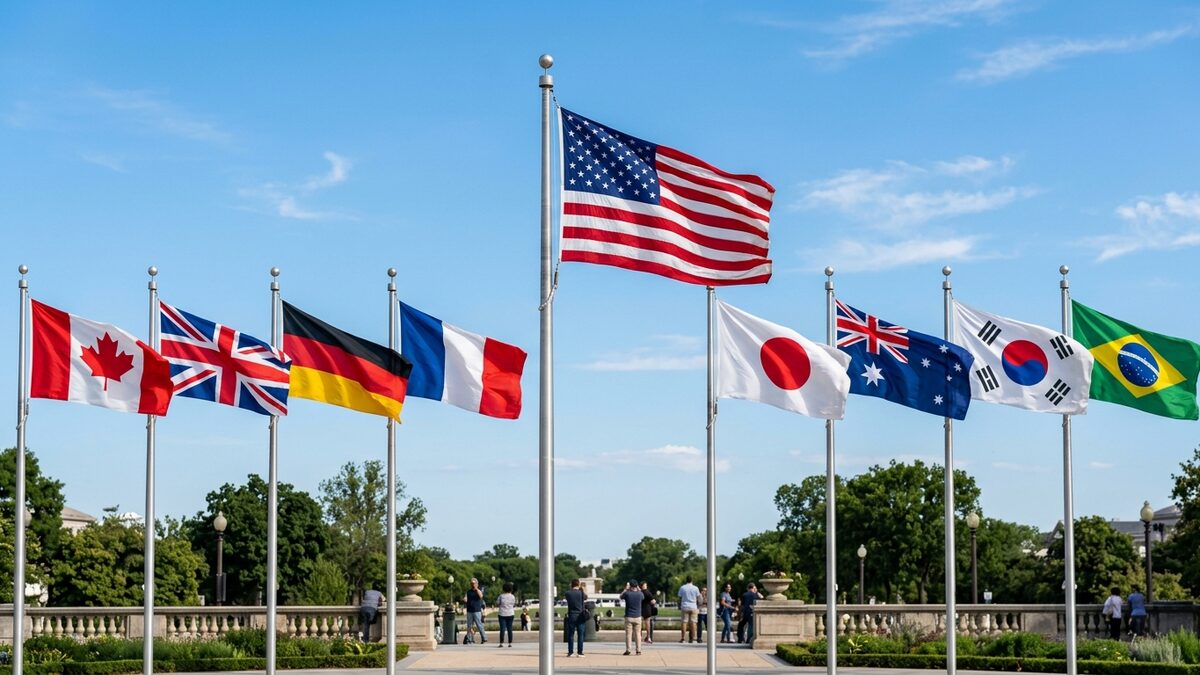
The established protocols for displaying the American flag alongside international flags reflect a careful balance between honoring national heritage and fostering global respect. These guidelines, shaped by history and legal mandates, address the nuances of flag etiquette in diverse settings. Understanding the principles behind these rules reveals the deeper significance of flag display practices and their role in diplomatic and public spaces.
Key Takeaways
- The American flag must never be displayed in a position of superiority over other national flags except at the UN headquarters.
- All international flags displayed with the American flag must be flown on separate staffs of equal height.
- The U.S. Flag Code ensures the American flag is presented with dignity alongside foreign flags.
- These protocols promote respect and harmonious representation among nations.
Since the Continental Congress adopted the first official American flag in 1777, the flag has symbolized the nation’s identity and values. As the United States increasingly engaged with the international community, the need for clear guidelines on displaying the American flag alongside foreign flags became paramount. This protocol, rooted in respect and tradition, ensures that the American flag is presented with dignity while fostering harmonious representation among nations.
Core Legal Rules for Mixed National Displays
U.S. law establishes definitive standards for the display of the American flag alongside international flags within the United States and its territories. Notably, no foreign or international flag, including that of the United Nations, may be displayed in a position of superior prominence, honor, or above the U.S. flag. An explicit exception exists solely for the United Nations headquarters in New York, where the UN flag is accorded superior prominence as a longstanding practice. Furthermore, the U.S. Flag Code mandates that when multiple national flags are displayed, they must be flown from separate staffs of equal height and be of approximately equal size. International conventions also prohibit the placement of one nation’s flag above another during peacetime, reinforcing the principle of equality among sovereign states.
No foreign or international flag, including that of the United Nations, may be displayed in a position of superior prominence, honor, or above the U.S. flag.
Official U.S. Government Protocol on Equal Treatment
The U.S. Department of State’s Foreign Affairs Manual provides detailed guidance on the Protocol for Displaying the American Flag with International Flags, emphasizing strict equality among sovereign nations’ flags. When flown together, no flag should be displayed at a higher level than any other. The flags should be uniform in size wherever feasible. On U.S. government premises, the American flag is accorded the position of honor by being placed first in the lineup of national flags. The remaining flags are arranged alphabetically, with a second American flag included within the sequence to maintain prominence and respect for the United States as host nation.
Positioning in a Line or Display
Proper placement of the American flag in physical displays is a critical aspect of the protocol. The U.S. flag should occupy the right side from its own perspective—that is, the observer’s left—when displayed in a line with other flags. In displays involving crossed staffs, the American flag’s staff is positioned in front and to the right of the other flag’s staff. Protocol guidance from Washington, D.C. further specifies that the U.S. flag stands to the right of a speaker or a lineup of flags, and in receiving lines, it is placed behind and to the right of individuals. Importantly, foreign flags should never displace the American flag from this position of honor, ensuring consistent respect for the national symbol in all international contexts.