
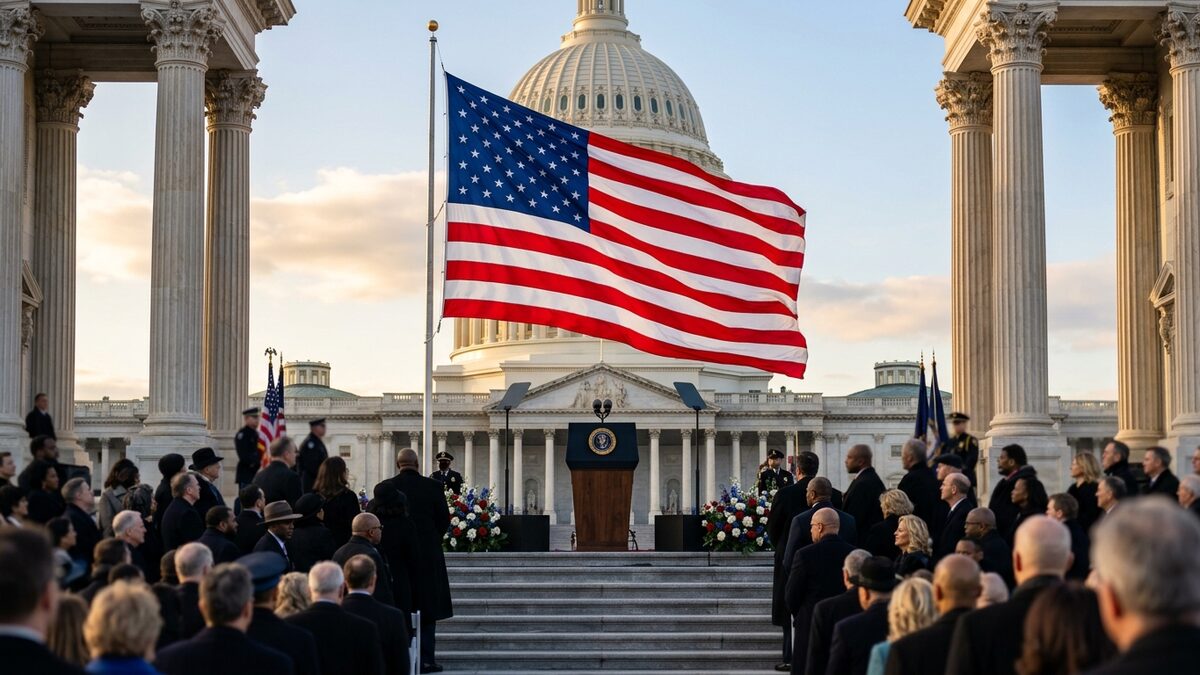
The American flag’s presence at presidential inaugurations transcends mere decoration, embodying themes of unity, democracy, and constitutional authority. From George Washington’s inaugural oath to modern ceremonies, the flag serves as a powerful symbol of national identity and the peaceful transfer of power. Examining this evolving role offers insight into how notions of patriotism and political legitimacy have shifted over time, inviting further reflection on the flag’s enduring significance in American political culture.
Key Takeaways
- The American flag has symbolized national unity and democratic continuity since the first inauguration in 1789.
- It is prominently displayed on the West Front of the U.S. Capitol during presidential ceremonies.
- The flag arrangement includes a central 50-star flag representing the current United States.
- Its presence highlights the solemnity and legitimacy of the inauguration as a constitutional rite.
Since George Washington’s first inauguration in 1789, the American flag has served as a potent emblem of national unity and democratic continuity during presidential ceremonies. Positioned prominently throughout these events, the flag symbolizes not only the transfer of executive power but also the enduring principles upon which the republic was founded. Its presence evokes the collective identity of the nation, underscoring the solemnity and legitimacy of the inauguration as a constitutional rite. This article examines how the American flag functions within this ceremonial framework, reflecting evolving notions of patriotism and political authority across different historical epochs.
Flag Display on the Inaugural Platform
The American flag occupies a central visual and symbolic role on the West Front of the U.S. Capitol, where presidential inaugurations are traditionally held. The Senate Inaugural Committee arranges five large American flags as a defining feature of the ceremonial setting. The centerpiece of this display is the current 50-star flag, representing the present-day United States. Flanking this central flag are two flags representing the national banner in use when the incoming president’s home state joined the Union. The outermost flags are the 13-star “Betsy Ross” style flags, harkening back to the early republic and the nation’s founding period.
Since George Washington’s first inauguration in 1789, the American flag has served as a potent emblem of national unity and democratic continuity during presidential ceremonies.
This specific arrangement of flags serves as a visual narrative linking the contemporary moment of inauguration to the historical foundations of the nation. By integrating flags from different eras, the platform’s design emphasizes the continuity of the American political experiment and the evolving nature of the Union. The flag display thus frames the presidential oath within a broader historical context, reinforcing the ceremony’s constitutional significance.
Symbolic Meaning of the Flag Arrangement
The deliberate positioning of the American flags at presidential inaugurations carries profound symbolic weight. The central 50-star flag embodies the current composition and unity of the nation, reaffirming the legitimacy of the incoming administration within the contemporary constitutional framework. Surrounding this are flags that evoke the historical circumstances under which the president’s home state entered the Union, connecting personal political origins to the collective national story.
By juxtaposing the present-day flag with historical variants, the inauguration visually reinforces themes of national continuity, the enduring authority of the Constitution, and the concept of the Union as an evolving yet stable entity. The consistent use of red, white, and blue throughout the ceremony’s imagery underscores these values, turning the flag arrangement into a symbolic bridge between past and present. This configuration highlights the inauguration not merely as a political event but as a ritual affirming the republic’s foundational ideals.
Flag Protocol and Public Behavior During Inaugurations
Flag etiquette during presidential inauguration ceremonies reflects the respect and solemnity accorded to the American flag as a national symbol. Federal flag code guidelines prescribe that during the hoisting or lowering of the flag, those present should face the flag and stand at attention. Members of the Armed Forces in uniform are required to render the military salute, while civilians customarily place their right hand over the heart. These protocols underscore the flag’s role as a focus of patriotic reverence during the transfer of presidential power.
Additionally, the flag must be raised and lowered by hand, executed slowly and with dignity to maintain ceremonial gravity. Importantly, the flag is not to be used to cover speaker’s tables or draped over objects, preserving its status as a respected emblem rather than a decorative element. These regulations ensure that the American flag’s presence at inaugurations maintains its symbolic integrity, reinforcing the ceremony’s authority and the solemnity of the constitutional transition.