
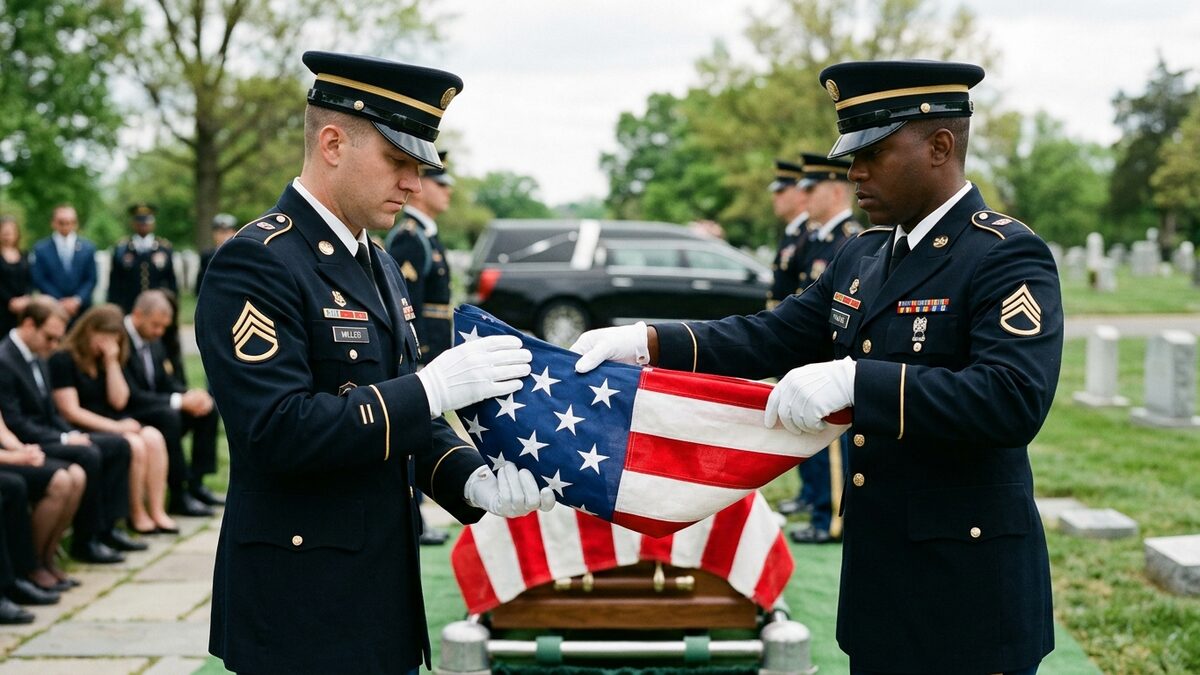
The folding of the American flag during military funerals is a time-honored tradition steeped in history and symbolism. Rooted in the Revolutionary War, this ritual has evolved into a highly structured practice that conveys profound respect for fallen service members. Examining the specific rules and protocols that govern this ceremony offers valuable insight into the values of honor, sacrifice, and patriotism that it solemnly represents.
Key Takeaways
- The folding of the American flag during military funerals symbolizes respect and solemnity for fallen soldiers.
- This ritual follows a precise, protocol-driven sequence reflecting honor, sacrifice, and patriotism.
- The ceremony takes place after "Taps" and ends with presenting the folded flag to the next of kin.
- The folded flag serves as a dignified memorial embodying the nation’s gratitude for the service member's sacrifice.
The tradition of folding the American flag during military funerals traces its origins to the earliest ceremonies honoring fallen soldiers in the Revolutionary War, symbolizing respect and solemnity for those who have served the nation. Over centuries, this ritual has evolved into a precise sequence, meticulously governed by protocols that reflect the values of honor, sacrifice, and patriotism. Understanding the rules that dictate the folding of the flag offers insight into the enduring reverence accorded to military service and the profound symbolism embedded in this time-honored practice.
Official Purpose and Setting
The folding of the American flag during military funerals is an integral component of the military funeral honors rendered to the deceased service member. This solemn ritual follows the playing of “Taps” and culminates in the presentation of the folded flag to the next of kin or a designated recipient. The folded flag serves as a dignified memorial, embodying the nation’s gratitude and respect for the fallen soldier’s sacrifice. Military protocols clearly define this ceremony as a formal and standardized element of military funerals, rather than a discretionary family custom.
The folded flag serves as a dignified memorial, embodying the nation’s gratitude and respect for the fallen soldier's sacrifice.
Official military guidance identifies the final folded shape of the flag as a representation of the tricorn hat famously worn by American patriots during the Revolutionary War. This symbolism underscores the enduring connection between the nation’s founding values and the sacrifices made by its military members. The ceremonial folding and presentation of the flag reflect a tradition steeped in honor, reinforcing the patriotic significance of the act within the military funeral honors framework.
Core Folding Sequence
The Folding Rules of the American Flag in Military Funerals prescribe a precise sequence to ensure uniformity and respect. The procedure begins with straightening the flag and folding it lengthwise once. Subsequently, the flag is folded lengthwise a second time to ensure that the union—the blue field with stars—remains prominently visible on the outside. For larger flags, a third lengthwise fold may be necessary prior to commencing the triangular folds.
The triangular folding process begins by bringing the striped corner of the folded edge to the open edge, creating a triangular shape. This step is repeated in a series of folds until the entire flag assumes a cocked or three-cornered shape. Throughout this process, care is taken to maintain the visibility of the blue union and to ensure that the flag is folded neatly and respectfully according to the established protocol.
The 13-Fold Symbolism
The culmination of the folding process results in a flag with 13 triangular folds, a number rich in historical symbolism. These 13 folds are traditionally understood to represent the original thirteen colonies of the United States, linking the ceremony to the nation’s foundational heritage. Official military guidance confirms that the final folded flag should appear as a symbolic tricorn shape, with only the blue field and stars visible, and no red or white stripes showing.
While the U.S. Flag Code does not legally mandate this particular folding method or its symbolism, military funeral protocols emphasize the importance of this tradition as a ceremonial tribute rooted in American revolutionary symbolism. The 13-fold design thus serves not only as a respectful conclusion to the flag folding ritual but also as a poignant reminder of the nation’s origins and the enduring values for which the fallen have served.