
The American flag’s role in military ceremonies embodies more than tradition; it serves as a powerful emblem of unity, sacrifice, and national identity. Tracing its significance from the Revolutionary War to contemporary rituals reveals how this enduring symbol continues to shape the solemnity and honor of military service. Exploring its ceremonial use uncovers layers of meaning that resonate deeply within the armed forces and the nation alike.
Key Takeaways
- The American flag has symbolized unity and sacrifice since the Revolutionary War.
- Military ceremonies follow strict protocols to honor the flag’s primacy.
- The flag must occupy the position of honor on the marching right in processions.
- Its use in ceremonies connects modern service members to a historic legacy of patriotism.
From the earliest days of the American Revolution, when the Continental Army first rallied under a banner of stars and stripes, the American flag has served as a potent symbol of unity, sacrifice, and national identity within military ceremonies. Its presence in battlefields and formal rituals alike echoes a tradition that dates back to the 18th century, embodying the ideals for which soldiers have fought and fallen. This enduring emblem, carefully integrated into military customs, continues to reinforce the solemnity and honor of service, linking contemporary ceremonies to a historic legacy of patriotism and collective resolve.
Flag Positioning and Precedence in Processions
The use of the American flag in military ceremonies is governed by strict protocols that emphasize its primacy and symbolic importance. In processions involving multiple flags, the U.S. flag must always occupy the position of honor on the marching right (the observer’s left), as mandated by Department of Defense Directive 1005.8. This positioning underscores the flag’s status as the foremost emblem representing national unity and authority. When displayed on a single staff alongside other flags, the American flag is positioned above all others, including service flags and foreign national flags, reinforcing its supremacy.
This enduring emblem, carefully integrated into military customs, continues to reinforce the solemnity and honor of service, linking contemporary ceremonies to a historic legacy of patriotism and collective resolve.
In formations featuring multiple flags on separate staffs, the U.S. flag takes center stage and is elevated above all others unless other national flags are present, in which case it maintains a place of respect. The order of precedence among service flags in parades follows a fixed hierarchy—Army, Marine Corps, Navy, Air Force, and Coast Guard—regardless of the hosting branch. Additionally, the U.S. Flag Code prohibits carrying the flag flat or horizontally in procession; it must always be aloft and free to fall, preserving its dignity and symbolic stature during movement.
Conduct During Hoisting, Lowering, and Passing
The ceremonial handling of the American flag during hoisting, lowering, or passing events is marked by precise observances that reflect its sacred role. According to 4 USC 9, military personnel in uniform are required to render the military salute during these moments, a gesture that conveys respect and allegiance. Veterans may also salute even when out of uniform. Civilians, while not saluting, must face the flag, stand at attention, and place their right hand over the heart to demonstrate reverence.
Further, individuals not in uniform must remove any headdress with their right hand, holding it at the left shoulder with the hand over the heart, a gesture rooted in longstanding tradition and respect. The Federal Flag Code also prescribes that the flag is to be displayed only from sunrise to sunset on stationary flagstaffs unless illuminated properly during darkness, ensuring the flag’s visibility is maintained with appropriate dignity and honor during ceremonial use.
Flag Usage at Military Funerals
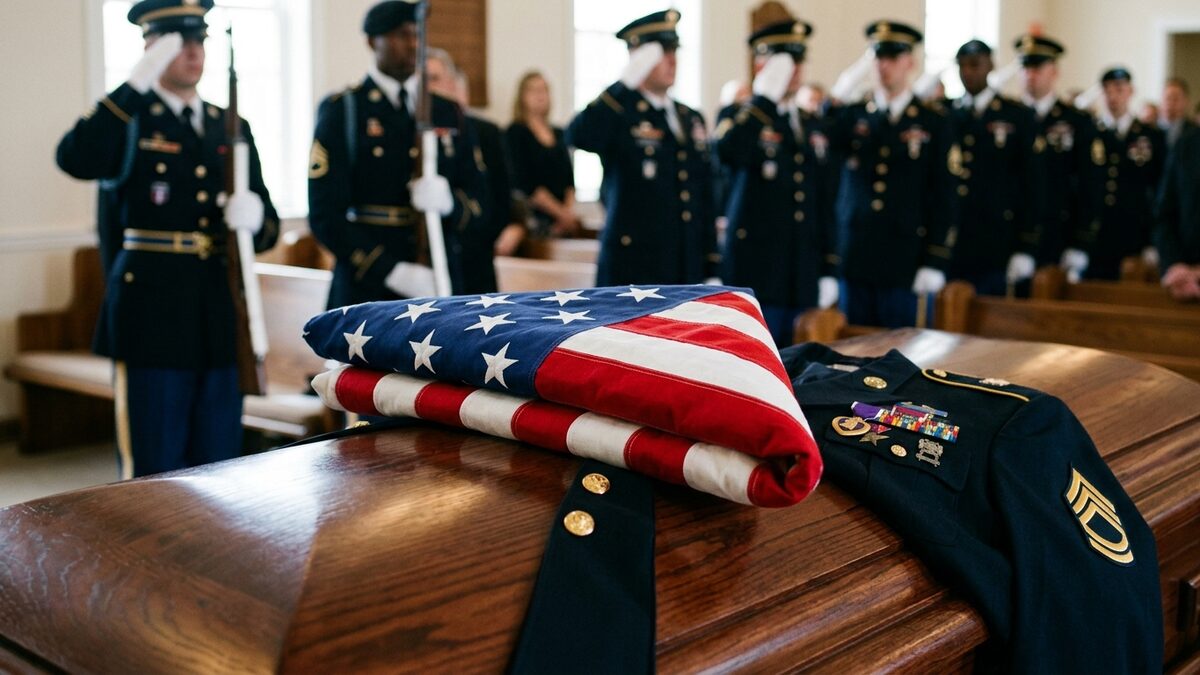
The use of the American flag in military funerals embodies the highest respect for those who have served. The flag is meticulously draped over the closed casket with the blue union field positioned at the head and over the deceased’s left shoulder, symbolizing honor and the protective embrace of the nation. Throughout the funeral proceedings, great care is taken to ensure the flag never touches the ground, reflecting the sanctity attributed to the emblem and the sacrifice of the individual.
Following the ceremony, the flag is ceremoniously folded into a triangular shape and presented to the next of kin, representing the nation’s gratitude and the continuation of remembrance. This ritual use of the American flag not only marks the solemnity of military funerals but also reinforces the enduring connection between the flag and the values of service, sacrifice, and national pride that define the armed forces.