
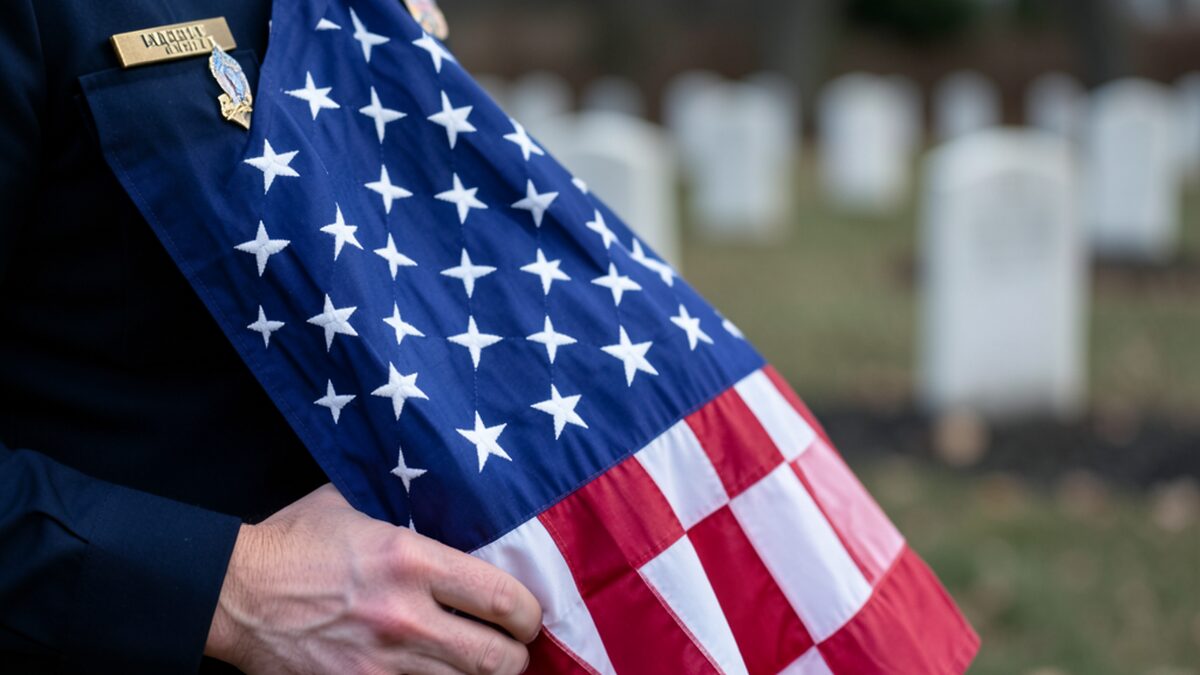
The tradition of draping the American flag over the coffins of fallen soldiers embodies a profound connection between individual sacrifice and national ideals. Originating during the War of 1812, this solemn ritual has evolved into a powerful symbol of patriotism and respect, honoring the valor and service of military personnel. Exploring its historical roots and significance reveals how this practice continues to shape collective memory and national identity.
Key Takeaways
- The tradition of draping the American flag over fallen soldiers' coffins began during the War of 1812.
- The flag at military funerals symbolizes national unity, sacrifice, and respect for service.
- Burial flags are provided to honor Veterans or Reservists discharged under conditions other than dishonorable.
- The flag serves as a lasting emblem of patriotism and remembrance at military honors and funerals.
The tradition of draping the American flag over the coffins of fallen soldiers traces its origins to the War of 1812, when the flag first became a potent symbol of national unity and sacrifice. Since that time, the flag’s presence at military funerals has evolved into a solemn ritual, embodying the nation’s recognition of service and valor. This practice not only honors the individual’s contribution to the defense of the republic but also serves as a tangible link to the enduring ideals that the flag represents. Through its use in military honors and funerals, the American flag continues to convey a profound narrative of patriotism, respect, and remembrance.
Eligibility for the Burial Flag
The entitlement to a burial flag is governed primarily by military service. According to the U.S. Department of Veterans Affairs (VA), a United States burial flag is provided to drape on a casket or to accompany an urn in honor of a Veteran or Reservist. This entitlement is not contingent upon rank or decorations but solely on the individual’s status as a member of the armed forces who has been discharged or separated under conditions other than dishonorable. Arlington National Cemetery emphasizes that burial flags are integral to military honors and may be obtained for eligible deceased service members.
This practice not only honors the individual’s contribution to the defense of the republic but also serves as a tangible link to the enduring ideals that the flag represents.
Typically, funeral homes facilitate the acquisition of the burial flag on behalf of the veteran’s family. However, families may also request the flag directly from the VA at the time of need, which is immediately following the death of the service member. This procedural detail reinforces the flag’s role as a symbol of immediate and enduring respect for military service, reflecting official recognition by the government and the nation.
Specifications of the Burial Flag
The American flag used in military funerals is distinct from common household flags in both size and purpose. Arlington National Cemetery specifies that the burial flag measures 5 feet by 9½ feet, a standard dimension used consistently in funeral honors. This size ensures visibility and solemnity appropriate to the ceremony. The VA describes these flags as United States flags specifically intended for burial honors, underscoring their ceremonial significance.
Regardless of the deceased’s branch of service, the flag employed is the national flag of the United States, symbolizing the collective service of the armed forces under a unified national banner. The flag may be used either to drape a casket or coffin or to accompany an urn, maintaining its symbolic presence in honoring the memory and sacrifice of the service member.
Display and Folding Traditions of the Burial Flag
The manner in which the American flag is displayed on the casket or urn is governed by established military customs and etiquette. The VA directs that the flag may be draped on a casket or placed alongside an urn. On a closed casket, the blue union—the field of stars—must be positioned at the head and over the deceased’s left shoulder, symbolically resting near the heart. For closed caskets, the stars are precisely placed over the heart area, reinforcing the connection between the flag and the individual’s service and sacrifice.
When a half-couch casket is used, the flag is arranged in layered folds with the blue field near the open side on the deceased’s left. In cremation or urn services, the flag is customarily folded into a triangular “tricorn” shape, the result of a ceremonial folding process involving thirteen precise folds. This folded flag is then displayed with the remains. The thirteen folds themselves carry symbolic meaning, referencing the original thirteen colonies and embodying themes of liberty and sacrifice, further enriching the flag’s narrative in military funerals.