
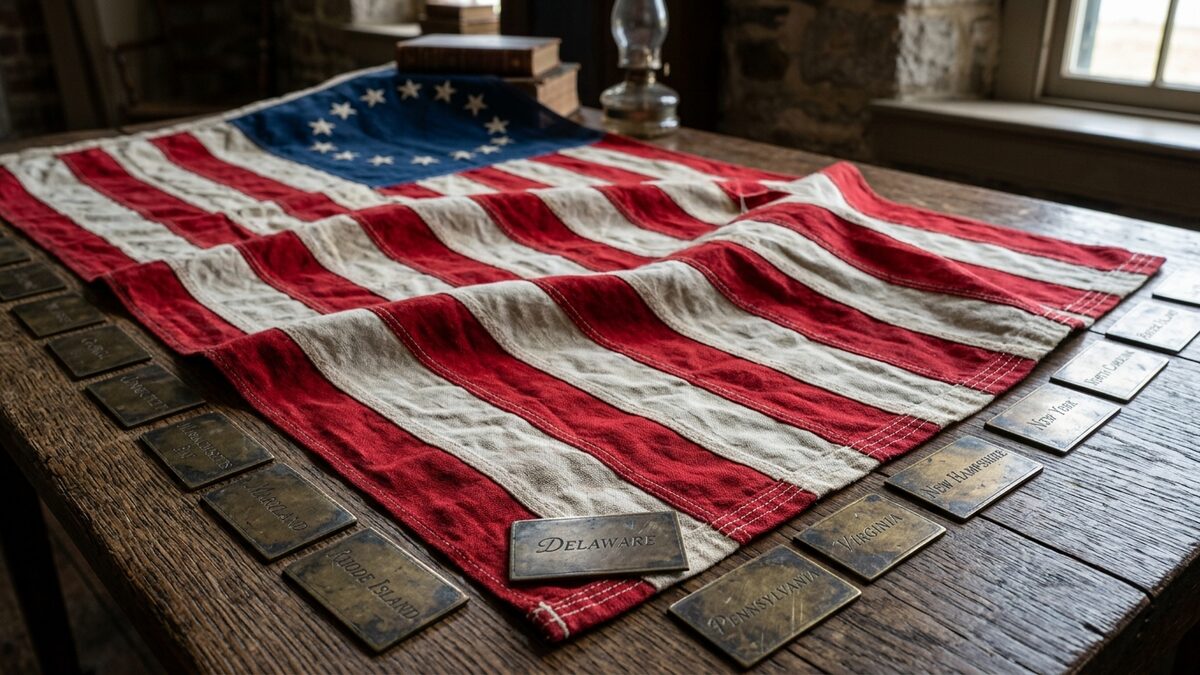
The 13 stripes on the United States flag stand as a powerful symbol of the original colonies’ unity and resilience during a pivotal moment in history. More than mere decoration, these stripes encapsulate the spirit of cooperation and defiance that fueled the nation’s founding. Exploring their significance reveals deeper insights into the political and cultural forces that shaped America’s identity and enduring legacy.
Key Takeaways
- The 13 stripes on the U.S. flag symbolize the original thirteen colonies.
- They were established during the Revolutionary War to represent colonial unity.
- The stripes alternate between seven red and six white bands.
- This design has remained unchanged since the flag's adoption in 1777.
The 13 stripes on the United States flag trace their origins to the early years of American independence, symbolizing the thirteen original colonies that united against British rule. Established during the Revolutionary War era, these stripes served as a visual representation of colonial solidarity and resistance, reflecting the collective identity forged through shared struggle. Rooted in the Continental Congress’s adoption of the first official flag in 1777, the stripes embody the foundational political and cultural union that ultimately shaped the nation’s birth.
The Official Meaning Behind the 13 Stripes
The 13 stripes on the United States flag are a deliberate and enduring symbol representing the original thirteen colonies that founded the nation. According to authoritative sources such as PBS and the U.S. Embassy in the United Kingdom, these stripes consist of thirteen equal horizontal bands of red and white. The red and white stripes alternate, with seven red stripes and six white stripes, a design that has remained consistent since the flag’s inception. This configuration serves as a constant reminder of the colonies’ unity and their collective role in American history.
The 13 stripes on the United States flag trace their origins to the early years of American independence, symbolizing the thirteen original colonies that united against British rule.
Complementing the stripes, the flag also features fifty white stars on a blue canton, each star representing one of the current states in the Union. However, the stripes specifically reference the nation’s origins, emphasizing the thirteen original political entities that declared independence and set the foundation for the United States. This symbolism is officially recognized and frequently cited in educational and governmental contexts, underscoring the importance of the stripes as a marker of the country’s foundational unity.
Historical Origins During the Founding Era
The 13 stripes have their roots in the American Revolutionary War period, a time when the thirteen original British colonies sought to assert their independence from Great Britain. In 1776, these colonies collectively declared their autonomy, a historic event that catalyzed the formation of a new nation. The stripes on the flag emerged as a visual representation of this union and shared purpose, symbolizing the colonies’ resistance to British rule and their commitment to self-governance.
The Continental Congress officially adopted the first American flag in 1777, embedding the thirteen stripes into the design to honor the colonies’ role in the nation’s birth. This design choice was more than symbolic; it was a political statement of unity and identity. Over time, the number of stripes has remained fixed at thirteen, despite the Union’s expansion, preserving the connection to the nation’s origins and the revolutionary ideals that shaped its creation.
The Thirteen Original Colonies Represented by the Stripes
The thirteen stripes symbolize the original colonies that formed the earliest political framework of the United States. These colonies were New Hampshire, Massachusetts, Rhode Island, Connecticut, New York, New Jersey, Pennsylvania, Delaware, Maryland, Virginia, North Carolina, South Carolina, and Georgia. Situated along the Atlantic seaboard of North America, these colonies were geographically and politically diverse, yet they united in their pursuit of independence and nationhood.
While the stripes collectively represent these thirteen entities, no official designation assigns a particular stripe to a specific colony. Instead, the stripes function as a unified emblem of the collective effort and shared identity of these colonies. This collective symbolism is consistently presented in educational materials and official descriptions, reinforcing the understanding that the 13 stripes represent the original colonies as a whole rather than individual entities.