
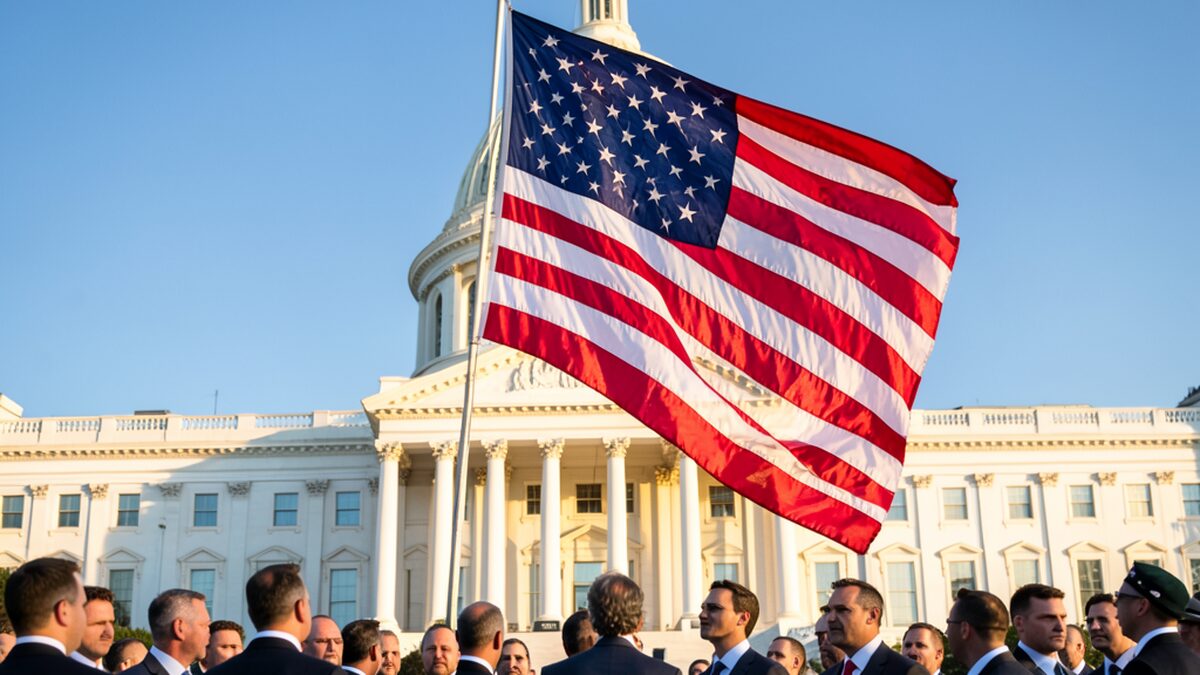
The American flag has served as a powerful emblem throughout presidential inaugurations, evolving alongside the nation’s political and cultural landscape. From its early association with fledgling republican ideals to its current role symbolizing continuity and democratic promise, the flag remains a poignant visual marker of unity and peaceful power transition. Exploring its significance offers insight into how national identity and values are ceremonially reaffirmed during these pivotal moments.
Key Takeaways
- The American flag has symbolized national identity and unity since the first presidential inauguration in 1789.
- Its presence during inaugurations reflects changes in political and cultural values over time.
- The flag is centrally displayed at key locations like the U.S. Capitol and the White House to highlight national unity.
- A White House proclamation requires the flag to be flown at full-staff on Inauguration Day.
Since George Washington first took the oath of office in 1789, the American flag has stood as a powerful emblem of national identity and unity during presidential inaugurations. Its presence, woven into the ceremony’s fabric, has evolved alongside the nation’s history, reflecting shifts in political climate, cultural values, and public sentiment. From early displays of patriotism amid fledgling republican ideals to its role in modern pageantry, the flag symbolizes not only the continuity of governance but also the enduring promise of democracy at each peaceful transfer of power.
The Official Role of the American Flag on Inauguration Day
The American Flag in presidential inaugurations serves as a central visual and ceremonial element, particularly at key locations such as the U.S. Capitol and the White House. The Capitol Architect, in conjunction with Congress’s inaugural planning committees, meticulously coordinates the arrangement and display of flags to emphasize national unity and the solemnity of the event. A formal proclamation issued by the White House mandates the flag to be flown at full-staff on Inauguration Day, extending this directive to public buildings, military posts, naval stations, federal vessels, and U.S. facilities overseas. This proclamation explicitly ties the full-staff display of the American flag to the inauguration and the ideals it represents, underscoring the flag’s role as a symbol of “everything good and noble” during the peaceful transfer of presidential power.
From early displays of patriotism amid fledgling republican ideals to its role in modern pageantry, the flag symbolizes not only the continuity of governance but also the enduring promise of democracy at each peaceful transfer of power.
The West Front Flag Backdrop Tradition
Since 1981, the U.S. Capitol’s West Front has been the designated site for presidential inaugurations, establishing a new tradition for the American Flag in presidential inaugurations. This location features a prominent flag arrangement that serves as a patriotic backdrop for the swearing-in ceremony, media coverage, and photographs. The centerpiece of this display is typically the current 50-star American flag, symbolizing the nation’s unity and contemporary composition. Surrounding this central flag are earlier versions of the flag, often arranged symmetrically to evoke the historical progression of the nation. This visual tableau reinforces continuity and the layered heritage of the United States, providing a solemn yet celebratory setting for the inauguration.
The Five-Flag Arrangement and Its Symbolic Significance
A common and widely documented flag configuration on the West Front involves five large American flags positioned above the inaugural platform. The central flag is the current 50-star version, representing the United States as it stands today. Flanking this centerpiece are two flags on one side that reference earlier official flags tied to the incoming president’s home state, thereby connecting the ceremony to the president’s political and personal origins. On the outermost edges of the display, two 13-star flags—popularly known as the Betsy Ross flags—are placed, symbolizing the nation’s founding and the original thirteen colonies. This arrangement not only honors the historical roots of the country but also acknowledges the continuity of American democracy through time. For example, discussions surrounding Donald Trump’s 2025 inauguration highlighted the inclusion of a flag variant connected to Florida, reflecting his state of residence and political base. Such traditions emphasize the layered meanings embedded in the American Flag in presidential inaugurations, blending regional identity with national symbolism.