
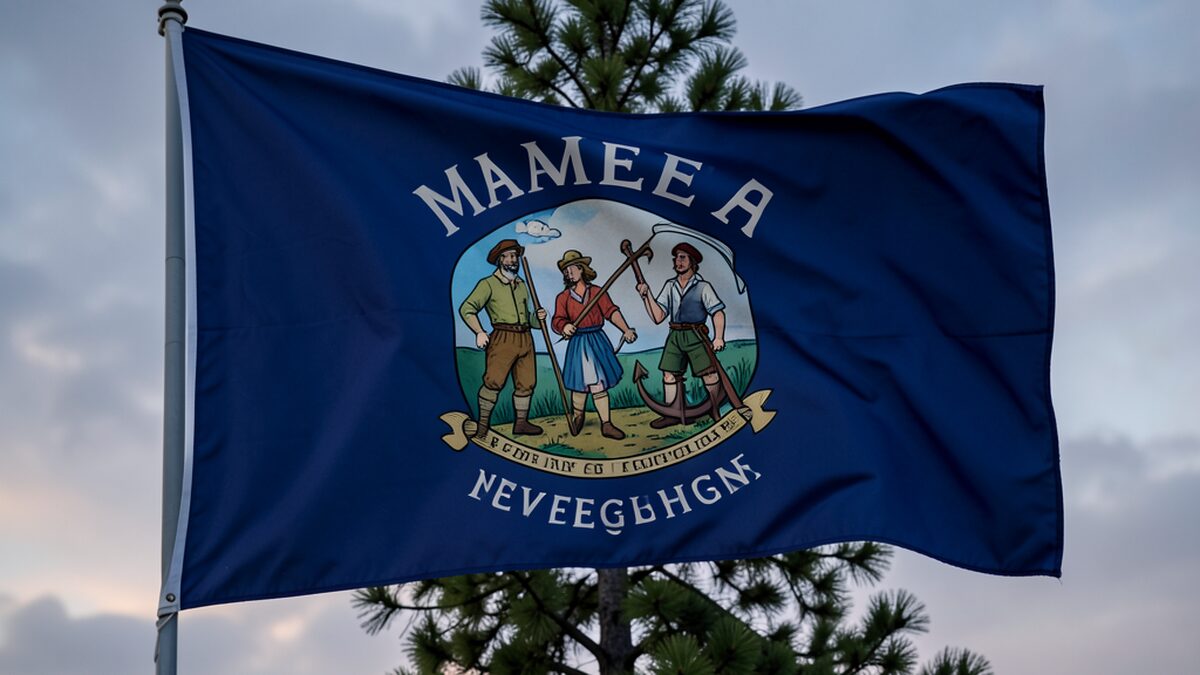
Maine’s state flag, adopted in 1909, serves as a rich emblem of the region’s colonial roots and Revolutionary War legacy. Featuring a moose beneath a pine tree on a blue field, the design draws from both the natural environment and historical militia symbols. The inclusion of the motto “Dirigo” further underscores Maine’s identity and leadership. Exploring the flag’s design influences reveals deeper insights into the state’s evolving character and heritage.
Key Takeaways
- Maine’s state flag, adopted in 1909, symbolizes its colonial and Revolutionary War heritage.
- The flag’s design features a moose beneath a pine tree on a blue field, representing the state’s natural landscape.
- The pine tree on the flag echoes the emblem used by colonial militias during the fight for independence.
- Maine’s motto "Dirigo," meaning "I lead," reflects the state’s historical identity and leadership.
In 1909, amid a period of burgeoning state identity and pride, Maine officially adopted its state flag, drawing upon symbols deeply rooted in its colonial and Revolutionary War heritage. The flag’s design, featuring a moose resting beneath a pine tree against a field of blue, evokes the natural landscape that early settlers encountered and the emblematic pine tree that once adorned colonial militias’ banners during the struggle for independence. This visual language, intertwined with the state’s motto “Dirigo,” meaning “I lead,” reflects Maine’s historical journey from rugged frontier territory to a distinct political entity within the Union, encapsulating both its natural bounty and its enduring spirit forged in the crucible of American history.
The First Official Maine State Flag: Origins and Design
The initial official flag of Maine was adopted on March 21, 1901, marking a significant step in the state’s efforts to establish a distinct identity through symbolism. Known as the Pine Tree Flag, it featured a green pine tree set against a buff-colored field, with a blue North Star positioned nearby. This design was the work of Adjutant General John T. Richards, who aimed to create a flag that was both emblematic and functional. The pine tree, as a central motif, underscored Maine’s nickname as the “Pine Tree State,” while the North Star symbolized guidance and leadership, directly referencing the state motto, “Dirigo.”
This visual language, intertwined with the state’s motto "Dirigo," meaning "I lead," reflects Maine’s historical journey from rugged frontier territory to a distinct political entity within the Union, encapsulating both its natural bounty and its enduring spirit forged in the crucible of American history.
The buff field was a deliberate choice to evoke an earthy, traditional tone, differentiating the flag from the more common blue backgrounds prevalent in other state flags. This simplicity also enhanced the flag’s visibility at sea, an important consideration given Maine’s extensive maritime activity. The Pine Tree Flag thus combined practical design with historical and regional symbolism, serving as a visual representation of Maine’s natural environment and its early colonial heritage until it was replaced in 1909.
Design Influences Behind the 1901 Pine Tree Flag
The 1901 Pine Tree Flag drew heavily on Maine’s regional identity and historical symbolism. The pine tree had long been a potent emblem in New England, representing the vast timber resources critical to both the local economy and naval construction. This symbol also linked Maine to the colonial militias, which famously used pine tree motifs during the Revolutionary War period, notably on the earlier “Liberty Tree” flags. The inclusion of the North Star aligned with the state’s motto, “Dirigo,” emphasizing Maine’s role as a leader and a guiding light, both geographically and politically.
John T. Richards’s choice to avoid the then-common “seal-on-blue” design was intentional, seeking to create a flag that was immediately recognizable and free from visual clutter. The flag’s simplicity ensured it could be easily identified by seamen navigating the difficult coastal waters of Maine, reinforcing the state’s maritime heritage. The combination of a buff background with the green pine tree and a blue star balanced symbolism with practicality, distinguishing Maine’s flag within the broader context of American vexillology.
Transition to the 1909 Flag: Historical Context and Symbolism
On February 23, 1909, Maine adopted a new state flag, replacing the Pine Tree Flag with a design featuring the state coat of arms centered on a blue field. This shift was influenced significantly by Civil War veterans serving in the state legislature, who preferred a flag that echoed the blue Union battle flags familiar from their military service. The new flag’s blue background aligned Maine’s identity with a broader national symbolism and matched the aesthetic of many other states’ flags that employed seal-based designs.
The 1909 flag incorporated more complex imagery: the coat of arms depicted a farmer and a sailor, representing Maine’s agricultural and maritime industries, alongside a moose resting beneath a pine tree, underscoring the state’s rich natural resources. Above the shield, the North Star remained a prominent feature, maintaining continuity with the earlier flag’s symbolism. The motto “Dirigo” was featured prominently, encapsulating Maine’s historical narrative of leadership and perseverance. This design reflected both the state’s evolving self-conception and the broader trends in American state flag design during the early twentieth century.