
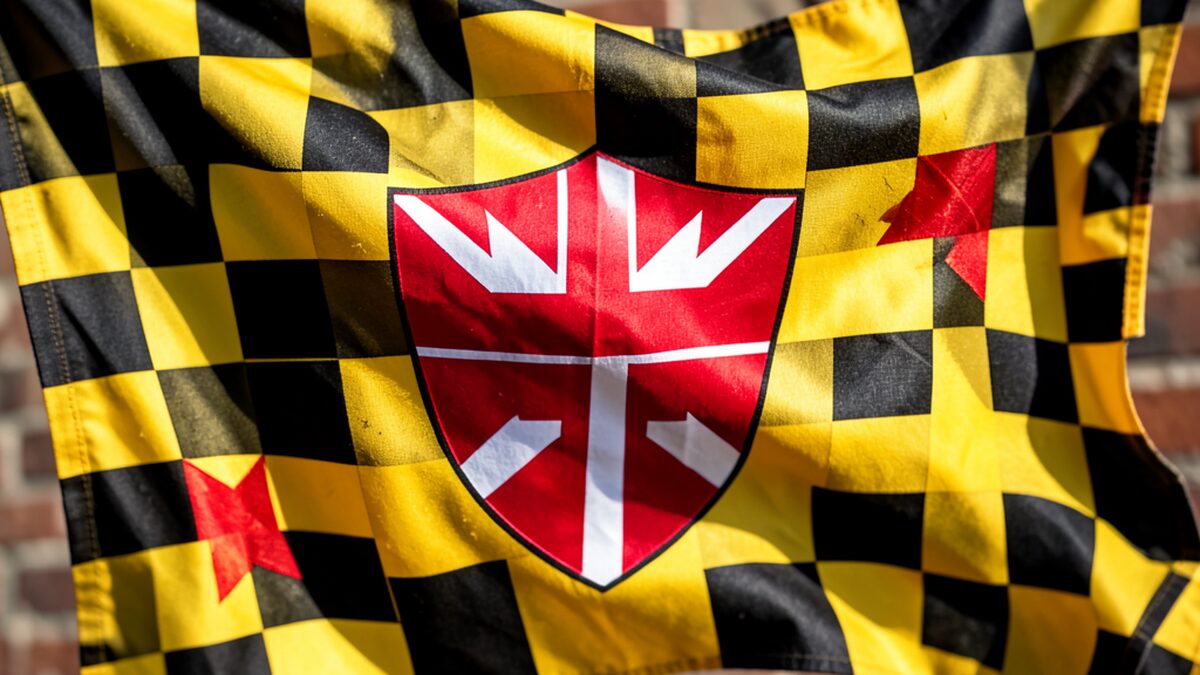
The Maryland state flag’s distinctive quartered design offers a compelling glimpse into the enduring influence of colonial heraldry on American symbolism. Rooted in the 17th-century coats of arms of the Calvert and Crossland families, the flag encapsulates themes of loyalty, lineage, and identity that resonate beyond its visual appeal. Exploring this connection reveals how historical narratives continue to shape contemporary expressions of state pride and heritage.
Key Takeaways
- The Maryland state flag’s design is based on the 17th-century heraldic arms of the Calvert and Crossland families.
- The flag reflects Maryland’s colonial origins and the legacy of Cecil Calvert, the colony’s founder.
- Its quartered gold and black and red and white pattern symbolizes loyalty, lineage, and identity.
- The flag represents a lasting connection between colonial heraldry and modern American regional identity.
The Maryland state flag, with its distinctive quartered design of gold and black alternating with red and white, draws directly from the heraldic traditions of the 17th century, specifically the coat of arms of the Calvert and Crossland families. These emblems, rooted in the English colonial era, reflect the complex interplay of loyalty, lineage, and identity that characterized Maryland’s founding in 1632 under Cecil Calvert, the second Lord Baltimore. By incorporating these ancestral arms, the flag serves not only as a symbol of statehood but as a living testament to the enduring influence of colonial heraldry on American regional identity.
Core Design Source
The Maryland State Flag design is fundamentally derived from the shield found in the coat of arms of the Calvert family, the colonial proprietors of Maryland. Cecil Calvert, the 2nd Baron Baltimore, was instrumental in establishing the colony, and his personal heraldic banner became the emblematic basis for the flag. Under heraldic custom, as noted by sources such as Britannica, the personal banner of the Lords Baltimore extended beyond private use to symbolize the territory they governed, thereby legitimizing the flag’s association with Maryland itself. The Maryland Secretary of State has emphasized that the flag exhibits “correct heraldry,” underscoring its fidelity to traditional heraldic principles and its capacity to “fairly shout Maryland.”
By incorporating these ancestral arms, the flag serves not only as a symbol of statehood but as a living testament to the enduring influence of colonial heraldry on American regional identity.
This quartered flag design, incorporating both Calvert and Crossland family arms, thus serves as a direct visual link to the colonial origins of the state. It stands apart from many American state flags by explicitly showcasing familial heraldry, reflecting a continuity of identity from the colonial proprietorship to modern statehood.
Calvert Family Heraldry
The Calvert family arms, which occupy the first and fourth quarters of the Maryland flag, consist of six vertical stripes alternating yellow and black, overlaid with a diagonal counterchanged stripe. This pattern is often described as a distorted checkerboard or palisade-like design, distinguished by its stark contrast and unique arrangement. This heraldic scheme was originally adopted by George Calvert, the 1st Lord Baltimore, and passed down through his lineage. Notably, the yellow-and-black Calvert design lacks explicit symbolic meaning; rather, its purpose was to serve as a distinctive familial mark.
The preservation of the Calvert arms within the Maryland State Flag design reflects both a respect for the colonial heraldic tradition and a visual assertion of the founding family’s legacy. The striking black and gold coloration and geometric precision of the Calvert pattern have become synonymous with Maryland’s historical narrative and regional identity.
Crossland Family Heraldry
The other half of the Maryland State Flag design originates from the Crossland family, the maternal lineage of the Calverts. The Crossland arms occupy the second and third quarters of the flag and are characterized by a quartered field of white and red featuring a counterchanged cross bottony. This type of cross is distinguished by arms ending in three rounded tips or “balls,” giving it a distinct decorative appearance within heraldic art.
The Crossland colors of red and silver (white) complement the Calvert gold and black, creating a balanced and visually arresting flag. The inclusion of the Crossland arms honors the maternal heritage of the founding family and reflects the colonial practice of combining paternal and maternal heraldic symbols to represent lineage and alliances. The integration of Crossland heraldry into the Maryland flag thus enriches its narrative, embedding within the state’s emblem a layered representation of familial identity and colonial history.