
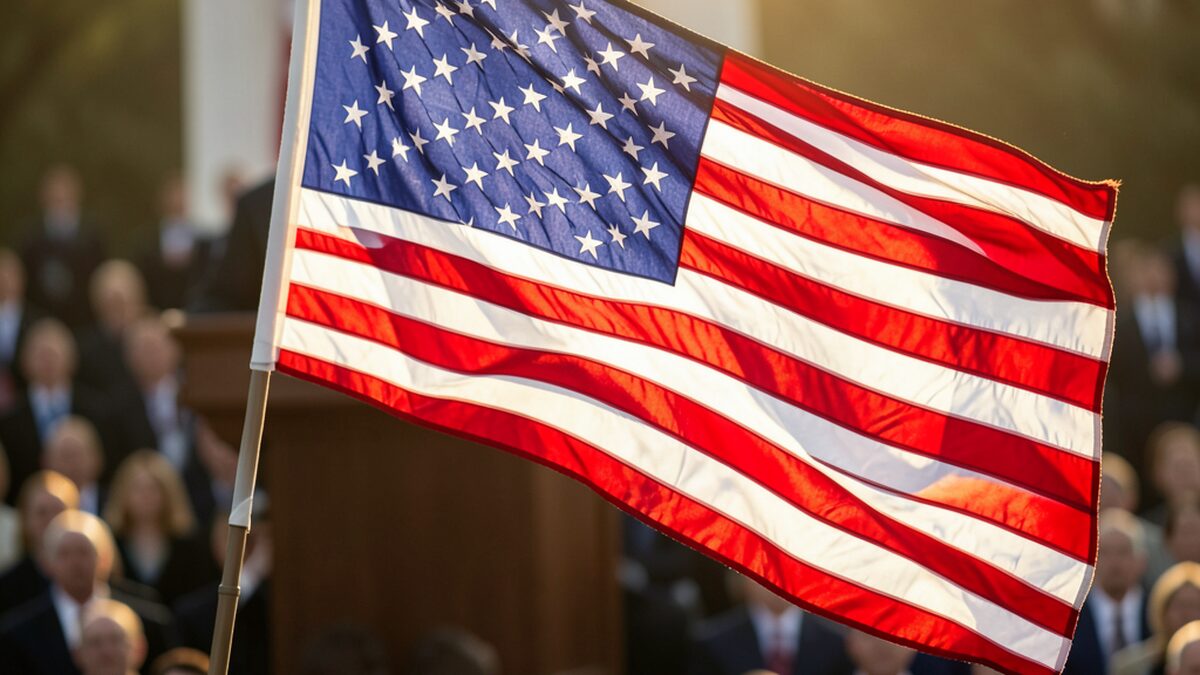
The American flag’s presence at presidential inaugurations offers a compelling lens through which to explore the evolving symbols of national identity and unity. From its modest beginnings at George Washington’s inauguration to its current prominence, the flag mirrors broader political and cultural shifts in the United States. Understanding this evolution reveals much about how patriotism and democratic values have been visually expressed during these historic ceremonies.
Key Takeaways
- The American flag has symbolized national identity and unity since the first presidential inauguration in 1789.
- Its display at inaugurations has evolved to reflect changes in patriotism and the political climate.
- The formal tradition of multiple flags on the Capitol's West Front began with Bill Clinton’s 1993 inauguration.
- This flag arrangement highlights the ideals of democracy and continuity during the peaceful transfer of power.
Since George Washington’s first inauguration in 1789, the American flag has served as a potent symbol of national identity and unity during the peaceful transfer of executive power. Its presence at presidential inaugurations has evolved alongside the nation’s political and cultural landscape, reflecting shifts in patriotism, political climate, and public sentiment. From its early display as a simple emblem of the fledgling republic to its prominent role in modern ceremonies, the flag encapsulates the ideals of democracy and continuity that underpin the inauguration ritual.
Historical Evolution of Inaugural Flag Displays
The visual prominence of the American flag during presidential inaugurations has undergone significant development, particularly in the late 20th century. Although flags have always been present as symbolic elements, the formal tradition of displaying multiple American flags on the Capitol’s West Front began with Bill Clinton’s inauguration in 1993. This arrangement established a standardized and visually impactful presentation that emphasized national unity and continuity. Prior to this, the 1989 inauguration of George H.W. Bush featured 38 flags, connecting the ceremony to the Centennial celebration of the American flag in 1876 and reflecting an awareness of historical symbolism.
Since George Washington’s first inauguration in 1789, the American flag has served as a potent symbol of national identity and unity during the peaceful transfer of executive power.
Ronald Reagan’s 1981 inauguration was a turning point not only for flag displays but also for the location of the ceremony itself. Moving the inauguration from the East Front to the West Front of the Capitol allowed for greater public attendance and a more expansive view of the National Mall. The West Front became a backdrop for a massive, multi-story display combining full-sized American flags and vertical stripes in national colors. Interestingly, Reagan’s ceremony utilized star-spangled bunting rather than multiple flags as a backdrop, with the Betsy Ross and current flags flanking the platform, signaling a nuanced approach to patriotic iconography.
The Five-Flag Display System
Modern presidential inaugurations have adopted a distinctive five-flag display system above the West Front inaugural platform, underscoring the layered symbolism embedded in the American Flag in Presidential Inaugurations. Central to this arrangement is the current 50-star flag, which serves as the focal point and represents the present-day United States. Flanking this centerpiece are two historic flags representing the state of the incoming president’s residence, chosen by the number of stars corresponding to that state’s admission to the Union. For instance, during Donald Trump’s inauguration, the flags representing Florida displayed 27 stars, acknowledging its 1845 statehood.
The outermost flags in the display are consistently the Betsy Ross 13-star flags, which frame the entire arrangement. These flags evoke the nation’s founding era and symbolize the original thirteen colonies. This deliberate combination of flags weaves together the past and present, illustrating the enduring ideals and historical continuity that define the American republic. The five-flag display thus functions as a visual narrative of American history, identity, and federalism during the inauguration.
Historic Flag Designs and Symbolism
Integral to the symbolism of the American Flag in Presidential Inaugurations is the use of historic flag designs, particularly the Betsy Ross flag. Featuring thirteen stars arranged in a circle, this flag represents the original thirteen colonies that declared independence from British rule. Designed by Francis Hopkinson, a signer of the Declaration of Independence, the flag has become an emblem of the nation’s revolutionary origins and foundational values.
The inclusion of historic flags alongside the modern 50-star flag during inaugurations serves to remind the public of the nation’s evolution. The Betsy Ross flag, in particular, symbolizes unity, the birth of the republic, and the democratic ideals that continue to inspire American governance. By integrating this historic design into the inauguration ceremony, the event transcends the mere transfer of power, becoming a reaffirmation of the country’s enduring principles and collective memory.