
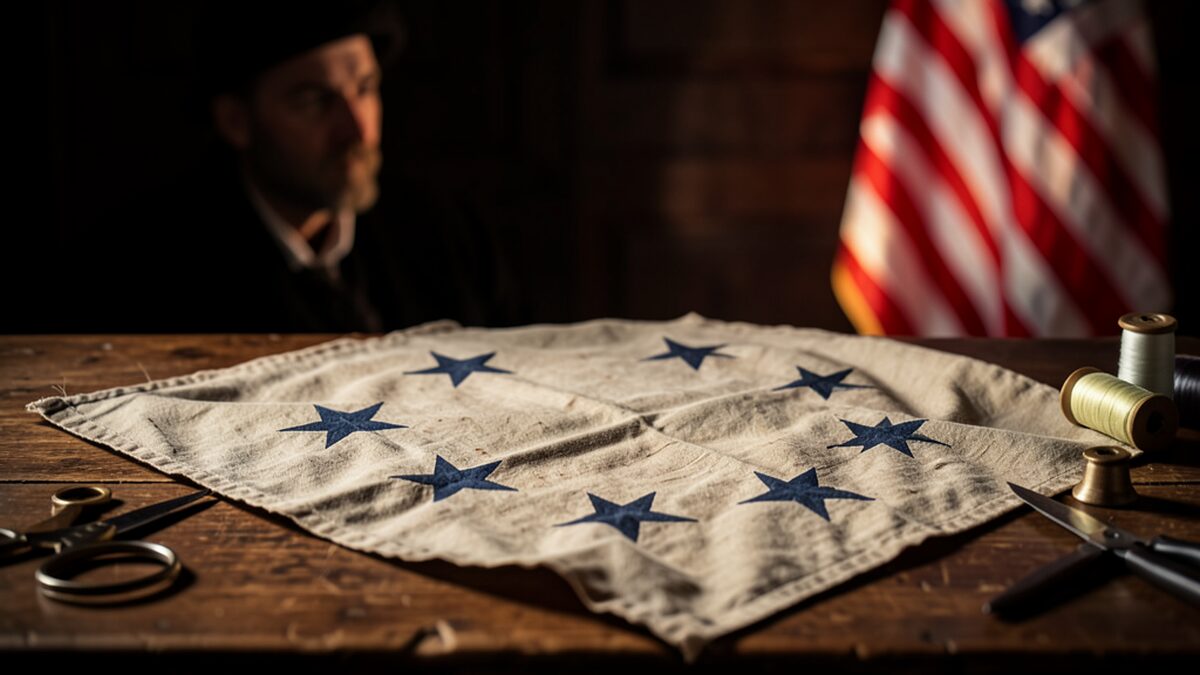
The Betsy Ross flag, despite its debated origins, emerged as a powerful emblem of American identity and unity after the Revolutionary War. Its legend, popularized in the 19th century, played a crucial role in shaping national symbolism by intertwining historical narrative with patriotic sentiment. Exploring how this blend of fact and folklore helped define core American ideals reveals the enduring impact of the flag on the nation’s cultural heritage.
Key Takeaways
- The Betsy Ross flag became a powerful symbol of American unity and identity after the Revolution.
- The legend of Betsy Ross sewing the first flag blends historical fact with patriotic folklore.
- Its design elements represent the original thirteen colonies and their collective struggle for independence.
- The flag's story reinforced ideals of liberty and grassroots nation-building in American culture.
In the wake of the American Revolution, a fledgling nation sought unifying symbols to embody its newfound identity, among which the Betsy Ross flag emerged as a potent emblem. Though historical evidence about its origins remains inconclusive, the narrative of Betsy Ross sewing the first American flag in 1776 gained widespread traction throughout the 19th century, intertwining fact and folklore. This legend, rooted in post-revolutionary nationalism and popularized during periods of heightened patriotism, significantly shaped the visual and cultural lexicon of American symbolism, reinforcing ideals of unity, liberty, and grassroots participation in nation-building.
The Betsy Ross Flag: Design and Symbolic Elements
The Betsy Ross flag is characterized by its 13 stars arranged in a circle on a blue canton, accompanied by 13 alternating red and white horizontal stripes. These elements symbolized the original thirteen American colonies unified in their struggle for independence. While the stars in the popular image are five-pointed, the 1777 Flag Act did not specify star shape or arrangement, only that there be 13 white stars and stripes. The circular arrangement of stars, emblematic of equality and unity, was later popularized through artistic depictions, such as John Trumbull’s painting of George Washington at Trenton. The name “Betsy Ross flag” itself was not contemporaneous with the flag’s use, emerging only decades after the fact, reflecting its evolution into a patriotic emblem infused with mythic significance.
This legend, rooted in post-revolutionary nationalism and popularized during periods of heightened patriotism, significantly shaped the visual and cultural lexicon of American symbolism, reinforcing ideals of unity, liberty, and grassroots participation in nation-building.
Today, the Betsy Ross flag endures as a symbol of early American identity, frequently displayed during national celebrations and political events. Its design elements have transcended their original context to evoke foundational values of the United States, including liberty and the democratic ideal of equal representation among states, reinforcing its place within the broader framework of American symbolism.
The Legal Framework and Variability of Early American Flags
The official legal context for the first American flag is found in the Flag Act of 1777, passed by the Continental Congress amid the Revolutionary War. This legislation mandated a flag with 13 alternating red and white stripes and 13 white stars on a blue field but did not provide specific instructions regarding the arrangement or shape of the stars. The absence of detailed design guidelines allowed for multiple flag variations to emerge simultaneously, reflecting the decentralized and evolving nature of the young republic.
This flexibility in design contributed to the eventual crystallization of the Betsy Ross flag image through popular and artistic representation rather than legislative prescription. The five-pointed star, now standard, was not officially codified until much later, underscoring how tradition and legend filled the gaps left by legal ambiguity. Consequently, the Betsy Ross flag legend gained authority not through legal mandate but through cultural adoption, shaping American symbolism in a way that formal statutes did not.
Betsy Ross: The Woman Behind the Legend and Its Cultural Impact
Betsy Ross, born Elizabeth Griscom in 1752, was a Philadelphia upholsterer known to have produced uniforms, tents, and flags for the Continental forces during the Revolutionary period. While historical records affirm her occupation and contributions to the war effort, there is no contemporaneous documentation conclusively proving she created the first American flag. Nevertheless, her figure became emblematic of grassroots involvement in nation-building, embodying the patriotic spirit of the revolution.
The Betsy Ross flag legend was popularized primarily through the 1870 account by her grandson, William J. Canby, who recounted a family story describing Ross’s consultation with George Washington and other founding figures in producing the flag. This narrative gained traction during a period of American nationalism following the Civil War, when the country sought to reinforce unity and shared heritage. The legend’s endurance highlights how myth and memory can influence the symbolic landscape, with Ross’s story serving as a touchstone for ideals of female contribution, craftsmanship, and democratic participation in the creation of national identity.