
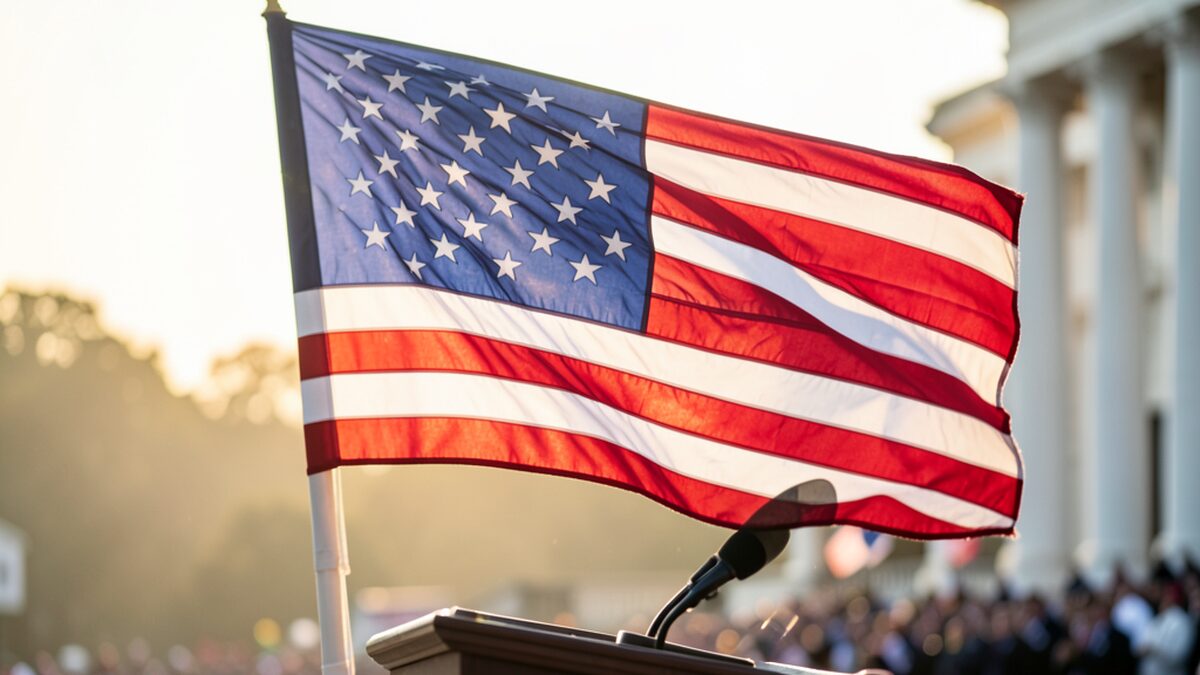
The American flag’s prominent role in presidential inaugurations reflects more than ceremonial tradition; it embodies the nation’s core values and the peaceful transition of power. From George Washington’s first oath to modern-day ceremonies, its symbolism has adapted alongside evolving political and cultural landscapes. Exploring this emblem’s significance offers insights into how national identity and democratic ideals are visually and symbolically reinforced during these pivotal moments in American history.
Key Takeaways
- The American flag has symbolized unity and continuity at presidential inaugurations since 1789.
- Its presence is legally and ceremonially managed by federal bodies like the AOC and JCCIC.
- The flag’s role has evolved alongside the inauguration ceremony and national identity.
- It remains a powerful emblem of patriotism and the peaceful transfer of power.
Since George Washington first took the oath of office in 1789, the American flag has been an enduring symbol woven into the fabric of presidential inaugurations, embodying the ideals of the republic and the continuity of government. Throughout the nation’s history, the flag’s presence at these ceremonies has served not only as a backdrop but as a powerful emblem of unity, patriotism, and the peaceful transfer of power. From early inaugural balls to modern televised events, the flag’s role has evolved alongside the ceremony itself, reflecting broader shifts in political culture and national identity.
Legal and Ceremonial Basis
The American flag’s presence at presidential inaugurations is deeply rooted in both legal frameworks and ceremonial traditions. These inaugurations are federally organized events conducted at the U.S. Capitol, where the Architect of the Capitol (AOC) manages the physical and ceremonial aspects of the occasion. The Joint Congressional Committee on Inaugural Ceremonies (JCCIC) further oversees the public-facing elements, including the staging, presentation, and flag displays that contribute to the solemnity and symbolism of the event. While the U.S. Flag Code provides guidelines for flag display, it remains largely advisory, allowing for customary practices to shape the flag’s role during inaugurations.
Since George Washington first took the oath of office in 1789, the American flag has been an enduring symbol woven into the fabric of presidential inaugurations, embodying the ideals of the republic and the continuity of government.
Inauguration Day is explicitly recognized in federal flag guidance as a day when the flag should be displayed, underscoring its integral role in marking the peaceful transition of executive power. The flag thus functions not only as a patriotic emblem but also as a formal component of the institutional ceremony, symbolizing the republic’s enduring values and the legitimacy of the incoming administration.
Inauguration Day and Half-Staff Controversy
The display of the American flag during inaugurations can also intersect with political and symbolic controversies, as exemplified on January 20, 2025. President Donald J. Trump issued a presidential action directing that the U.S. flag be flown at full-staff throughout Inauguration Day, with the flag lowered to half-staff only after the day concluded. This directive referenced Proclamation 10876, issued by President Joe Biden on December 29, 2024, following the death of former President James Earl Carter, Jr., which ordered flags to be flown at half-staff for 30 days as a mark of national mourning.
This situation highlighted the tension between tradition, mourning protocols, and political considerations. Several Republican governors and House Speaker Mike Johnson mirrored Trump’s directive by raising flags to full-staff on Inauguration Day before returning them to half-staff afterward. This episode illustrates how the American Flag in Presidential Inaugurations can become a focal point for differing interpretations of respect, symbolism, and political messaging during highly visible national ceremonies.
Historic Symbolism on the Capitol’s West Front
The visual prominence of the American flag during inaugurations has been significantly shaped by the ceremony’s location on the U.S. Capitol’s west front since Ronald Reagan’s 1981 inauguration. This site, facing the National Mall, offers a symbolic axis that includes views of the Washington Monument and Lincoln Memorial, situating the flag within a broader landscape of American memory and identity. The arrangement of flags on the west front platform has become a defining visual element of modern inaugurations, framing the president-elect and reinforcing the connection between the office and the nation’s foundational symbols.
The flags displayed on the Capitol’s west front serve both aesthetic and symbolic purposes, visually underscoring themes of unity and continuity. This carefully curated backdrop reflects the evolving role of the American Flag in Presidential Inaugurations, transforming it from a mere emblem into a central feature of the ceremony’s narrative and visual impact.