
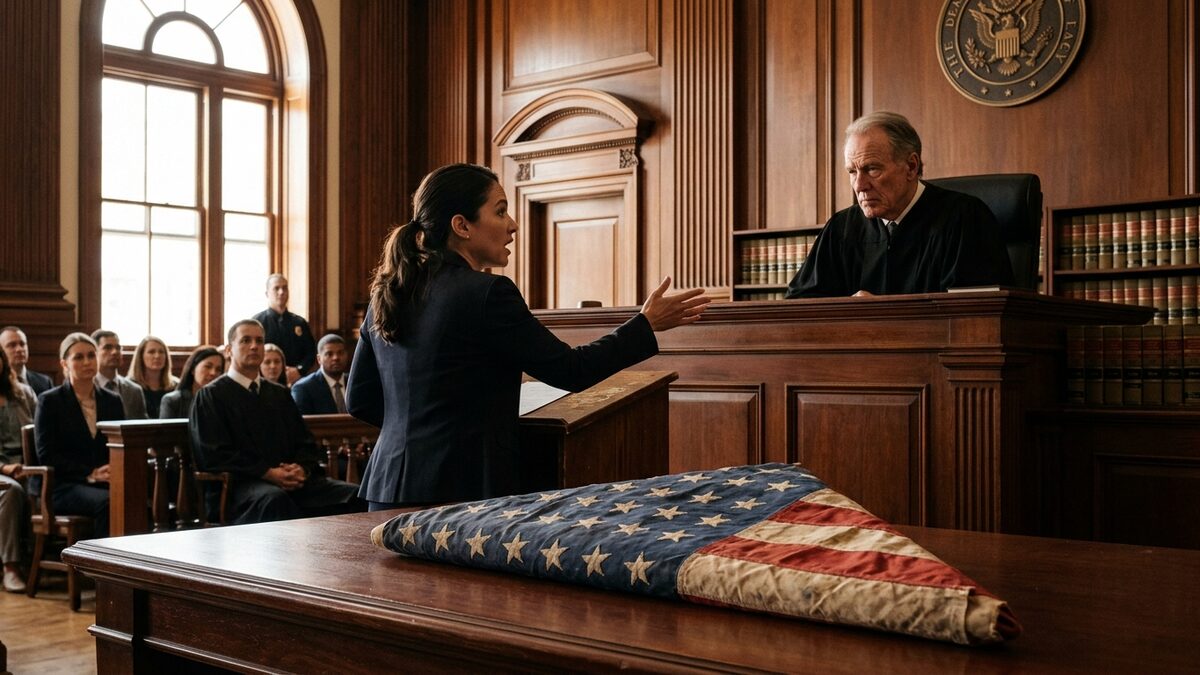
The article examines the complex legal battles over flag desecration laws, highlighting the delicate balance between safeguarding national symbols and preserving constitutional rights. It highlights how these laws test the limits of free speech and government power, with the pivotal Texas v. Johnson case serving as a cornerstone in defining symbolic expression. This exploration invites a deeper understanding of how democratic values are reconciled with national identity in legal discourse.
Key Takeaways
- Flag desecration laws challenge the balance between national reverence and constitutional freedoms.
- The 1989 Texas v. Johnson case was a landmark decision protecting flag burning as free speech.
- The Supreme Court ruled 5-4 that flag burning is symbolic speech protected by the First Amendment.
- These legal controversies highlight ongoing debates about government limits on expressive conduct.
What does it mean to protect a symbol that embodies national identity, and at what cost should such protection come? The legal controversies surrounding flag desecration laws force a confrontation between reverence for a nation’s emblem and the fundamental freedoms enshrined in constitutional law. These statutes, often enacted to punish acts viewed as offensive or unpatriotic, raise profound questions about the limits of free expression, government authority, and the role of symbolic speech in democratic society.
The Landmark Texas v. Johnson Case (1989)
The case of Texas v. Johnson stands as a pivotal moment in the legal controversies of flag desecration laws. In 1984, Gregory Lee Johnson publicly burned an American flag during a political protest in Dallas, Texas, expressing dissent against then-President Ronald Reagan’s nomination. Convicted under a Texas statute criminalizing flag desecration, Johnson was fined and sentenced to jail. His conviction was ultimately appealed to the U.S. Supreme Court, which, in a narrow 5-4 decision, overturned the conviction in 1989.
The Court's majority opinion, authored by Justice William Brennan, emphasized that flag burning constitutes expressive conduct—"symbolic speech"—protected under the First Amendment.
The Court’s majority opinion, authored by Justice William Brennan, emphasized that flag burning constitutes expressive conduct—”symbolic speech”—protected under the First Amendment. The ruling underscored that the government cannot prohibit expression solely because it is offensive or disagreeable to society. Consequently, Texas v. Johnson established a constitutional precedent that flag desecration, as a form of political expression, falls within the ambit of protected speech, thereby limiting government authority to regulate such acts.
United States v. Eichman and the Flag Protection Act (1990)
In response to the Texas v. Johnson decision, Congress enacted the Flag Protection Act of 1989, criminalizing flag desecration nationwide in an attempt to circumvent the Supreme Court’s ruling. However, this legislation soon faced judicial scrutiny in United States v. Eichman. Decided in 1990, the Supreme Court again invalidated governmental efforts to prohibit flag desecration, striking down the Flag Protection Act as unconstitutional.
Justice Brennan, once more authoring the majority opinion, found that the Act, despite its content-neutral language, effectively suppressed expression based on the communicative impact of the conduct. The decision reaffirmed that the First Amendment protects even offensive symbolic acts and rendered all existing state and federal laws banning flag desecration unenforceable. Despite this ruling, many states retained their flag desecration statutes on the books, perpetuating ongoing legal and political debates.
Historical Precedents: Street v. New York and Halter v. Nebraska
The legal controversies of flag desecration laws have deeper roots in Supreme Court jurisprudence predating Texas v. Johnson. In Street v. New York (1969), the Court addressed the conviction of Sidney Street, who burned an American flag in protest after the assassination of Martin Luther King Jr. The Court ruled his conviction unconstitutional, reinforcing the principle that symbolic speech involving the flag is protected when not intended to incite violence or breach the peace.
Conversely, in Halter v. Nebraska (1907), the Court upheld a state statute prohibiting the use of the American flag on commercial beer labels. This decision reflected a different era’s perspective, emphasizing respect for national symbols over expressive freedom in commercial contexts. The contrasting outcomes of these cases illustrate the evolving legal landscape regarding flag-related expression and the tension between symbolic reverence and constitutional freedoms that continue to underpin the ongoing controversies surrounding flag desecration laws.