
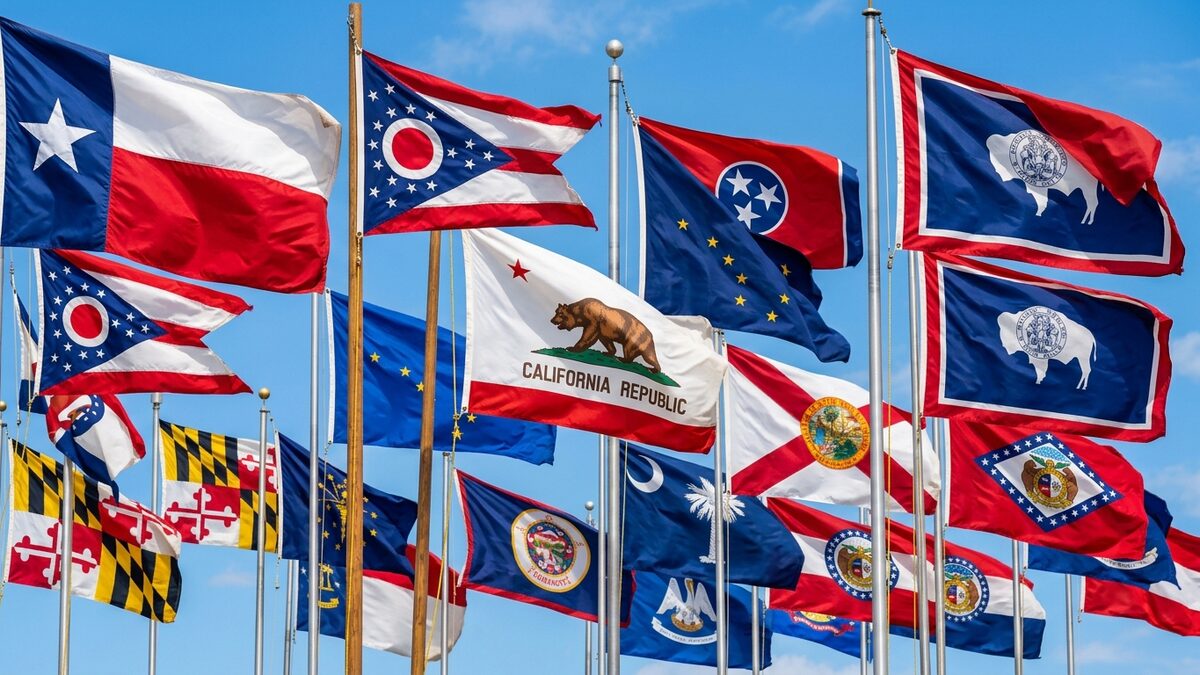
The integration of American flag elements into state flags offers a compelling lens through which to explore the balance between state identity and national unity. By examining how stars, stripes, and colors are adapted, one can better understand the nuanced ways states express allegiance to the republic while asserting their unique heritage. This interplay of symbolism invites a deeper reflection on the evolving relationship between state sovereignty and collective patriotism.
Key Takeaways
- State flags often incorporate stars and stripes to reflect their historical connection to the United States.
- The use of red, white, and blue colors in state flags symbolizes shared national values of liberty and unity.
- Stars on state flags frequently represent the order of statehood or the original colonies.
- State flags visually balance state identity with allegiance to the federal union through American flag elements.
Since the adoption of the Stars and Stripes in 1777, the American flag has served as a powerful emblem of unity, liberty, and national identity. State flags, many of which were designed in the decades following the Civil War and during periods of burgeoning state pride, often incorporate elements of the national banner to reflect their connection to the broader American narrative. By embedding stars, stripes, and colors derived from the flag of the United States, these state banners not only honor the foundational ideals of the republic but also assert their place within the federal framework, creating a visual dialogue between state sovereignty and national allegiance.
1. Shared Symbolism of Stars and Stripes
Many state flags adopt stars and stripes directly inspired by the American flag’s symbolism. For instance, Indiana’s flag features 13 outer stars representing the original colonies and five inner stars for states admitted subsequently, echoing the national narrative of expansion. Similarly, Arkansas’s 25 white stars denote its rank as the 25th state, directly referencing the star-count progression on the U.S. flag.
By embedding stars, stripes, and colors derived from the flag of the United States, these state banners not only honor the foundational ideals of the republic but also assert their place within the federal framework, creating a visual dialogue between state sovereignty and national allegiance.
2. Color Symbolism and National Identity
The colors red, white, and blue dominate both the American flag and numerous state flags, serving as a visual cue of shared values. Texas and Tennessee use blue to symbolize loyalty and justice, mirroring the national field, while red conveys bravery, and white purity—colors that maintain consistency with the American palette. Arizona and Iowa also utilize this triad, linking state identity to national symbolism through color.
3. Historical References to the Original Colonies
State flags frequently incorporate the number 13 to honor the original British colonies foundational to the United States. Indiana’s 13 outer stars and Georgia’s 13 white stars surrounding its coat of arms exemplify this homage, reinforcing a historical connection that aligns state identity with the nation’s origin story.
4. Incorporation of Unique Regional Symbols Within the National Framework
Some states blend American flag elements with regional or historical symbols to assert both local identity and national belonging. Hawaii’s flag, for example, uniquely includes the Union Jack, acknowledging its British colonial past, while its eight stripes represent the main islands, merging local heritage with the American flag’s design principles.
5. Emphasizing Federal Integration Through Design
States like Texas and Tennessee incorporate stars and stripes in patterns that emphasize their integration within the United States, using these elements to visually affirm loyalty to the federal union. By adopting these motifs, the flags communicate a dual identity that balances state pride with national allegiance, a hallmark of American federalism.