
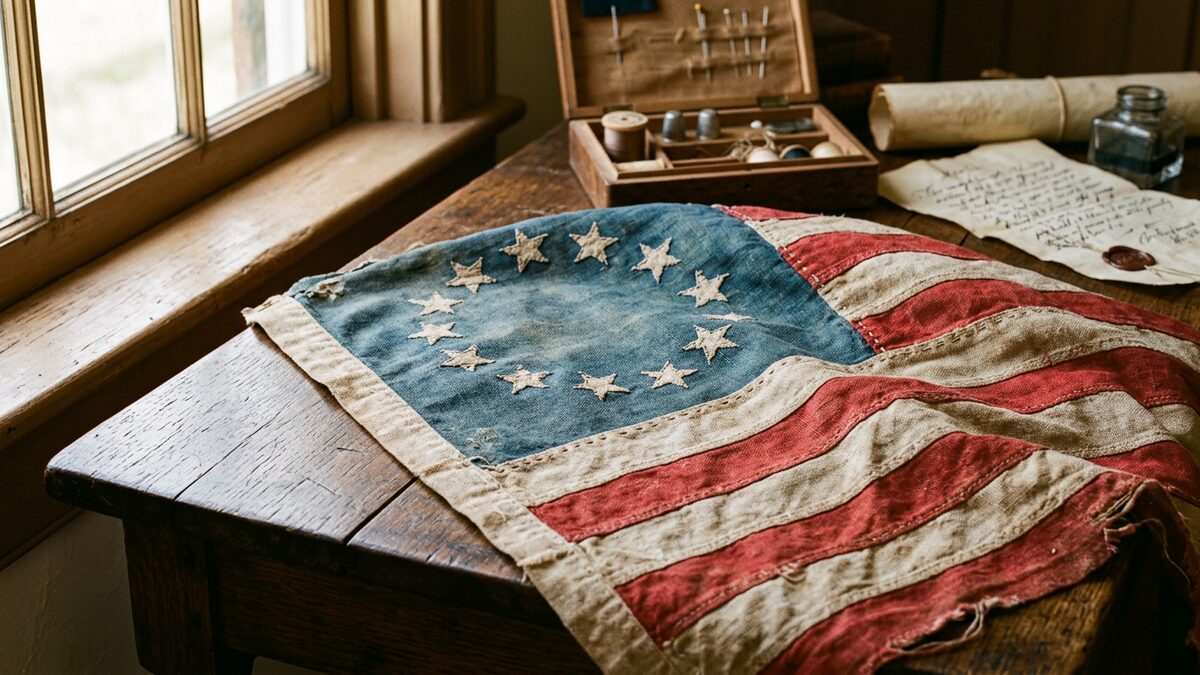
The Betsy Ross flag, with its iconic circle of thirteen stars, stands as a lasting emblem of American unity during the Revolutionary era. Yet the narrative attributing its creation to Ross herself is steeped in uncertainty and conflicting accounts. This article explores the origins of the flag legend, examining the historical evidence and the role of family lore in shaping a symbol that has come to represent the birth of a nation.
Key Takeaways
- The Betsy Ross flag symbolizes the unity of the thirteen American colonies during the Revolution.
- The story of Betsy Ross designing the flag first appeared in 1870 through her grandson's account.
- No contemporary records from the Revolutionary period confirm Ross's role in creating the flag.
- Historians view the Betsy Ross flag legend as a mix of myth and family oral tradition.
In 1776, as the thirteen American colonies declared their independence from British rule, the symbolism of a unified nation became paramount. Amidst this revolutionary fervor, the image of a flag adorned with thirteen stars arranged in a circle—commonly attributed to Betsy Ross—emerged as an enduring emblem of the new republic. However, the origins of this iconic banner are entwined with myth and sparse documentation, prompting historians to reexamine its provenance within the broader tapestry of American revolutionary iconography.
The Origin of the Legend and Key Narrators
The history of the Betsy Ross flag legend primarily stems from a presentation made in 1870 by William J. Canby, the grandson of Betsy Ross, to the Historical Society of Pennsylvania. Canby’s account was the first formal documentation of the story, relying entirely on sworn statements and oral recollections from Betsy Ross’s daughter and other family members. Prior to this, no written records, diaries, or official correspondence referenced Ross’s involvement in designing the flag, which raises questions about the story’s authenticity.
However, the origins of this iconic banner are entwined with myth and sparse documentation, prompting historians to reexamine its provenance within the broader tapestry of American revolutionary iconography.
The legend gained widespread prominence during the United States Centennial celebration in 1876, a period marked by heightened interest in revolutionary symbolism and national identity. This timing contributed to the embedding of the Betsy Ross narrative into American cultural memory, despite the absence of contemporaneous evidence. Key figures in this origin story include Betsy Ross herself, her grandson William J. Canby, and the Historical Society of Pennsylvania, which helped disseminate the tale to a broader audience.
The Core Narrative: The 1776 Meeting and Design Changes
The core narrative of the Betsy Ross flag legend describes a meeting on June 1, 1776, in Philadelphia, where George Washington, Colonel George Ross, and Robert Morris visited Betsy Ross’s upholstery shop. These men, said to be part of a secret committee, allegedly presented Ross with a rough sketch of a flag featuring thirteen six-pointed stars. According to the story, Ross suggested altering the stars to a five-pointed design, which she demonstrated could be cut with a single snip of scissors, simplifying production.
The meeting is said to have taken place in Ross’s parlor, where the design was finalized. This narrative emphasizes Ross’s practical skills and her direct contribution to the flag’s creation, presenting her as a pivotal figure in the visual unification of the new nation. However, this account remains anecdotal, as no official documentation or eyewitness records from the period corroborate these events.
Verified Historical Facts About Betsy Ross’s Life and Work
Betsy Ross, born Elizabeth Griscom in 1752, was a skilled upholsterer and flag maker in Philadelphia. She married John Ross, a naval officer, and continued her upholstery business after his death. Historical records confirm Ross’s occupation and her role in producing flags during the Revolutionary era, but there is no direct evidence linking her to the design of the first American flag.
While Ross undoubtedly contributed to flag making and may have produced flags for military and civic purposes, the specifics of her involvement in designing the original thirteen-star flag remain unsubstantiated. The absence of archival records or official endorsements from the Continental Congress or other governing bodies casts doubt on the historicity of the commonly accepted narrative, positioning the Betsy Ross flag more as a potent symbol than a documented artifact.