
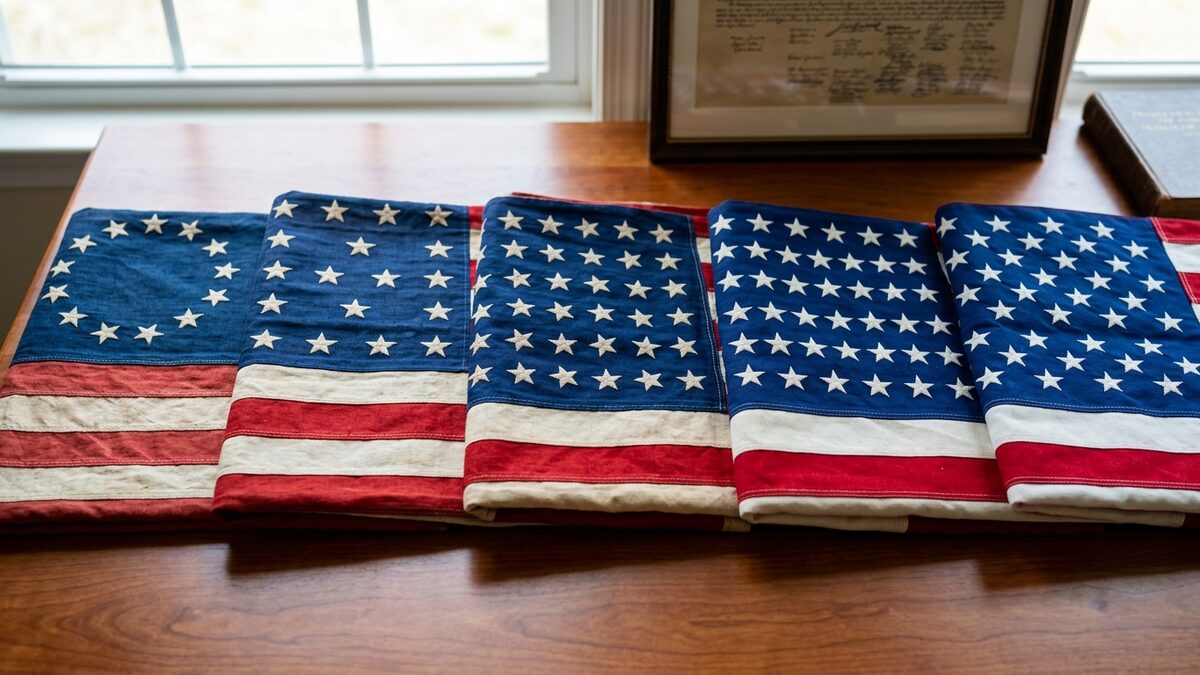
The evolution of the U.S. flag’s star arrangement offers a fascinating lens through which to explore the nation’s history and identity. From the original circle of thirteen stars symbolizing unity among colonies to the numerous configurations that followed, each design choice reveals shifts in political, cultural, and practical considerations. Understanding these changes provides deeper insight into how America’s expanding federal structure has been visually represented over centuries.
Key Takeaways
- The first official U.S. flag in 1777 featured thirteen stars arranged in a circle symbolizing unity.
- Early U.S. flags had no official star arrangement, allowing flag makers creative freedom.
- Star arrangements on the flag changed over time to reflect new states and evolving design ideas.
- The flag’s star patterns illustrate the growth and identity of the United States.
When the Continental Congress adopted the first official flag of the United States on June 14, 1777, its design featured thirteen stars arranged in a circle, symbolizing the unity of the original colonies. This initial pattern set a precedent for the evolving constellation of stars that would come to represent each new state’s admission to the Union. Over the centuries, the arrangement of stars on the U.S. flag has undergone numerous modifications, reflecting not only the nation’s growth but also changing design philosophies and practical considerations. Understanding these shifts offers insight into the broader narrative of American identity and federal expansion.
Early U.S. Flags Had No Official Star Arrangement
The first congressional resolution in 1777 officially described the U.S. flag as having thirteen stars, but it made no stipulation regarding the arrangement or pattern of those stars. This absence of specific guidance left the star layout entirely to the discretion of individual flag makers. As a result, early flags featured a variety of designs, including stars arranged in rows, circles, scattered patterns, or other custom layouts. Despite this flexibility, straight rows of stars became a common practical choice. The Smithsonian Institution notes that the lack of standardization during this period accounts for the significant visual differences among surviving 18th and 19th-century flags, which reflect diverse interpretations rather than official design mandates.
This initial pattern set a precedent for the evolving constellation of stars that would come to represent each new state’s admission to the Union.
The 1794 Act Increased Stars and Stripes but Left Layout Unstandardized
With the admission of Vermont and Kentucky to the Union, the Act of January 13, 1794, mandated an increase in both stars and stripes to fifteen each, effective May 1795. This legislative change marked an important shift from the original thirteen-star, thirteen-stripe flag toward a design that symbolized the growing nation. However, like the 1777 resolution, the 1794 Act did not specify a fixed arrangement for the stars on the flag. Consequently, flags produced in this era continued to display varied star patterns without any official uniformity. This period thus represents a transitional phase in the evolution of the flag, where symbolic expansion was recognized legislatively but design standardization had yet to be implemented.
The 1818 Flag Act Standardized Stripes but Not Star Arrangement
The Flag Act of April 4, 1818, represented a significant milestone in the history of the U.S. flag’s design. It restored the number of stripes to thirteen, permanently honoring the original colonies, and established the principle of adding one star for each new state admitted to the Union. This act also set the tradition of updating the flag’s stars annually on the Fourth of July following state admissions. The legislation was influenced by advice from U.S. Naval Captain Samuel C. Reid, who advocated for a design that balanced historical symbolism with federal expansion. Despite these advances, the act did not impose any regulations on the precise arrangement of the stars. Throughout the 19th century, star patterns remained unofficial and variable, continuing the legacy of diverse star layouts that characterized the flag’s earlier history.