
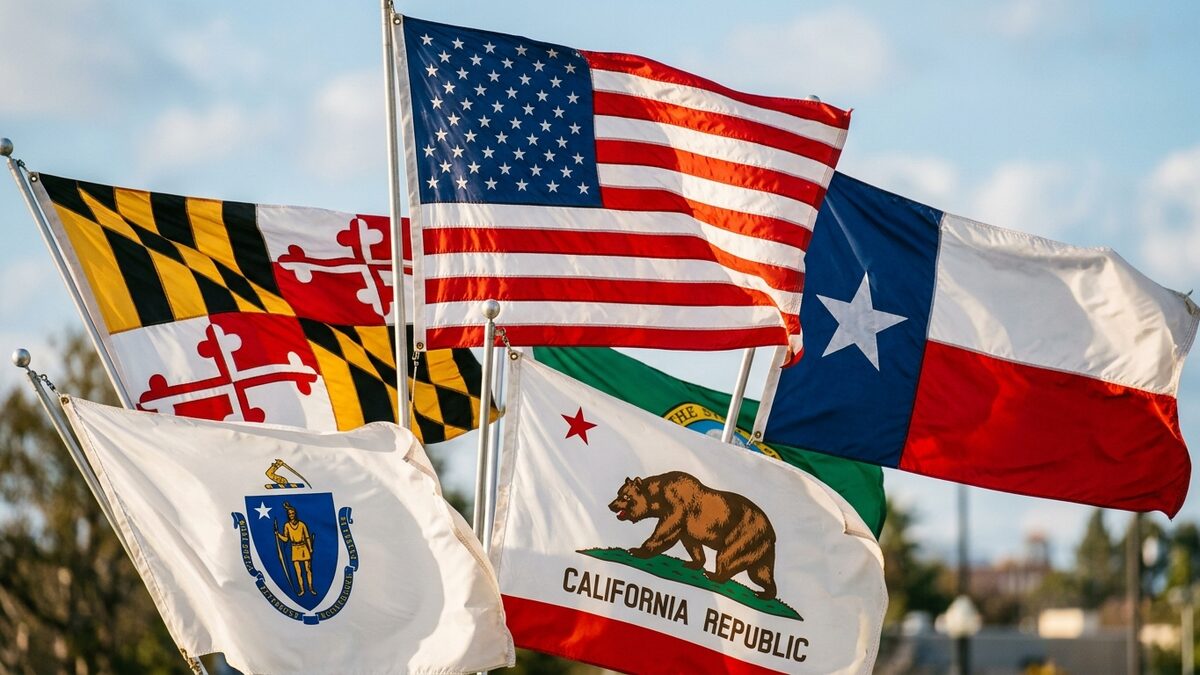
The integration of American flag motifs into state flags offers a compelling lens through which to explore the interplay between national identity and regional expression. By adopting stars, stripes, and patriotic colors, states convey nuanced messages of unity and independence. This fusion not only underscores historical ties to the Revolution but also reveals evolving interpretations of federalism and pride. What deeper stories emerge from these symbolic choices within state flag designs?
Key Takeaways
- State flags often incorporate stars, stripes, and red, white, and blue colors from the American flag to express unity and identity.
- The design elements of the national flag serve as a visual template for state flags, reinforcing federalism and patriotism.
- Incorporating the American flag’s motifs in state flags symbolizes allegiance to the Union and shared historical values.
- The use of national iconography in state flags reflects a balance between regional pride and national unity.
Since the adoption of the Stars and Stripes in 1777, the American flag has served not only as a national emblem but also as a template for state identity and unity. In the decades following the Revolution, as states sought to assert their distinctiveness within the new republic, many incorporated elements of the national flag—such as stars, stripes, and red, white, and blue color schemes—into their own banners. This practice symbolized both allegiance to the Union and the recognition of shared values forged in the crucible of independence. The interplay between state and national iconography reveals a layered narrative of federalism, patriotism, and regional pride embedded within the vexillological tradition of the United States.
1. Standardized Visual Grammar of the American Flag as a Template
The American flag’s design, codified by the Flag Act of 1818, established a visual grammar featuring 13 alternating red and white stripes representing the original colonies, alongside a blue canton bearing one white star per state. This configuration became a recognizable motif that many state flags borrowed, especially the blue canton, which evolved into a symbolic anchor for state identity. By echoing these elements, state flags align themselves visually and conceptually with the federal emblem of unity and continuity.
This practice symbolized both allegiance to the Union and the recognition of shared values forged in the crucible of independence.
2. Alaska’s Starry Tribute to the National Flag’s Canton
Designed by a young Alaska Native, Benny Benson, in 1927, Alaska’s flag uses a dark blue field that parallels the American flag’s canton, symbolizing sky and sea. Eight gold stars form the Big Dipper and North Star constellation, providing a celestial counterpart to the 50 stars of the U.S. flag. This constellation arrangement not only honors Alaska’s northern geography but also reflects a star-centered design closely aligned with the national flag’s iconic star field.
3. Arizona’s Star and Rays: A Symbolic Nod to Patriotism
Arizona’s flag features thirteen red and yellow rays on its upper half, directly referencing the original thirteen colonies. Central to the flag is a copper-colored star, emblematic of the state’s significant copper mining industry. This combination of stripes and a prominent star establishes a bold, patriotic design that recalls the American flag’s symbolism while asserting Arizona’s unique identity within the Union.
4. Hawaii’s Flag: A Hybrid of American and British Influences
Hawaii’s flag uniquely integrates the Union Jack in its upper hoist canton, reflecting historical British influence, while also displaying eight horizontal stripes representing the main Hawaiian Islands. Despite the foreign canton, the overall design mirrors the American flag’s canton-and-stripes structure, making it the only state flag to visibly incorporate a foreign national flag. This fusion illustrates Hawaii’s complex historical affiliations and its place within the American federal system.
5. Red, White, and Blue: The Dominant Color Scheme in State Flags
Many state flags adopt the red, white, and blue palette of the American flag, reinforcing themes of patriotism and unity. This color scheme serves as a visual shorthand for allegiance to the Union and shared national values. By employing these colors, state flags maintain a coherent aesthetic dialogue with the American flag, symbolizing both individuality and collective identity.