
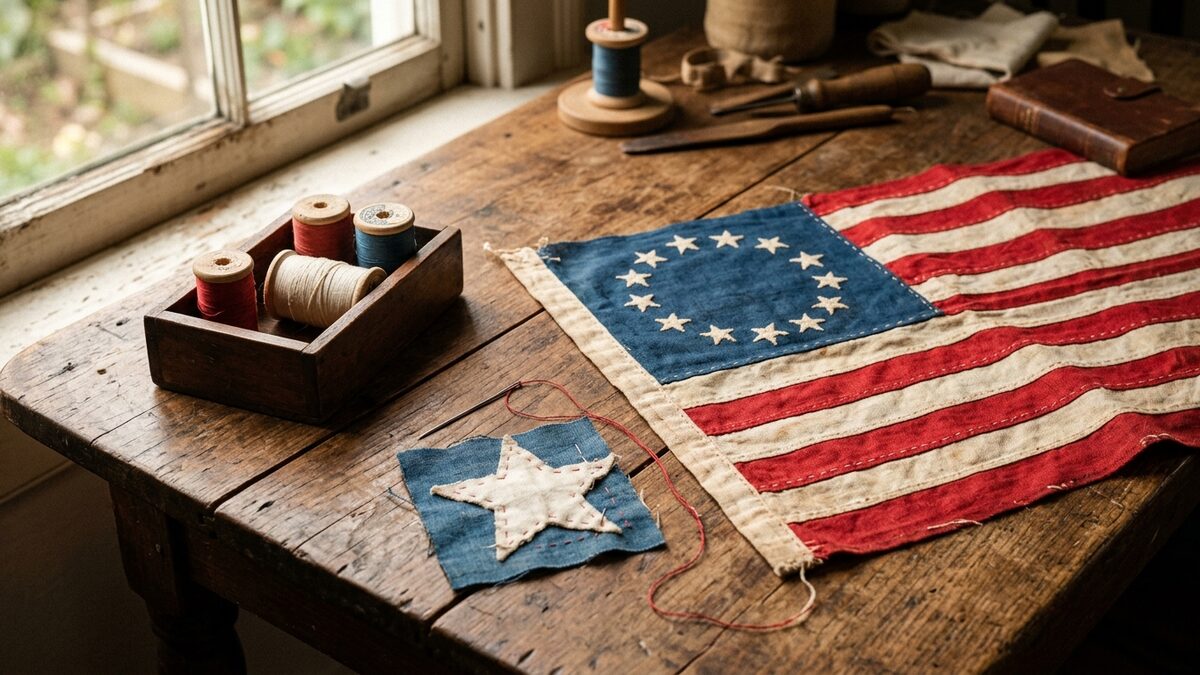
The story of Betsy Ross and the creation of the first American flag occupies a unique space at the intersection of history and legend. Emerging from post-Revolutionary family accounts rather than contemporary records, this narrative highlights how symbols like the flag serve not only as unifying emblems but also as vessels for collective identity and myth-making. Exploring this dynamic offers insight into the complexities of national memory and the ways historical truths are constructed.
Key Takeaways
- The Betsy Ross story emerged after the American Revolution as a symbolic narrative rather than a documented fact.
- No contemporary evidence from the Revolutionary War period confirms Betsy Ross's role in creating the first American flag.
- The story reflects broader themes of national identity and the use of myth in American history.
- The flag's design and symbolism evolved over time, beyond the singular Betsy Ross legend.
In the midst of the American Revolution, as the thirteen colonies sought symbols to unify their struggle for independence, the image of the fledgling nation’s flag began to take shape. Central to this narrative is the figure of Betsy Ross, whose reputed creation of the first American flag in 1776 has become a foundational story in the nation’s collective memory. This account, emerging from post-Revolutionary recollections, intertwines with the broader history of the flag’s evolution, reflecting both the symbolic needs of a new republic and the construction of national identity through myth and memory.
The Betsy Ross Story as a Later Family Legend
The Betsy Ross story in American flag history is notably absent from contemporaneous Revolutionary War records. Extensive searches through diaries, letters, and journals of the Continental Congress have failed to uncover any documentation verifying the narrative of Ross’s involvement in designing or sewing the first flag. The National Postal Museum highlights that no record exists of a flag being discussed during the timeframe the story situates the event, particularly the alleged 1776 meeting with George Washington and other leaders. This meeting itself remains undocumented in surviving official records.
The Betsy Ross story in American flag history is notably absent from contemporaneous Revolutionary War records.
Smithsonian sources describe the tale as widely believed but “most likely false,” emphasizing that the story did not enter the public consciousness during Ross’s lifetime or the Revolutionary era. Instead, it emerged much later, suggesting the narrative functions more as a constructed myth than a verified historical fact. This delay in documentation points to the role of oral tradition and family lore in shaping national symbols rather than direct archival evidence.
Betsy Ross: The Real Person Versus the Flag Maker Legend
Betsy Ross, born Elizabeth Griscom Ross in 1752, was a Philadelphia upholsterer whose trade naturally involved sewing and fabric work. Historical records confirm her existence and occupation, situating her within a community of women engaged in similar crafts during the Revolutionary period. Museums acknowledge that Ross did sew flags during the war, placing her within a broader network of female labor contributing to the war effort.
However, the claim that Ross created the first American flag remains unproven. The Smithsonian and other institutions emphasize that many women in Philadelphia were making flags at the time, and no direct evidence links Ross uniquely to the original design or production of the flag. While she was undoubtedly a skilled seamstress, the historical consensus refrains from confirming her as the creator of the iconic banner that came to symbolize the United States. Thus, the Betsy Ross story occupies an ambiguous space between fact and folklore.
The Emergence and Popularization of the Betsy Ross Legend
The Betsy Ross story in American flag history gained prominence largely in the 19th century, particularly around the 1876 Centennial celebrations marking 100 years since the Declaration of Independence. It was descendants of Ross who promoted the narrative, rather than Revolutionary-era government or military records. Smithsonian research characterizes the story as an oral-history tradition that surfaced well after the Revolution, reflecting a period when Americans sought to solidify national identity through heroic and symbolic figures.
The late appearance of the story explains its absence from official archives and suggests its function as a patriotic myth. The Centennial era’s focus on commemorating the Revolution created fertile ground for such family testimonies to be embraced and popularized. Consequently, the Betsy Ross story endures as a powerful element of American cultural memory, symbolizing unity and the birth of the nation’s flag despite its uncertain historical accuracy.