
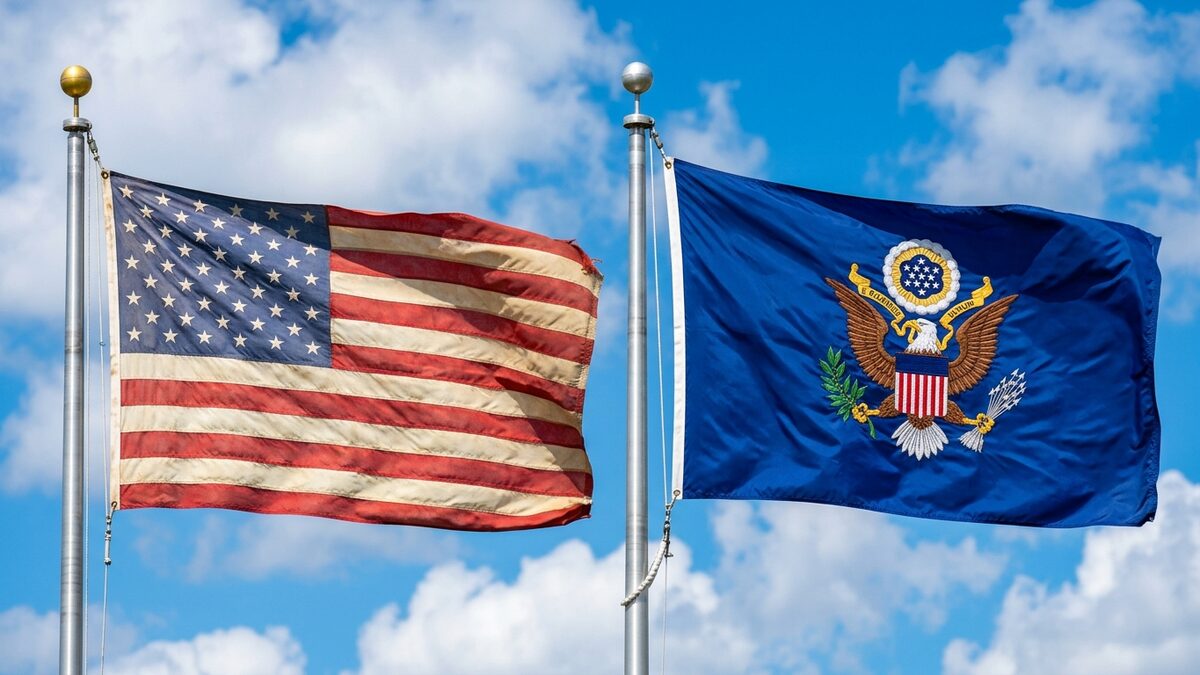
The article explores the nuanced distinctions between civilian and government flags in the United States, revealing how design, symbolism, and legal guidelines shape their divergent purposes. While civilian flags celebrate local identity and cultural expression, government flags embody formal authority through strict standards. This contrast not only highlights differing roles but also raises questions about the evolving significance of flags in representing community versus institutional power.
Key Takeaways
- Civilian flags in the U.S. focus on local identity and cultural expression with diverse designs.
- Government flags adhere to strict standards and protocols to signify official authority.
- The federal Flag Code offers advisory guidelines mainly for civilians, not binding rules for government agencies.
- Executive branch agencies can set their own flag regulations separate from the civilian Flag Code.
The flags representing civilian entities and those symbolizing government authority in the United States diverge sharply in design, purpose, and usage. While civilian flags often emphasize local identity, cultural heritage, or commercial branding with varied motifs and colors, government flags maintain strict adherence to standardized symbols, proportions, and protocols that convey official status and legal authority. This juxtaposition underscores the distinct roles each category of flags plays within American society, reflecting contrasting priorities between personal expression and institutional representation.
Legal Scope and Audience
The legal framework governing the use of the United States flag differentiates between civilian and government contexts. The federal Flag Code is primarily directed at civilians and civilian organizations, providing advisory guidance rather than mandatory regulations. Codified in Title 4 of the U.S. Code, the Flag Code establishes standards for the respectful display and use of the flag by private citizens. It explicitly excludes executive branch agencies, which may implement their own regulatory measures. This distinction allows government entities to prescribe flag protocols that align more closely with institutional functions and official authority, whereas civilians are encouraged to follow customary practices as outlined by the Flag Code.
This juxtaposition underscores the distinct roles each category of flags plays within American society, reflecting contrasting priorities between personal expression and institutional representation.
Civilian Flag Rules
Civilians are instructed to display the flag under specific conditions to preserve its dignity. The Flag Code advises that the flag should be shown only from sunrise to sunset when flown from buildings or stationary flagstaffs in open areas. Continuous display is permissible only if the flag is properly illuminated during nighttime hours. The Code also provides detailed recommendations regarding the occasions appropriate for display and the proper conduct during ceremonies such as the Pledge of Allegiance. Notably, the civilian guidelines codify longstanding customs rather than introducing alternative flag designs. Thus, civilian use emphasizes respectful presentation without altering the flag’s official appearance.
Government and Military Usage
Government and military organizations operate under separate protocols for flag display and conduct. Federal departments and agencies may issue their own regulations, which can diverge from civilian Flag Code recommendations to reflect official status and operational context. For example, military personnel in uniform render the military salute during the Pledge of Allegiance instead of placing a hand over the heart, a gesture reserved for civilians. Veterans and service members not in uniform may also salute in the manner prescribed for uniformed personnel. The Flag Code explicitly distinguishes these government-bound protocols from civilian practices, acknowledging that official flag conduct varies according to institutional affiliation and situational context.