
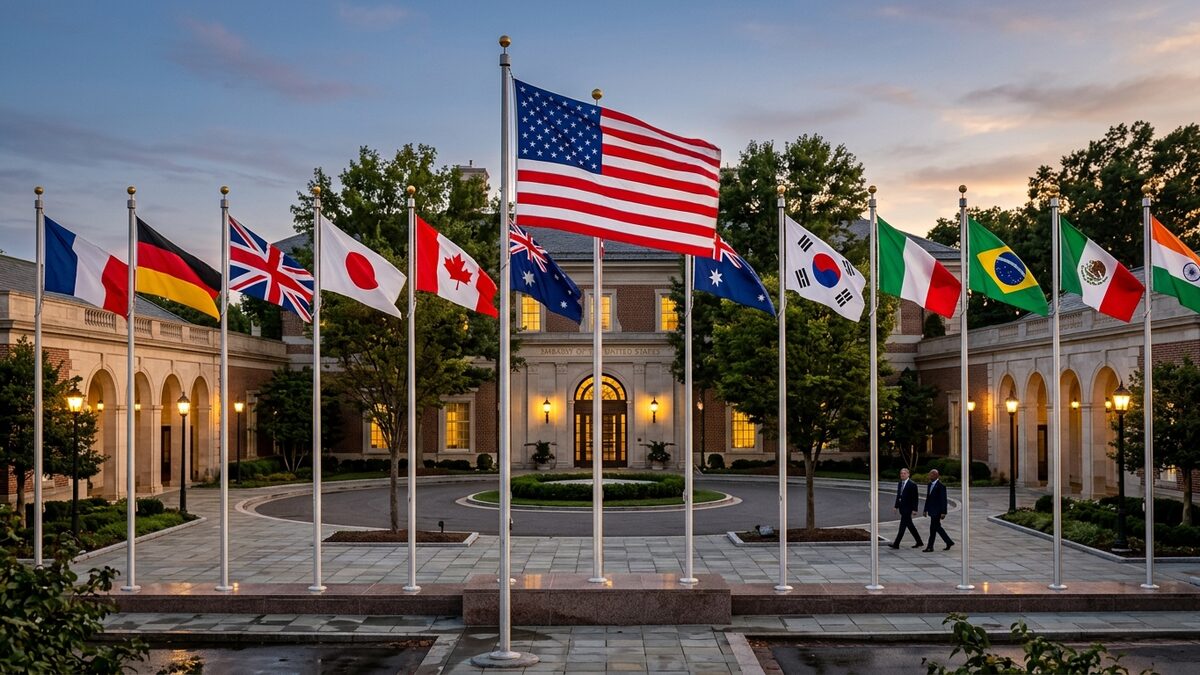
The display of the U.S. flag in diplomatic settings is governed by intricate protocols that reflect deep-rooted national values and respect for international counterparts. Understanding these guidelines reveals how symbolism and tradition intersect to uphold the dignity of diplomatic interactions. Exploring the nuances of these practices offers insight into the careful balance of honor and equality maintained in global relations.
Key Takeaways
- The U.S. flag symbolizes American ideals and sovereignty in diplomatic settings.
- Flags must be displayed on separate staffs of equal height and size to show mutual respect.
- The U.S. flag holds the position of honor on the viewer's left side.
- Proper flag display protocols reinforce respect and solemnity in international relations.
Since the Continental Congress passed the Flag Resolution in 1777, establishing the stars and stripes as a symbol of the United States, the proper display of the American flag has carried profound diplomatic weight. Throughout history, the flag has served not only as a national emblem but also as a representation of American ideals and sovereignty in foreign relations. In diplomatic settings, adherence to established protocols for displaying the U.S. flag underscores respect for these enduring traditions and reinforces the solemnity of international engagement.
Core Diplomatic Display Rule
In diplomatic contexts, the display of the U.S. flag alongside the flag of a foreign nation is governed by precise guidelines to signify mutual respect and equality. According to the U.S. Department of State, the flags must be mounted on separate staffs of equal height, with both flags being the same size. This parity reflects the principle of sovereign equality between the United States and the host nation. Importantly, the U.S. flag is accorded the position of honor, which is defined as the viewer’s left when observing the display. This positioning communicates respect for the American emblem while maintaining diplomatic decorum.
Since the Continental Congress passed the Flag Resolution in 1777, establishing the stars and stripes as a symbol of the United States, the proper display of the American flag has carried profound diplomatic weight.
U.S. Embassies and Consulates Abroad
At U.S. diplomatic missions overseas, including embassies and consulates, strict regulations govern the public display of the American flag. The State Department mandates that only the U.S. flag may be flown or publicly exhibited on government premises, both within the United States and abroad. The standard flag size for outdoor display at Foreign Service posts is five by nine and a half feet, although variations are permitted depending on the physical dimensions of the flagstaff, building, or location. These provisions are codified in 2 FAM 150, the official State Department manual on flag use, ensuring consistency and formality in the representation of the United States overseas.
Interior Placement Inside a Diplomatic Post
Within the offices of principal officers at Foreign Service posts, the U.S. flag is displayed following similarly rigorous protocols. The flag is positioned on a staff to the right of the officer’s desk, with the Foreign Service flag placed on a staff of identical height to the left. The designation of the “right” side refers explicitly to the officer’s right, establishing a clear and consistent framework for internal flag placement. This arrangement exemplifies the observance of formal precedence within the mission itself and reflects the broader diplomatic principles that govern flag etiquette in international settings.